In champagne's major export markets, which, now I come to think of it, coincide rather neatly with those countries where my newspaper the FT is most read, the current fashion is for growers' champagnes.
The champagne business has long been a delicate balance between the growers who grow the grapes and the big houses who buy them and turn them into raw material for the brands they have so assiduously developed and marketed over the last century and more.
But today's increasingly sophisticated consumers have become rather bored by big-volume brands carrying famous names whose most trumpeted virtue is consistency. They have accordingly been branching out into pastures new: much smaller volume wines, often with more individuality, made by the growers themselves.
It is delightfully easy to spot the source of a champagne from its label. Virtually all of them carry a numerical code prefixed by two letters. NM stands for négociant-manipulant, one of the big houses. RM stands for récoltant-manipulant, a grower. CM, incidentally, indicates that the wine was made by a co-operative, some of which, such as Union Champagne/De Saint Gall, which supplies so many of the UK supermarkets' own labels, have established a fine reputation. MA is the prefix for buyers' own brands, many of which come from a single huge supplier.
There is something immediately attractive about buying at source. It chimes with our modern quest for traceability and our desire to commune with the earth as directly as possible (see, for example, all those industrialists and tech billionaires who pour their hard-earned cash into a newly acquired vineyard or cellar).
Importers such as Terry Theise in the US and Vine Trail in the UK have made a speciality of selecting some of the finest champagne growers to adorn their lists.Along the way is the implication that the big houses' champagnes are overpriced and possibly second best anyway.
I am a huge fan of some of the best of the champagne growers' wines, and I also believe they can offer much better value than many of the wines offered by the big houses which have such substantial teams, plant and marketing budgets to sustain.(It was always said, for example, that a member of the Krug champagne family absolutely had to travel first class.Anything else would give the wrong impression.I wonder whether this has survived this old family house's transition into the maw of LVMH? I have yet to receive an answer to my enquiry.*)
A recent blind tasting of 64 champagnes in which growers' champagnes were mixed up with wines from some of the most famous houses in Champagne demonstrated however that growers' champagne is not necessarily superior.
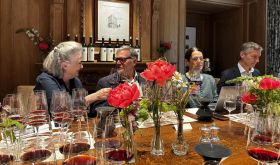
London wine brokers Fine & Rare Wines organised this revealing comparison. They had observed the fashion for growers' champagnes and wanted to add some to their list.Accordingly they went out in search of names they thought were not so far represented in the UK (although Montrachet already import Tarlant, H H Bancroft have Pierre Moncuit, and Gauntleys of Nottingham sell Rodez, for example).The other criterion was that their wines should have won approval from either the American magazine Wine Spectator or the American burgundy specialist Allen Meadows (aka Burghound) who has recently branched out into the fizzy stuff.
I suggested that perhaps French sources such as La Revue du Vin de France might also have been a useful source of recommendations, being so much closer to the Champagne region, but was told firmly that the Americans had been chosen instead 'because our customers trust them'. So much for the cheese-eaters.
The wines were split into 36 non-vintage blends – including NVs from Ayala, Bollinger, Moët & Chandon, Pol Roger, Roederer, Ruinart and Taittinger – and 28 vintage champagnes, in which exactly the same big houses were represented except that Veuve Clicquot substituted for its LVMH stablemate Ruinart.
The Fine & Rare team reported that all champagne producers, growers and houses alike, were remarkably keen to supply samples, which in these depressed times does not surprise me one bit. Champagne sales have been in free fall. And one delightful consequence of this for those who still dare to drink champagne is that the wine currently on sale seems to have benefited from more age than has sometimes been the case. In this tasting the overall quality was pretty high, and there were hardly any wines that conformed to the typical cuvée hurried on to the market in times of shortage in which green acidity and astringency is accompanied by too much sugar added in an attempt to disguise them.
Another general observation was that the vintage-dated champagnes in many cases did not seem superior to the basic non-vintage wines made from a blend of different years, even though the latter usually cost quite a few pounds a bottle more. I should say that there was a wide diversity in styles, from the piercing Blanc de Blancs of Pierre Moncuit to the almost oxidised, defiantly oaky wines of Tarlant.
But perhaps the most significant result for me was the number of growers' champagnes that were not particularly well made. Some of them seemed rather coarse and simple to me. Meanwhile the big houses' champagnes showed pretty well. My top score (with apologies for reducing something as magical as champagne to numbers) was 17.5, which went to three growers' wines. But of the 15 champagnes I scored 17, six of them were from the houses. So although the houses' wines represented only 22% of the total tasted, they represented 35% of all those wines scoring 17.
Below I have included Fine & Rare's equivalent guide price per bottle in their current offer, but you will have to place an order worth at least £200 pre taxes and may have to wait quite a while for stock to arrive.
* News just in: Olivier Krug responds: 'I do not travel first class and believe that the best way to maintain (whatever) status of the name is to pursue the vision and implement what the "old days" people have taught me ...'
My favourite champagnes in this blind tasting
17.5/20
Lallier Grande Réserve Grand Cru £21.94
Jean Laurent Blanc de Blancs 1997 £25.92
Tarlant Brut Prestige 1998 £33.65
17/20
NV
Ayala, Brut Majeur NV
Bollinger Special Cuvée NV
Coutier Grand Cru NV £20.53
Pierre Moncuit, Hugues de Coulmet Blanc de Blancs NV £20.53
Ployer-Jacquemart Extra Quality Brut NV £22.98
Pol Roger Brut Réserve NV
VINTAGE
Ayala 1999
Pascal Doquet, Mont Aimé 2002 £28.85
Pascal Doquet, Vertus 2004 £30.81
Michel Loriot, Pinot Meunier Vieilles Vignes 2004 £33.75
Pierre Moncuit, Grand Cru Blanc de Blancs 2004 £27.38
Ployer-Jacquemart, Extra Brut Blanc de Blancs 2002 £38.64
Rodez Grand Cru 2002 £32.00
Roederer 2003
Veuve Clicquot 2002
International stockists from www.wine-searcher.com and full tasting notes on all the wines on Purple pages.