Of all the many people who played some part in the removal of Maison Troisgros, the longest-running three-star Michelin restaurant in France, from its former home in the centre of Roanne in central France to its new location at Ouches, a small village eight kilometres to the west, some are more conspicuous than others.
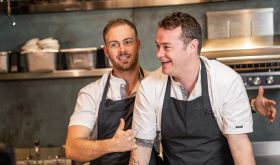
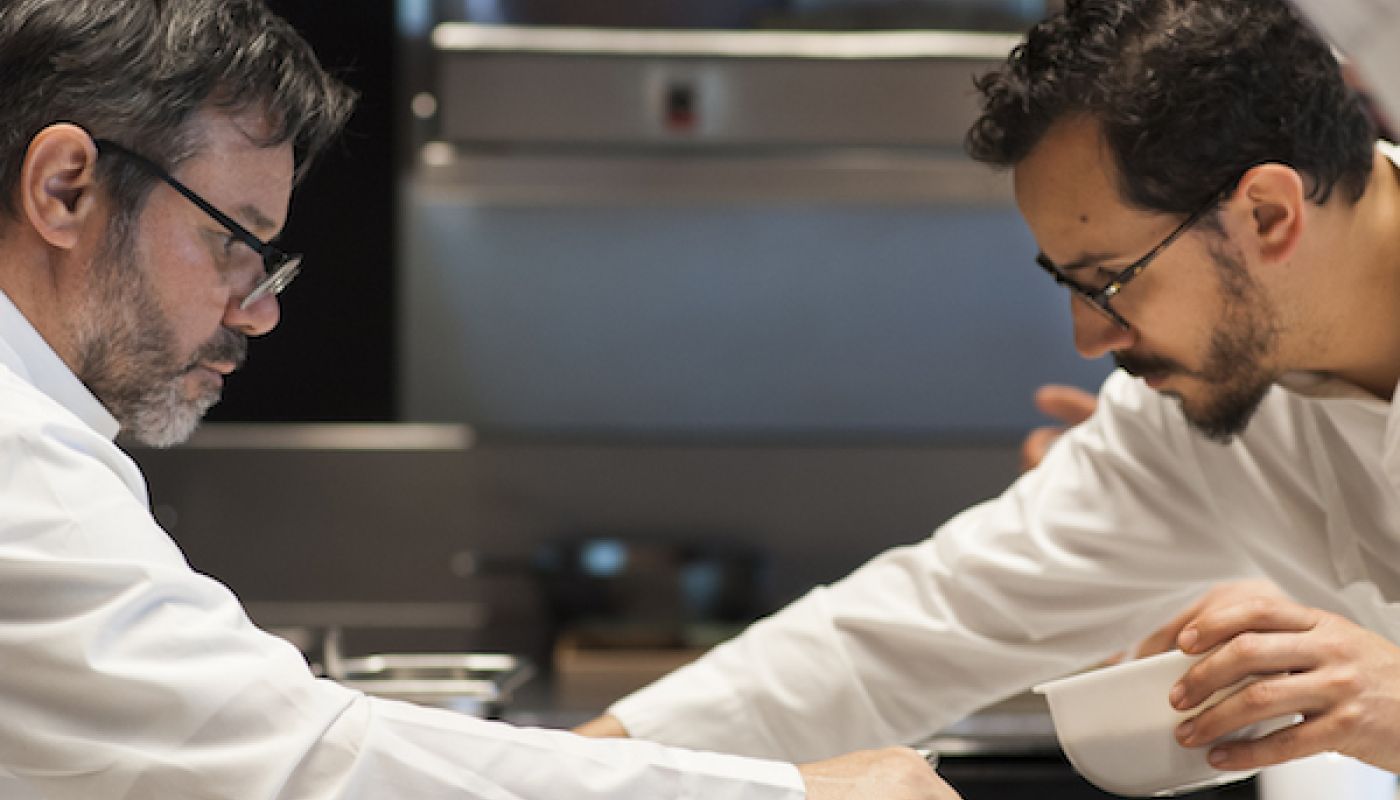
The biggest roles have undoubtedly been played by Michel and Marie-Pierre Troisgros, its chef and his restaurateur wife, who have masterminded the whole project. There is Pierre Bouchain, their friend and obviously highly inspired architect. Then there are their two sons, César, 30 and already in charge of the new restaurant’s kitchen, and his younger brother Léo, who is with them until he goes off to cook in Tokyo for a year. Then there are the bankers who have lent the Troisgros family the €8.5 million to realise their dream. Felix Ledru's picture above is of Michel (left) and César at the range.
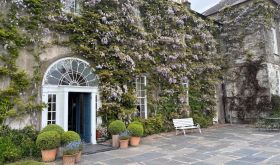
There is the team who have transformed the former house that belonged to the late Madame Crouzet, whose husband had built it initially in the Italianate style so beloved of the local wealthy industrialists. Then there is team of seven who for five weeks packed up, transported and then re-opened all the cases containing the 38,000 bottles of wine that constitute the restaurant’s formidable wine list. Then, above them all but largely forgotten, there is the figure of Napoleon Bonaparte.
It was his confirmation of an act of the French Revolution that everything left in a will has to be shared equally among all the beneficiaries that prompted the Troisgros to contemplate moving in the first place. They were mere tenants in the building that housed the restaurant and hotel that had borne their name for over 50 years. When they failed to agree terms with the several owners, based in Paris, to purchase it the Troisgros decided to move.
This was not a step taken lightly. Breaking with a building, and a city, that has been home to Pierre Troigros, Michel’s father, for 86 of his 88 years was not easy, but it was done for the best of reasons. Michel has been able to construct a new menu and a new, and more relaxed, approach in the dining room alongside César in the same way that, he recalled, he had worked alongside his father in the early 1980s before taking over in the family kitchens. (See One day my son....)
This new style Troisgros cuisine – the word Maison has been deliberately dropped and a new logo skilfully created by Parisian graphic artist Michael Levin – has been becoming lighter and more informal over the past decade. It was six years ago that tablecloths were rejected in place of top-quality wooden surfaces, and these tables have found their home in the new restaurant. So too have accompanying changes to the waiting staff’s uniform. Today, no member of staff wears a jacket or a tie but everybody seems easily recognisable in a black waistcoat and an open-necked white shirt.
The menu itself looks completely different. Instead of the old conspicuous and colourful one, the menu today comprises four pages of silver lettering on white paper. On the third page is the set menu for that month, while pages 4, 5 and 6 explain the choice of four first courses, three fish main courses, four meat main courses and five desserts on offer à la carte.
Although I was fortunate enough to eat dishes from both menus, according to Benjamin Guillaume, the youthful maître d’, it is the set menu at €250 that is the more in demand, particularly at the weekend. And here both father and son have the potential to experiment.
I was struck particularly by one dish, described simply as ‘oysters, cabbage and curried toast’. What arrived on a gleaming white plate bore no resemblance to any of the ingredients mentioned. The cabbage leaf had been put directly on to the surface of a very hot grill so that it was more black than green and it enclosed the two oysters which had been poached in their own liquor. But what had also taken place was a considerable sweetening of the cabbage. Its outer extremities had been caramelised. It was a hugely successful combination not just of an expensive ingredient alongside a much less expensive one but also the culmination of Michel’s experience and César’s search for new flavours.
The following morning, in the vast kitchen now all on one floor and with windows opening on to the adjacent verdant but very wet farmland (a month’s rain fell during my 24-hour stay), I watched two young chefs prepare the ingredients for this dish. On top of a large table that came, along with two 40-year-old ovens that according to Michel still roast chickens to perfection, from the former restaurant were the large individual leaves of cabbage. As the oysters were placed into them before being folded and trimmed, Michel explained how it had initially been César’s idea to combine the two ingredients. A period of trial and error had ensued during which time the dish was poached. It was not to everyone’s taste before it was decided to try it on the grill. To great effect, I would argue.
César’s time in the US (he spent 18 months at The French Laundry in Napa Valley) has opened his eyes and taste buds to the world of spice, to a much greater extent than had he remained in France. This experience was put to good use in a dish described as ‘petit rouget rouge’, a dish whose name particularly intrigued me.
I was aware that in France red mullet is prized for its flavours and texture much more highly than in the UK but what, I wondered, was the significance of the double use of the word rouge or red. It transpired that the red skin of the fish had been coated in a further ‘red skin’, this time pimento-based, and was served with a rich butter sauce flecked with more pimento. This was an extremely adept use of both the fish and the pepper.

Finally, to a meat main course described simply as ‘ears and sweetbreads, inspired by Mionnay’, a hamlet put on the culinary map by the late chef Alain Chapel. What I envisaged as a form of stew arrived preceded by a carving board and a very sharp knife. The dish was in fact a crisp tube, a mixture of sweetbreads and truffles wrapped in the thin membrane of a cow’s ear that had then been roasted. It was sliced and then served alongside a dish of cardoons finished under the grill, as memorable an accompaniment as the cannelloni of artichokes that had been served alongside the red mullet.
The move, which took place two weeks ahead of schedule on 18 February this year, has obviously inspired all who have been involved. The Troisgros are now cooking in a fashion that manages to be both more adventurous and yet more relaxed. Patrick Bouchain, inspired by René Magritte’s 1965 painting Le Blanc Seing, has designed a dining room that has glass walls and surrounds an old chestnut tree, and allows the waiting staff the opportunity to be warm and welcoming. All of which, including the very comfortable bedrooms, contributes to quite a performance.
Troisgros 728 route de Villerest, 42155 Ouches, France; tel +33 (0)4 77 71 66 97