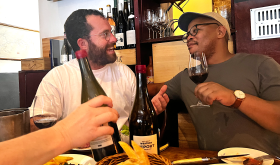
“What you have to understand about chefs,” Bruce Poole explained as he served me the large dish of cassoulet we were sharing at The Anchor & Hope near Waterloo Station, “is that we are all insecure. We want our customers to like our food and in deciding whether they do or not means forming an opinion about us.”
Poole’s admission came half-way through a fascinating meal to which I had invited him after we had had dinner in his restaurant, the highly admired Chez Bruce in Wandsworth, during which he had made trenchant comments about the style of the dishes on his menu. These ranged from the intentionally limited bread offer to the relatively small number of petits-fours via his belief that crème brulée is such a good dessert that it must never be adulterated. What I wanted to know, as we sat down at one of Poole’s favourite London restaurants, is what drives chefs to write the menus they do.
Poole stressed at the outset that now he is not cooking full-time at Chez Bruce (he is also a partner in La Trompette in Chiswick and The Glasshouse in Kew on whose menus he keeps a keen eye) and he shares the writing of the menu with his Head Chef, Matthew Christmas. But his principles will never change. “A menu must never be bland, trendy, too modern or play to fads. It has to have character, to show that there is someone bright behind it. It’s the restaurant’s beating heart.
“And, for me, first of all, it has to be grammatically correct – no spelling errors or commas in the wrong place which just show laziness. I’m a great stickler for this. Although we know what is going to be on our dinner menu well in advance we only print it at 6pm and I have been known, when someone discovers something wrong when we hand them out to the staff at the briefing before the first guests arrive, to bin the lot and print them again.”
Grammar aside, the menu for Poole has to be balanced. “There has to be a combination of simple and intricate dishes. There is definitely a place for really good soups and a plate of really wonderful ham but it is equally depressing to confront menus that are only composed either of the obvious or those where the chef is only trying to show you how clever he thinks he is. A confident chef will show you both.”
Poole went on to give examples of both these approaches. Although impressed by the technical ingenuity of the food during his only visit to El Bulli in Spain, he confessed that what left the deepest impression was the fact that there Ferran Adria serves only one type of bread. “Why, in this instance,” Poole asked rhetorically, “is more so often considered to be better?”
The same relatively simple approach covered the first course he had ordered in his own restaurant, a warm onion tart with Mrs Kirkham’s Lancashire cheese, endive and walnuts. “This dish has appeared on my menu on and off for the past 12 years and I think it is a very good example of how chefs have to maximise the time available not just to prepare dishes during the day but also to allow us to serve them promptly when we have the usual 120 customers a night. The tart case is first baked ‘blind’ in the morning, then allowed to rest, then baked again empty in the afternoon because I like them to be crisp. But this is when it can be tricky as the shells can easily crack or warp because of air pockets in the pastry. Then about 5pm the tarts are filled and baked for the final time and held at the right temperature during service because this is a dish that must not be served hot and is horrible if it is served cold. But it is a dish I am happy to see back on the menu and I like its easy description. I would never call it a ‘thrice-baked’ onion tart!”
Does that mean, I asked, that Poole would happily eat everything on his menu? “Yes, of course,” he responded, “chefs must enjoy everything they are cooking. No good chef would put on anything that he could not eat but I do think that now there is a tendency to confuse popularity with quality. What is popular is not necessarily the best. Offal is a case in point. We have got brains on the menu at the moment which will never be a big seller but there is a place for it now and again and when it is on the menu I will always balance it with a more mainstream offal main course, such as calves’ liver.”
Poole continued in this vein by confessing that there will never be a soufflé on his menu. “I have never really enjoyed eating them so I have never taken the time to learn how to cook them properly.” And then, illustrating the insecurity he sees in every chef, he continued, “But does that make me a bad cook? Why spend time to perfect something you don’t like eating? But I do like iced soufflés, nougat glacé
for instance, and the ones I make I think are pretty good.”
As Poole tucked into the almond cake with the first of this year’s forced rhubarb, he expounded on his obvious passion for pastry and desserts. “I draw my main culinary inspiration from northern Europe down to Provence with its emphasis on dairy produce. I love the food and wines of Alsace, in particular. And I think that northern Europe’s array of classic desserts simply cannot be surpassed, even such relatively simple desserts as chocolate mousse. Everybody loves it but, bafflingly, it seems to have gone out of fashion. My personal favourite is a pithiviers, a style of puff pastry from the town of Pithiviers south of Paris, which can be used for sweet and savoury dishes. I could really enjoy a meal that incorporated this dish as a first course, main and dessert.”
But where Poole refused to be drawn was on his own signature dish. “I don’t think I have ever cooked any dish well enough to stake my career on one. I am never satisfied, I have never thought about any dish that I have cooked whether in the restaurant or at home that that was fantastic. A good chef is never comfortable with what he does and the stress of living with that is one of the most difficult aspects of the profession.” Poole’s parents, both of whom are painters, labour under the same difficulty but he continued, “It isn’t about the desire to be a perfectionist but of understanding your craft and always wanting to be better. That’s what keeps us going.”
Seventeen years at the stoves have left Poole with a very distinct impression of what a meal in a good restaurant should entail and a chef’s role in that process. “Restaurants should lift their customers’ spirits and if as a chef you are not providing that magic then you are failing in your job. I am always happier when I leave this place than when I came in and I would like to think my customers feel the same when they leave Chez Bruce.”
Chez Bruce, 2 Bellevue Road, London SW17, 020-8672 0114, www.chezbruce.co.uk
The Anchor & Hope, 36 The Cut, London SE1 020-7928 9898 but bookings are taken only for Sunday lunch.