The 2013 harvest in Burgundy is in the process of completion. The rain and cold have arrived, but fortunately most famous vineyards are already picked. A late and complex flowering engendered two important characteristics of the 2013 vintage: millerandage is fairly widespread in both the Côte de Beaune and the Côte de Nuits, and the late flowering and rain have resulted in significant delays in maturity and especially small quantities.
Faced with these two hazards, winemakers throughout the year have been trying to catch up by working as early as possible in the vineyard. But it is clear that the grapes have not reached very high ripeness levels and many grapes have millerandage (which is not bad for the quality but generates a tiny quantity). Rain, which could be beneficial just before the harvest, became a significant problem last week as grey rot began to develop. Sorting has been crucial.
The acidity is good, at around 5.5 to 6 g/l for the total acidity, and the initial analyses demonstrate a high level of malic acid (which will help alleviate the feeling of acidity in wines). My first tastings (notably chez Jadot) demonstrated balanced and fruity wines. Everyone agrees not to posit 2013 as the vintage of the century and smiles were few and far between during my visit to Burgundy.
Arnaud Mortet of Domaine Denis Mortet, who finished his harvest Tuesday 8 October, said it reminded him of vintage 2000, a crunchy and fruity vintage with an average ageing potential. We'll see after the vinification…

However, based on different visits, there is an important point in the vintage: the choice of viticultural methods. Biodynamic viticulture provided an interesting focus for this year. I must admit, I was particularly surprised by the quality of biodynamically grown berries. Just a little grey rot, great berries with a lot of millerandage but stunning grapes (as you can see in the photo, right, of Liger-Belair). Biodynamic practices allow few methods of combating grey rot. But vines are stronger and able to fight with natural weapons.
Another interesting point is that Lalou Bize-Leroy, from biodynamic Domaine Leroy, who readily admits that her well-established biodynamic vineyards ripen earlier and earlier, harvested a week before practically everyone else. It is quite possible that the concomitant work in the vineyard, and in particular her refusal to trim vines, has resulted in an interesting harvest.
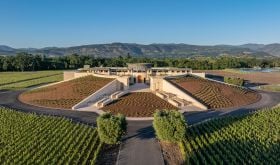
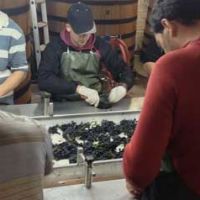
At Domaine de la Romanée-Conti, as you can see from the picture top-left and the video below, the grapes are magnificent and the number of people at the sorting table is relatively huge (14 people, the greatest number I have ever seen). The grapes picked during my visit were from the Grands Échezeaux grand cru vineyard. La Tâche had been harvested in the afternoon. Aubert de Villaine said he was confident for this year, even if it is not 2009, but because of the malic acid content he expected to achieve a 'fine wine'.
 At Domaine Liger-Belair, biodynamics has allowed the picking of grapes in a beautiful state of health. The decision to destem berries with a new tool provides exceptional-quality grapes, some of the cleanest I saw on my trip. As shown in the pictures, the berries are intact and in excellent health (the grapes come from Nuits St-Georges, Clos des Grandes Vignes). In addition, Louis-Philippe Liger-Belair decided to use only 15% whole clusters and only from the best terroirs. Whole-bunch fermentations may be complicated this year because maturity is far from optimum and stems are not fully ripe.
Christophe Roumier of Chambolle-Musigny told me 'it was not possible to push the harvest date'. Although the quantity is the same as last year, he thinks that 'the choice of vinification has great importance this year (maceration, cooling the grapes, maceration time, etc)'. In the photo, right, we can see Jacques-Frédéric Mugnier's Bonnes Mares grapes. He said '2013 is the latest harvest since 1984 (which took place on 11 October). The hot and humid weather meant that fermentations started quickly . Mugnier's winemaker Adeline Legris talked of a pH of 3.06 and natural alcoholic degrees of 11.5% – not high!
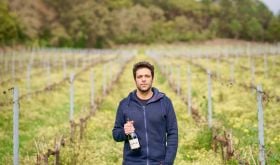
 Frédéric Barnier (pictured left), the new winemaker at Jadot who succeeded Jacques Lardière, is very happy with all Maison Jadot wines. 'Once you get past the trauma of the quantity we are relatively happy.' For the whites, their 'health status is correct, with balanced and pure juice with lots of malic and tartaric acids. Reds are more difficult with a big difference depending on the terroirs. Terroir differences will be important in 2013', he added. In conclusion, Frédéric Barnier has 'great faith in the whites' but reports 'considerable variation' in the reds. Like many winemakers, Jadot will chaptalise widely.
Finally, Philippe Chalopin, who was picking Chambertin grapes when I arrived (battery failure forced me not to take pictures!) is happy with the quantity (40 hl/ha), a relatively high yield for this year. Even though he had to 'fight against the rot in Chablis'. He said that the reds are good but 'with no north wind, warm nights and humidity, it is also very good for grey rot'. As usual, Charlopin is using an optical sorter but refreshes the grapes at 10 °C before they arrive at the sorting table 'to strengthen the skin and prevent the sorter throwing everything out'.
Interestingly, he told me me that phenolic maturity varied considerably according to rootstock. Rootstock SO4, for example, that was widely planted in the 1970s and 1980s, produced 'low-quality grapes', whereas 3309 or Riparia Gloire produced riper grapes and better quality berries, although grey rot has been widespread.
In conclusion, while the Côte de Beaune produced some stunning berries because the grapes are in a good state of health (the trauma of hailstorms apart), the Côte de Nuits is heterogeneous with significant grey-rot pressure. The best soils should be fully expressed. Chablis has been troubled by rot because most growers harvested a few days after the Côte de Beaune. Mâcon has managed an interesting year. This will not be the vintage of the century but 2013 should offer pleasant wines to drink relatively young. Let us see how vinifications and the first tastings proceed.
The more upbeat and defiant Gregory Viennois, director of vineyards and wine at Laroche, has just sent these words about the vintage in Chablis, where the harvest at Domaine Laroche finished last week:
It was particularly belated this year. We started 1 October with Vaillons and ended 9 October with Vaudevey, one week later than in 2012, three weeks later than in 2011.
This season has required meticulous care for the vines. Disbudding, trellising and leaf plucking have been used intensively this year to avoid the development of diseases that the disappointing weather at spring brought.
Flowering period took place under mitigated weather conditions. Fruit setting was compromised by coulure (flower does not transform into fruit) and millerandage (development of small berries), which implied a significantly reduced crop, from the very beginning of the growing season. Moreover, our vineyard is mainly planted with old vines that naturally produce small bunches.
The aeration of bunches with leaf plucking was highly beneficial. We did this in two steps: one just after fruit set, on the eastern side, the other later on at véraison, in mid-August, on the western side. All this work was done by hand. The human factor was particularly crucial this year, and went on up to the harvest period.
Like every year, we have harvested premier and grand cru vineyard by hand, then sorted the grapes at the winery on a vibrating table by hand
The harvest took place in a very narrow time frame, when the grapes were both ripe and healthy. This year, this frame was half the normal time.
The abundant small berries in the bunches give the juice excellent concentration and beautiful acidity. These little berries are most sought-after by winemakers in Burgundy for Chardonnay and Pinot Noir. Indeed, they have very good complexity, unlike bunches from vigorous vines and large berries with diluted juice.
The volume of the crop is considerably reduced this year but this vintage looks similar to 2008 for fruit ripeness and to 2010 for balance.
This vintage has already been widely commented on. It can reveal some very good surprises. We are particularly enthusiastic and optimistic with premiers crus Montmains, Vaillons and Fourchaumes (Homme Mort) and grand cru Blanchots.
Juice has just started to ferment. So, it is far too early to conclude anything now. The next few weeks will be very interesting.