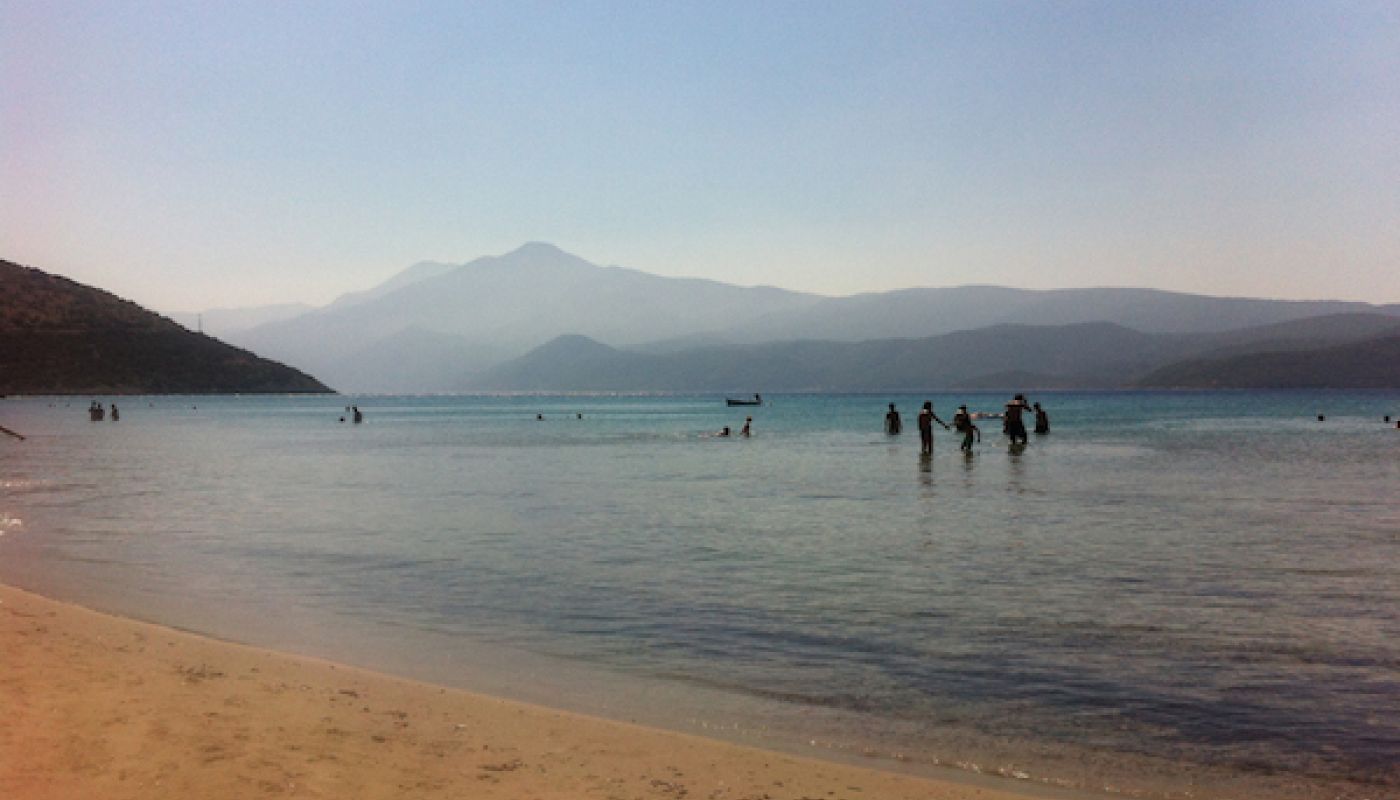
Since the advent of Europe’s refugee crisis, the pretty passage of water between the Greek island of Samos and Turkey has been loaded with almost more significance than it can bear. The blindingly beautiful scenery of the mile-wide Mycale Strait between Kalamaki National Park in Kuşadası and the cove of Psili Amnos on the eastern reaches of the island (pictured here, with the Turkish coast in the background) would tempt anyone to try to swim it. But neither Greeks nor Turks would have got much of a welcome on the other side during the 20th century. Now, the winds seem to have changed: first following the dispatch of Greek rescue teams after the devastating earthquake that hit İstanbul in August 1999; and more recently because of the vast numbers fleeing the Middle East for Europe.
Last year approaching the island with my family in August, we saw hundreds of migrants in the port of Vathy, waiting to be taken to another island that functioned as an assembly area. If it is any consolation, their immediate needs were being taken care of assiduously by local volunteers. As the grandson of a young Syrian bride who more than 90 years ago left her hometown of Aleppo for Turkey to marry, I counted my blessings as we observed the patrolling helicopters and frantic coast guards checking for shipwrecked casualties. They drowned out the seagulls and dolphins that had accompanied our vessel in previous years.
I have visited Samos each year since 2009 and I am seasoned enough not to expect the 45-minute ferry journey from Kuşadası to take me to another world. All in all, what you come across on Samos as a Turk is a similar landscape, the same lazy coastal attitude, and a cuisine that is so similar to home as to be disconcerting at times. Visually, much continues to strike me: the dusty, dumped cars like the one pictured below near the port of Vathy that greet you as you set foot in the island (it is not worth transporting them elsewhere). And the local women who queue and chat in front of the bank well before its opening time each morning. Not to mention the weird sight of the old sailor grazing his goat on a leash around the little harbour of Pythagorion. Yet this time what drew me here once again was what the island is best known for and what keeps its economy alive: the Muscat grape.

Muscat Blanc à Petits Grains, habitually considered in Turkey to be native to western Anatolia under the name Bornova Misketi, is enjoying an early phase of revival under the hands of a few of the country’s booming new producers. For the island of Samos, Muscat grapes have been the main agricultural product, their cultivation almost uninterrupted since antiquity, accounting for 97% of the island’s total grape produce.
Mostly scattered in the north of the island, low-yielding bush vines that are on average 20 years old, some more than a century old, cover 1,600 toilsome hectares (3,950 acres) of terraced vineyard on a mix of schist and gravel. They surround the foothills of the imposing mountains Ambelos (1,095 m/3,590 ft) and Kerkis (1,434m/4,700 ft), at elevations as high as 900 m (2,950 ft), and face across the sea the peninsula around İzmir where most of the remaining 135 hectares (335 acres) of Muscat vines left in Turkey are to be found.
_copy-6.jpg)
Each harvest, 2,850 different growers deliver 6,000 tons of grapes to one of the two wineries of The Union of Winemaking Co-operatives of Samos (UWCS), the grape growers' trade union established in 1934 that supplied the picture of terraced Muscat vineyards above. Today, I am meeting Yiannis Parassiris, its diligent marketing coordinator pictured below and a food and wine lover himself who is preoccupied with matching the wines of Samos with the other produce of the island.
He tells me that 70% of what UWCS produces is exported. This is certainly impressive, but it is easy to speculate that the 7 million litres (1.85 m gallons) of wine produced on the island is simply too much for its 40,000 inhabitants, who choose to drink beer or ouzo mostly. Yet it is a surprise to hear that more than half of those exports is dispatched - in bulk – to France. An underground pipeline between the Malagari winery and the port used to pump the ‘Grand Cru’ – a sweet wine made by arresting the fermentation half-way through by addition of alcohol – is tangible proof of this deep-rooted trade. Some part of the sweet wine that does not leave Greece ends up as an ingredient in the country’s famous spirit Metaxa.
The sweet wines for which Samos is well known are made in different styles. Apart from the aforementioned Grand Cru, with a residual sugar of 130 g/l, the Vin Doux is a vin de liqueur made by stopping the fermentation as soon as the residual sugar reaches 200 g/l. Both of these wines are released early in the year after the harvest. Anthemis, an aged version of the Vin Doux, is released after five years of ageing in old French oak, having developed a syrupy concentration. It displays caramelised walnut aromas rather than the grapey Muscat character of the younger wines.
Nectar, on the other hand, is distinct, being made from late-harvested, sun-dried grapes that are allowed to complete fermentation to achieve an alcohol level of around 14% with 150 g/l of sugar remaining in the wine. The wine is then aged for three years in oak. This amber-coloured wine has compelling aromas of nuts and raisins with a rich, viscous mouthfeel. Considering Nectar’s price tag in the island’s grocery stores, this must be one of the world’s most undervalued sweet wines.
For the range of dry wines that are less known beyond the island, the co-operative has a unique method of classification: by the average elevation of the vineyards that helps extend the harvest over a period of two months.
The grapes for the non-vintage Samena are sourced from vineyards located between sea level and an elevation of 200 m (656 ft) while Golden Samena is made from grapes cultivated on narrow terraces at altitudes between 200 to 400 m. When young, both wines are fragrant, showing lychee and rose-petal aromas in a surprisingly refreshing way.
A relatively new label, Psiles Korfes vintage-dated wine, is made from grapes sourced from vineyards at 400 to 600 m above sea level or even higher. Hence the name that translates as ‘High Peaks’. Succulent and vivacious with a zesty bitter tang, this wine has a rich, layered nose with a floral character and the peculiar citrus aromas the wines tend to reflect with altitude.
These dry wines usually have around 12% alcohol and about 5 g/l residual sugar.

Yiannis Parassiris (above) told me about the new temporary influx of visitors, 'It was quite hard for all the people living on the island to watch the refugees and their families, especially the children, arrive by boats and walk from one side of the island to the other to catch the next ship to continue their long journey. Many of us would stop and give them water and food, especially for the young ones. In a more organised manner, groups of people gathered clothes and food and donated to the refugees. The financial crisis that we are going through, with unemployment rising and the standard of living worsening, did not prevent the Samians and Greeks, in general, from being hospitable and helpful to the extent that each of us could. Of course, there were real heroes among us, like the coast guards and all kinds of rescue teams, whether professional or volunteers, who would jump into the cold waters to save as many as possible, especially the children, when their boats were tipped over. Let’s all hope that this situation will eventually be resolved in a humane and dignified manner.'
Despite its remoteness, Samos is well connected to mainland Greece by a couple of daily flights in summer as well as chartered flights to some European airports. There are also two ferry services to Turkey’s busiest port Kuşadası. Although Samos and other Greek islands close to the Turkish coast are now in the shadow of the refugee crisis, the islands’ economies rely mainly on tourism revenues. They may be more associated with human tragedy lately, but they still need tourists to help them cope with the difficulties.
For those thinking of visiting Samos, here are a few recommendations. If you decide to visit the Malagari winery overseen by winemaker Evangelia Argirou, who recently took over when the previous chief winemaker Emmanouil Tsakalakis retired, make time for the neighbouring Samos Wine Museum (where Yiannis Parassiris is pictured above) to see the history of winemaking on the island and to taste their latest offerings.
Finally, if you choose to drink a dry, non-vintage Muscat at a restaurant, make sure that it is a recent release as those kept in their cellars for over a year do not deliver the same pleasure as a fresh release. Otherwise, don’t worry! For a contribution to the new Drinks Not Wine series on Purple Pages, I should tell you that the island also produces some excellent ouzos.
Last but not least, don’t miss the other sweet delicacy of the island, the Samos honey that is definitely worth trying.
















