
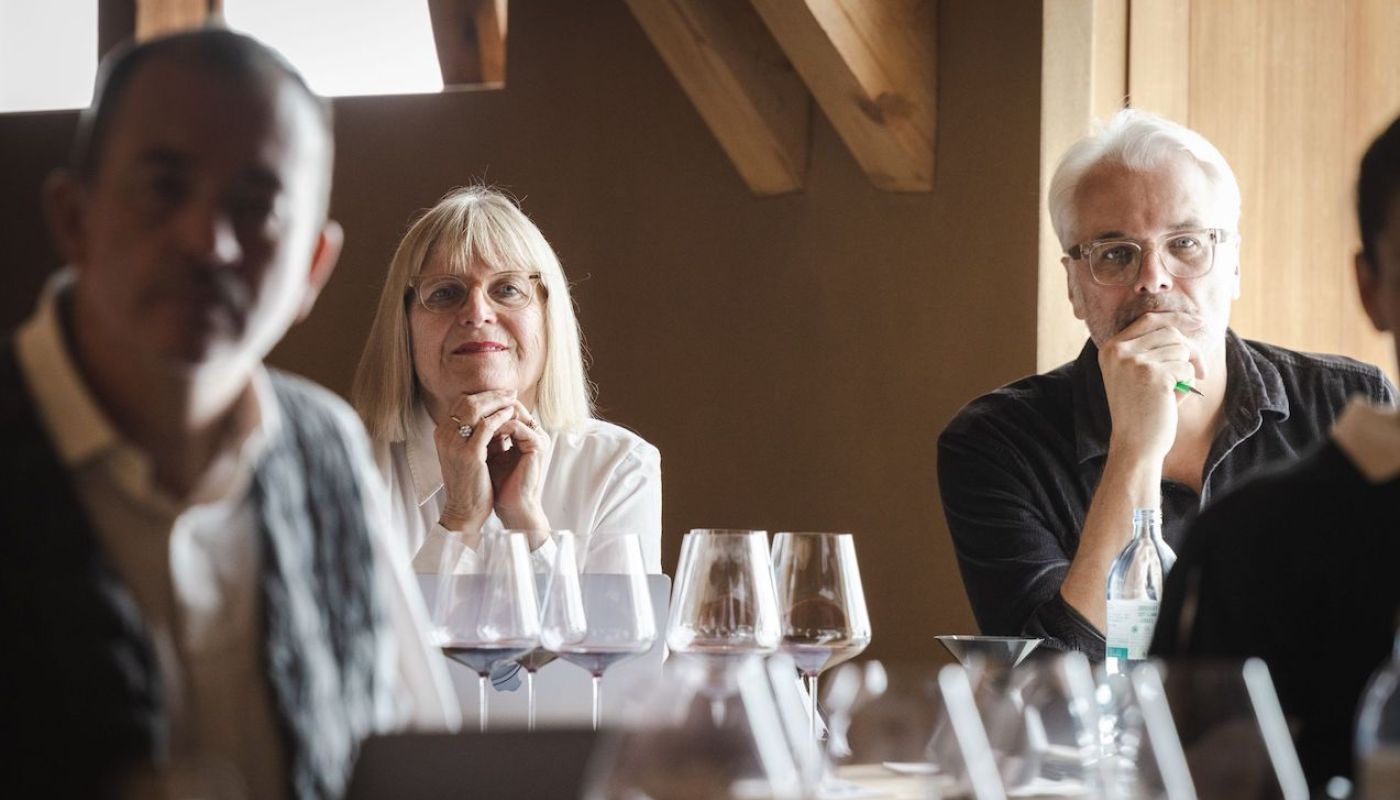
Austrian wine producers would like you to regard their signature red wine grape Blaufränkisch with the same sort of respect as Cabernet Sauvignon, Pinot Noir and Syrah – but there is a snag. They themselves started to do so only relatively recently.
Like so many of their counterparts elsewhere, at the end of the last century they were preoccupied with famous French grape varieties such as these and with heavily oaked, powerful styles of red wine. (See Tam on this phenomenon in Hungary.) Blaufränkisch tended to get a look-in only as an ingredient in a ‘Cuvee’, as Austrians tend to call blends of different grape varieties. Red wines were still a bit of a novelty in the land of Grüner Veltliner and the most admired examples tended to be copies of red bordeaux based on Cabernet Sauvignon grapes, with Kollwentz of Eisenstadt a revered pioneer of the style.
Blaufränkisch was seen as a bit of a wild, gauche native compared with the sophisticated foreigner. Its wine is naturally high in both acidity and tannin in its youth, which initially made it relatively difficult to appreciate as a single-grape ‘varietal’ wine.
But warming summers and changing fashions have come to the rescue of this grape with its notoriously long growing season. Higher temperatures in summer and early autumn mean lower acidity and riper tannins, and Austrian winemakers’ growing experience with making varietal Blaufränkisch has resulted in better and better wines. But the inconvenient fact remains that most serious varietal Blaufränkisch really needs extended time – years – in bottle to show its best, which is not helpful in our fast-forward age.

All this emerged at a Blaufränkisch Summit, a convocation of wine professionals from all over Europe and the US in the Austrian ski resort of Lech am Arlberg that was designed to showcase and discuss the variety. It was organised by Dorli Muhr, Austria’s leading wine publicist (in the pink scarf in the picture above of attendees trekking to the chalet in which the summit was held), who also happens to produce some of the most distinctive Blaufränkisch of all in the windswept Carnuntum region. She explained to us all, ‘in our new red-wine era, [Austrian] consumers wanted early-drinking copies of bordeaux so this was not a good time for Blaufränkisch. Now we realise we must give Blaufränkisch both time in bottle and the right site, so we need to help the consumer understand that.’
Ernst Triebaumer’s 1986 Blaufränkisch, still in good shape, was a seminal, if lone, example that showed many years ago just what was possible for varietal Blaufränkisch. The next milestone in the history of Blaufränkisch came when celebrated winemaker Roland Velich decided to devote his new Moric label to varietal, terroir-driven Blaufränkisch, launching it with the 2001 vintage and making increasingly complex, expressive examples, often from very old vines, every year since. That both of these producers are based in the warm Burgenland region in the far east of Austria is no accident. Burgenland summers tend to be very dry and Blaufränkisch copes with drought conditions much better than most wine grapes.
But Burgenland is very different from most other Austrian wine regions, being effectively a continuation of Hungary’s Pannonian Plain. And, as Velich pointed out, in Hungary as opposed to Austria, communism shrivelled traditional, quality-driven wine culture during the Soviet era so that Blaufränkisch, essentially an Austro-Hungarian grape, suffers from a shortage of history. The variety is more commonly encountered in western Hungary just across the border to the east than in Austria. But in Hungary the grape is known as Kékfrankos, which may be a direct translation of Blaufränkisch but the synonymy is not obvious to those who don’t speak both German and Hungarian. And the fact that the variety goes under myriad aliases may be another brake on its progress.
Recent DNA profiling suggests that Blaufränkisch is probably a spontaneous crossing of Gouais Blanc, parent of the giant Pinot family, with an obscure Rheinhessen vine which may have taken place in what is now Slovenia, where it’s known as Modra Frankinja. It’s also known as Frankovka in Slovakia, Gamé in Bulgaria, Borgonja in Croatia and Burgund Mare in Romania – oh, and as Lemberger in Germany and Washington State. This profusion of names does nothing to help the reputation of Blaufränkisch, whose Austrian name (and its spelling) are a bit challenging in many of the world’s most important wine markets.
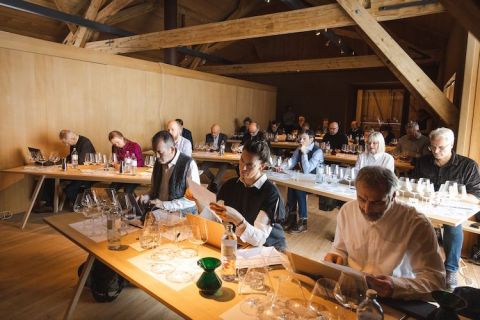
But at the Blaufränkisch Summit, Sascha Speicher (left of me in the picture of the group hard at work above), respected editor-in-chief of Germany’s Meiningers Sommelier magazine, reported that he had recently organised a blind tasting of Austrian Blaufränkisch and German Lemberger for top producers of the latter and that the Austrian wines were judged consistently superior, as well as notably and unexpectedly higher in acidity. The Germans were (wrongly) convinced that the Austrians must routinely add acid to their Blaufränkisch.
Even in warmer vintages, Blaufränkisch is typically quite fresh and chewy in youth, only medium-bodied with deep colour and, often, a little bitterness on the finish. (Local sommelier Günther Meindl suggested, comparing it to Tuscany’s relatively tart red wine grape, ‘for guests, I describe it as close to Sangiovese but a little lower in acidity’.) All these elements need time to knit together to produce something truly satisfying in a classically made Blaufränkisch. Velich suggested that at least 15 years is needed. Can twenty-first century wine consumers wait that long?
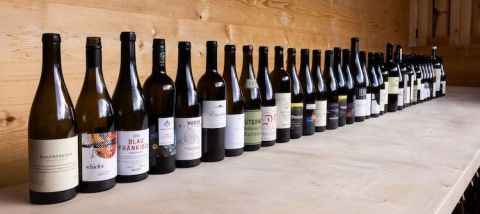
But today, as in so many wine regions, there is a new generation that wants to do things a little differently, as the 2020 and 2021 examples from Claus Preisinger that we tasted at the Summit showed most dramatically, thanks to early-picked grapes and fashionable amphora ageing. These wines were much paler than most, having had only a few days’ contact with the grape skins in the fermentation vat, and they seemed already approachable. An increasing number of Blaufränkisch wines are beginning to be made like this but they are routinely rejected by the tasting panels, which, throughout Austria, are notoriously inflexible in the styles they allow to carry an official appellation as a ‘quality wine’.
One of the liveliest discussions at the Summit was about this long-standing issue. The head of the Austrian Wine Marketing Board Chris Yorke made the point that the country’s wine rules had been devised for prevailing tastes in the domestic market, which don’t necessarily match those outside Austria today. ‘But now there are some producers who export a lot and they are affecting the internal market too’, he reported, adding, ‘20% (50% in Canada) of our exported wines are not officially approved. And yet the average price of non-quality wines is higher than the average price of quality wine!’
Things do seem to be changing in Austria. But I’m still not sure how long it will be before Blaufränkisch joins the grape greats.
Blaufränkisch/Kékfrankos recommendations
Many of these wines, and many more, are also available in Austria.
Heumann, Rosé 2021 Villány, Hungary (Kékfrankos with 25% Syrah) 13.5%
£8.50 The Wine Society
Hans Igler, Classic Blaufränkisch 2020 Burgenland 13%
£10.50 The Wine Society
Peter Wetzer, Spern Steiner Kékfrankos 2018 Hungary 14%
£19 The Wine Society
Claus Preisinger, Bonsai Blaufränkisch 2021 Burgenland 12%
£34.49 Sip Wines Shop, London; $49.99 Wine Therapy, New York; also (cheaper) in Germany, Czechia and Norway
Rosi Schuster, St Margarethen Blaufränkisch 2013 Burgenland 13%
€49 Broeding, Munich; AU$75.83 Wine Seek, Melbourne
Wachter Wiesler, Saybritz Blaufränkisch 2017 Eisenberg 13%
€49 Nur Gutes, Germany; 63.97 Swiss francs, Smith & Smith; $81.95 The Wine Consultant, CA
Krutzler, Perwolff 2009 Burgenland 13.5%
149 Swiss francs, Weingallerie, St Gallen
Moric’s Burgundian Blaufränkisch wines are imported into the UK by Clark Foyster and into the US by Winemonger. Lay & Wheeler in the UK have a good selection.
A wide range of Dorli Muhr’s fresh, expressive Carnuntum examples are available from Justerini & Brooks in the UK, the Swedish and Norwegian monopolies, Westgarth Wines in California, and retailers in The Wine Collective in Australia, as well as from dorlimuhr.at.
Tasting notes and scores on most of these wines can be found in Blaufränkisch goes uphill, and all of them can be found in our database. Some international stockists on Wine-Searcher.com.
See all our previous coverage of Blaufränkisch.













