
See full tasting notes listed at the top of our guide to coverage of Bordeaux 2009.
Look at any guide to investing in wine and it will tell you that you can't go wrong if you buy the best, in particular the first growths of Bordeaux. But that advice is now thoroughly out of date. The most recent heavily hyped vintage was 2009, a particularly ripe year that required remarkably little effort on the part of the grower and winemaker, resulting in unusually concentrated, alcoholic wines. Encouraged by the high scores meted out by their 'enabler', American guru Robert Parker, the Bordelais asked for record prices for their 2009s, with first growths released at five-digit prices in pounds per dozen bottles. The Chinese, many of them with zero experience of the wine market, bought particularly heavily, as did some investment funds.
The theory is that once the prices (but not wines) are released, after the famous en primeur tastings, then they steadily rise, providing a nice return for investors. But for the first time since the overpriced 1997 vintage was released, prices for 2009s have actually fallen since release. This is not meant to happen for vintages like 2009. Prices for 1997 fell because it was a very ordinary vintage but, bolstered by unprecedented demand for the much better 1995s and 1996s, the Bordelais thought (wrongly) they could get away with another price hike. But 2009 is unequivocally a good-quality vintage. The problem was, again, overpricing. Demand from Asia gave the Bordelais the confidence to ask for unprecedented prices for the top 2009s (and 2010s) but investors have been left with a nasty taste as they have watched prices soften.
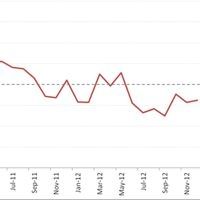
Of course, the general economic climate hasn't helped, but the real problem has been with the first growths. The London-based fine-wine trading platform Liv-ex kindly prepared this graph that tracks the average price of 45 top red 2009s since release. It shows that, even having rallied since hitting bottom last September, the average price is still about 3.5% below release price.

Separating out the different categories of wines, however, the top wines have fallen in value far more dramatically than the rest. The left bank (Médoc and Graves) first growths – Châteaux Lafite, Mouton, Latour, Margaux and Haut-Brion – have fallen by 17% on average and the top wines of the right bank (St-Émilion and Pomerol) by about 3%, while over the same period since early summer 2010 the other smarter wines have on average risen by about 7% on the left bank and almost 10% on the right. That's more like it!

Part of the problem was that the Chinese in particular wildly over-valued Château Lafite, which achieved near-mythical status in China for a while, which inflated the average first-growth price. Another contributory factor is that, especially on re-tasting the wines once bottled, Robert Parker scattered 100-point scores like confetti. Score-conscious investors realised they didn't have to spend first-growth sums in order to secure a 100-point wine. Since even the best wines in the next rank down, the so-called super seconds, cost less than half as much as the first growths, this helped to soften first-growth prices.
But this to me is the tawdry aspect of Bordeaux. How do the 2009s actually taste today? A group of three wine writers and up to 16 wine merchants meet every January in the Suffolk seaside town of Southwold for a three-day immersion in the vintage that went into bottle 18 months before. Recently retired Bordeaux négociant Bill Blatch somehow manages to source examples of every single significant wine and several other associated ones that are less important – well over 250 in all, including the top whites both sweet and dry. Most importantly, and in contrast to Robert Parker's assessments, we all taste blind, comparing like with like – usually calling on a second bottle if we think there may be a problem.
With all this ripeness, and alcohol levels stated on the label (which were probably a little less than actual strengths) from 13 up to 15.5% for some right-bank wines, the wines could have been very tiring to taste. But the best wines were beautifully balanced and, notably from Pomerol and Pauillac, provided some of the greatest pleasure I can remember in a Southwold bordeaux tasting.
Early showings elsewhere of the 2009 crus bourgeois, the less starry wines of the Médoc, were impressive. I suspected this would be an early-drinking vintage that would exhibit much more consistency than many and, unlike most Bordeaux vintages, might not retreat into a shell as it evolves in bottle. But few of the 'lesser' Médocs we tasted (which admittedly were weighted heavily in favour of properties there owned by highly ranked châteaux to the south) were really thrilling, although the best offer very good value. And some wines, notably the consistent and impressive reds of St-Julien, seem more marked currently by their structure than their fruit – more concentration than just ripeness – whereas the Pauillacs were in general much sweeter. St-Estèphe yielded some real bargains.
As usual, St-Émilions and Margaux varied enormously, but the excesses of over-oaking and serious over-ripeness are very much less evident than in the early years of this century. The Pessac-Léognan reds, which usually score highly for their extra freshness, didn't this year. And the dry whites, which came mainly from the same appellation (although more and more fancy Bordeaux châteaux have planted white wine grapes on their less satisfactory land and are trying to sell expensive whites too), in general lacked a bit of fruit in the middle – perhaps because they had to picked so early as acidity levels plummeted.
There were certainly one or two wines, of both colours, that tasted as though they had been acidified, as is routine in so many wine regions outside Europe. It is perfectly legal in France so long as the same lot of wine is not chaptalised (has sugar added to bolster alcohol). No one would have dreamt of chaptalising in 2009. And, as old hand Bill Blatch pointed out, no one needed recourse to the 15% of another vintage which may legally be added to the blending vat.
At the very end, when we were reviewing all three days' tastings, one senior wine merchant fixed the younger ones with a beady eye and dared to ask, 'Are you proud to have sold these wines which proved overpriced?' No substantive answer was forthcoming. We moved swiftly on to how much we are looking forward to seeing the lovely and less flamboyant 2010s in a year's time.
GOOD VALUE 2009s
(with average per bottle prices according to wine-searcher.com)
Right-bank reds
Larmande, St-Émilion £24
Tertre Daugay, St-Émilion £23
Ésprit de l'Église, Pomerol £26
Rol Valentin , St-Emilion £28
Left-bank reds
Fourcas-Borie, Listrac-Médoc £15
Gazin Rocquencourt, Pessac-Léognan £18
Haut-Beausejour, St-Estèphe £19
Moulin Riche, St-Julien £22
La Louvière, Pessac-Léognan £22
Pavillon de Poyferré, St-Julien £26
Branas Grand Poujeaux, Moulis-en-Médoc £26
Ormes de Pez, St-Estèphe £26
Cos Labory, St-Estèphe £26
Angludet, Margaux £26
Lynch-Moussas, Pauillac £28
de Fieuzal, Pessac-Léognan £29
Phelan Ségur, St-Estèphe £32
Haut-Marbuzet, St-Estèphe £35
Lafon-Rochet, St-Estèphe £36
Boyd-Cantenac, Margaux £37
Ch Duhart-Milon 2009 Pauillac £90 (From the same stable as Ch Lafite, this may cost about £90 a bottle but it did extremely well in our Southwold tasting – much better than stablemate Carruades at three times the price.)
Dry whites
Grand Village Blanc, Bordeaux £8
Haut-Bergey, Pessac-Léognan £25
Sweet whites
Filhot, Sauternes £25
Doisy-Védrines, Sauternes £29
Rabaud Promis, Sauternes £31
Lafaurie Peyraguey, Sauternes £39













