My first wine encounter after a stint in hospital with double pneumonia was a lunch two weeks ago with fellow members of a group known rather confusingly as the 1950 Babes, even though only three of us are female. This informal band of UK wine professionals born in 1950, notching up about 500 years of wine experience between us, meets about once a year to chew the cud and share far too many special bottles.
Our group includes Allan Cheesman, who, as head of Sainsbury’s wine department in the 1980s and 1990s, was the country’s most powerful professional wine buyer in an era when supermarkets really cared about the quality and range of bottles on their shelves. Between 1989 and 2008, Tim How turned Majestic Wine into the dominant specialist wine retailer in the UK. Tim Littler of Whitwhams was the UK’s most successful international fine-wine trader then, most unusually based nearly 200 miles north of London, in Altrincham, with outposts in the US, Bordeaux and Japan.
Bill Rolfe was marketing director of the Unwins chain of high-street wine retailers, the sort that have now largely disappeared, and in 2002 jumped to the more future-proof field of wine supply. Tony Stebbings is a fifth-generation wine merchant who has worked in most aspects of the wine trade but also ended up as a wine importer, selling millions of cases of wine, and now runs a wine travel company with his son. Like Stebbings, Anthony Sykes spent most of his career importing wine, buying posh wine merchant Corney & Barrow’s cash cow Ernst Gorge Wine Shippers in 1994.
Joanna Delaforce was born into the Delaforce port family and, after a few years working outside the wine trade, bowed to the inevitable in 1983. Since then she has been the ‘first female …’ in several wine capacities. Like me, Rosemary George is now a self-employed Master of Wine and wine writer, having written 14 books, but started out as a secretary at The Wine Society and worked at wine importers Sichel, where fellow 1950 Babe David Hunter spent 25 years, ending up as purchasing director, having originally intended to stay three months. Many wine students in the UK will know him best, however, in his subsequent role as an educator at the Wine and Spirit Education Trust.
I asked them all how they feel the wine world today compares with the one they started out in. With only one exception, and completely independently, they volunteered that the main difference is that the overall quality and range of wine has improved immeasurably. Only Tim Littler had another suggestion for how the wine world has improved: ‘From a fine-wine broker’s perspective, that there is now instant access to all available fine wines due to the advent of the internet.’ But then he also argued that this is why things are worse: because it has ‘made brokers less relevant and put downward pressure on margins’. Bad news for brokers is of course good news for us consumers.
The other Babes’ observations about how the wine world is worse today than it used to be were much more varied. Cheesman, whose buying mantra was ‘firm but fair’, laments that today supermarket wine buyers are more likely to buy to a price than on quality and that long-term relationships with suppliers are no longer cultivated. ‘In my day supplier relationships would be annual contracts, open and honest discussions, regular visits and meetings, an understanding of the nature of their businesses and the cyclical nature of wine production. And remembering that we were not in business to put suppliers out of business! I had a philosophy, too, that suppliers could have one Rolls Royce but not two.’ Others, also apparently focused on less expensive wine, lament the ‘rampant commercialisation’ and ‘commoditisation’ of wine today.
Rosemary George regrets ‘the internationalisation of some flavours. You can find Chardonnay or Cabernet Sauvignon all over the world, and so many of those wines lack a sense of place.’ Stebbings is similarly shocked that people today order wine by grape variety without having a clue where it’s from.
I asked everyone what they felt was their greatest disappointment and which their greatest achievement. Littler, who started out as a 17-year-old office junior with a Liverpool wine merchant, said his greatest regret was ‘not starting sooner!’. Delaforce, Cheesman and Hunter all regret their lack of a formal qualification, especially the last two, who got close to becoming Masters of Wine. George cited as her greatest achievement ‘becoming one of the first women to pass the MW. Aileen Trew and I doubled the female content of the Institute [of Masters of Wine] overnight in 1979.’
For others, as for so many wine lovers who were around in the 1970s, their chief regret was not snapping up what now look like irresistible wine bargains, especially the classed-growth bordeaux that was offloaded en masse, chiefly by the British brewers who overbought in the early 1970s. Rosemary George regretted ‘not buying more bottles of 1970 Château Palmer with Sichel’s generous staff discount’ (the Sichel family are part-owners of Palmer). Bill Rolfe was personally involved in a later liquidation: ‘my biggest regret is being part of the auctioning off of Unwins’ huge stocks of 1982 clarets at cost price in 1992. (It wasn’t my decision; it was the financial director’s.)’ Anthony Sykes cited as his primary regret ‘not marrying a Puligny-Montrachet grower’s daughter.’
Cheesman regards his greatest achievement as introducing own-label wines [which at one stage constituted 95% of all the wine sold by Sainsbury’s] and ‘demystifying and popularising wine’. He started out just as the UK joined the Common Market (now EU), when wine sold in the UK became much more likely to be bottled at source rather than in the UK, with much more rigorous authenticity.
Rolfe reported himself to be ‘most proud of starting my own company at the age of 56 and receiving a thank-you letter from Sir David Attenborough congratulating me on launching our ethical wine brand Sea Change’. Businessman How, who regrets not visiting more wine regions, is most proud of ‘turning Majestic from loss-making to a successful public business where we achieved profit growth every year for 15 years to 2008’.
Hunter, when working for Sichel, is justifiably proudest of blending Blue Nun so that it was a consistent, superior example of that much-traduced commodity Liebfraumilch. As Cheesman pointed out, when we all started out, the wine landscape was populated by the likes of Blue Nun, Mateus Rosé, Lutomer Riesling (which wasn’t Riesling at all) and Bull’s Blood (which of course had nothing to do with either bulls or blood).
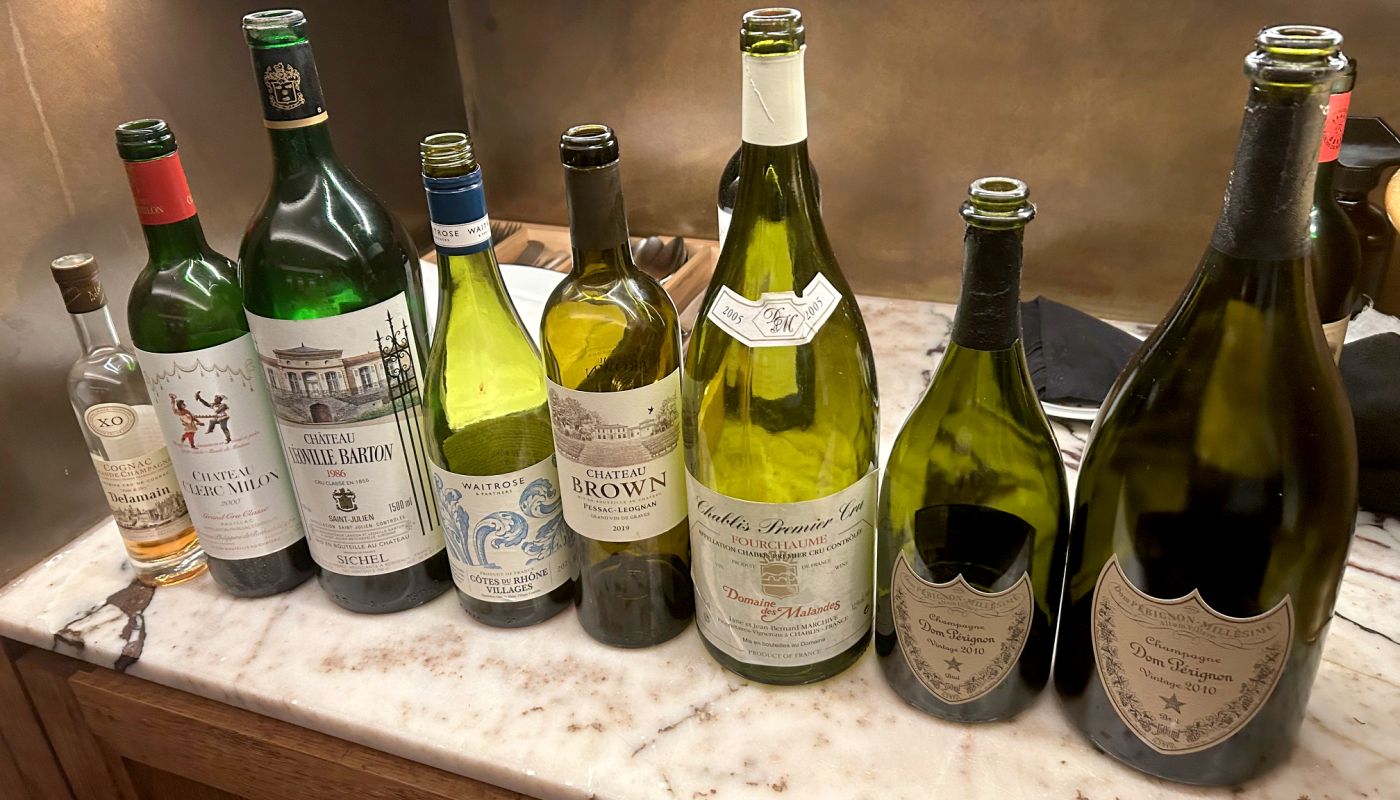
Today we all drink much better, as witness the wines served at our recent lunch: Dom Pérignon 2010 in both magnum and bottle; Château Brown Blanc 2019 Pessac-Léognan; a magnum of Domaine des Malandes, Fourchaume Premier Cru 2005 Chablis; Domaine Courbis, La Sabarotte 2004 Cornas; Château Clerc Milon 2000 Pauillac; a magnum of Château Léoville Barton 1986 St-Julien; an Army & Navy bottling of Taylor’s 1963 port (missing from the picture at the top of this article as the wine was decanted); and a whiff of Delamain cognac.
Only two of the 1950 Babes have severed professional links with the wine trade. How sails between fulfilling his several chairmanships. Littler now runs luxury train tours, initially specialising in Russia. His colourful career includes some fine tales about handing over cash for Crimean wine treasures to a distinctly dodgy middleman with a gold-embossed Cadillac. All very different from filling out a supermarket purchase order.
The 1950 Babes’ best buys
I asked them all which wines they consider best value today.
- Cheesman – Languedoc and Roussillon offer fabulous wines across the colour spectrum, from the Rhône Valley to the Spanish border
- Delaforce – subregions of France and Eastern Europe
- George – the Languedoc and also Roussillon
- How – we entertained 25 friends for dinner on my last birthday and drank Saladini Pilastri Pecorino (£11.99 Majestic) and Chapoutier, Belleruche Côtes du Rhône (£12.99 Majestic)
- Hunter – Riesling, particularly German Riesling
- Littler – Domaine de la Bongran Viré-Clessé (£34 Huntsworth Wine) and Apothic, Inferno ($13.99; not currently available in the UK but their Winemaker's Blend is featured in Richard’s recent Singapour collection of tasting notes)
- Rolfe – wines from southern Italy
- Stebbings – Côtes du Rhône, particularly wines from villages other than Châteauneuf-du-Pape
- Sykes – northern Rhône wines and southern burgundies; Muscadet has experienced a revival as a serious player
For scores, tasting notes and suggested drinking dates of thousands of wines from these regions, see our tasting notes database. For international stockists, see Wine-Searcher.com.
See also Jancis's February 2024 diary. Previous 1950 Babes encounters are described here, here, here and here.