
11 Mar 2014 The buzzword at this year's Chianti Classico en primeur presentation (detailed tasting notes to follow) was 'Gran Selezione'. That is to say that the Consorzio of Chianti Classico did everything it could to embed it into our consciousness. It surely sounds catchy enough and proved to be very Twitter-compatible too. It did stick in my mind, but only because every time I heard 'Gran Selezione' I asked myself: what does it mean?
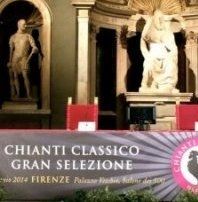
Off I went to the press conference in Florence last month in the hope of understanding more about what the Consorzio called 'a historic event'. With suitable grandeur, the Gran Selezione was presented in Florence's stately Palazzo Vecchio, watched over by a pensive Pope Leo X, who looked as though he was giving it his blessing.
The distant thunder of the approaching Gran Selezione could already have been heard back in 2011, when the first plans for this new category of Chianti Classico emerged, immediately igniting a lively debate in the region. The intention was to create a new top category for the Chianti Classico pyramid. Chianti Classico and Chianti Classico Riserva are now complemented by Gran Selezione. Because the Gran Selezione is now officially part of the denomination, it is enshrined in law, which automatically comes with a set of production rules. These rules must be stricter than those for the production of Riserva in order for it to be truly a step up from the latter. But it is here that the problem starts.
Looking at Gran Selezione's production regulations, the most important rule is that the grapes for this wine must come exclusively from vineyards owned by the producer who also bottles it. It seems a given that high-quality wine comes from estate-grown grapes. And it was especially this aspect that initially got smaller producers excited. Large bottlers, responsible for the distribution of low-quality Chianti Classico but without their own vineyards, seemed to be automatically excluded from this top level. But during the three years of endless discussions and general assemblies, most of the smaller producers somehow lost interest in the category.
This in no small measure reflects the fact that the other production rules that have now been established seem to have little to do with increased quality. Ageing requirements for the Gran Selezione, for example, are 30 months instead of 24 for Riserva. Down to the nitty-gritty, the minimum dry extract for Gran Selezione is 26 g/l compared with 25 g/l for the Riserva and alcohol by volume 13% compared with 12.5%. These tiny differences, insignificant in themselves, did however allow the net to be cast wider and wider and the criteria became so lenient that, finally, every producer, small or large, could gain access to the prestigious new level, even if the restriction on owning the vineyard excluded the big bottlers. In the light of this laxity it seems Gran Selezione was never about increasing quality but more about the creation of a marketing tool.
This marketing tool is very much needed by the Consorzio in order to continue its ongoing efforts to make a clear distinction between Chianti Classico and the much larger Chianti zone. Every aspect of the Consorzio's marketing strategy has always centred on explaining this difference, which is crucial for obtaining better prices for the wines in the market, but one that is hardly understood. The average Chianti finds its way to the consumer via supermarkets at some of the lowest price points around and this has a negative knock-on effect on Chianti Classico as consumers are not aware of the difference between normal Chianti and Chianti Classico. The Consorzio hopes that with the creation of Gran Selezione it finally has the weapon as well as the crucial point of difference to reach the consumer with an unambiguous message.
Even if one can understand the motivation for Gran Selezione's creation, when scrutinising it more closely, several facts emerge that cast doubt on the category. For example, before reaching the market every Chianti Classico must be analysed for alcoholic content, total dry extract, volatile acidity, etc and undergo a tasting to establish 'typicity'. In the past the Consorzio used to oversee this by arranging a panel of 'professionals'. But since the EU wine reforms of 2008 (the reforms to the Common Market Organisation for wine that also brought in the overarching PGI and PDO categories), this must be done by an independent body, called Valoritalia. However, in the case of Gran Selezione, the process for selecting the final 34 wines from some 80 submitted seems subjective, to say the least.
It looks as though the Consorzio wanted to put a firm stamp on the Gran Selezione in determining the desired style. Instead of letting Valoritalia do the tasting, the Consorzio created a panel of tasters consisting of members of its technical committee, including Renzo Cotarello, consultant to Antinori; Marco Pallanti, owner of Castello di Ama; and Franco Bernabei, who consults at several Chianti Classico estates. In their roles all three have plenty of potential for conflict of interest, which should automatically disqualify them as judges.
Since I had a hard time understanding this, and just in case I got it completely wrong, I contacted the Consorzio to verify the selection process for those wines chosen for the new Gran Selezione category. They replied that the tasting panel 'served to give an indication to the wineries as to the level of future Gran Selezione wines since some of the submitted samples didn't pass this selection.' This must have sent a clear message to any producer wanting to produce a Gran Selezione, also because the Consorzio states that this category represents only 10% of the total Chianti Classico production. But it is a complete mystery to me how there can be such precision about a category that is yet to come into being. Unless, of course, the objective is that Gran Selezione should never grow bigger in order to keep its exclusivity – an exclusivity determined by an equally exclusive tasting panel.
Looking at the final selection of the wines, I cannot help but feel that the new category is totally irrelevant. Most of the wines are from the 2010 vintage, made when Gran Selezione didn't even exist. Practically all wines are ones that already existed before the introduction of the classification, the only difference being the added Gran Selezione title. The tasting panel apparently saw no harm in accepting wines from the 2009 or even the 2007 vintage – wines which should already have been released as Riservas but can now take advantage of the even higher prices of a Gran Selezione. Even worse, the selection includes wines from the 2011 vintage. Counting from September 2011, the alleged date of harvest, these wines should not have been released until March 2014.
During the press conference one could hear the word 'cru' all the time, so much so that Gran Selezione came to stand for Grand Cru – but the Consorzio is clearly unwilling to say explicitly that some terroirs are better than others. The suggestion that hung heavy in the room was that with Gran Selezione, a system of crus had been created. This may have been why wines going back to 2007 were included in the final selection and why only 10% would be eligible for it. But looking at some of the wines that made the final selection, I think nothing could be further from the truth.
This is why I consider the Gran Selezione a step sideways. The Consorzio stresses the relevance of terroir and superiority of wines based on provenance but doesn't dare to make the logical next step: allowing for subzones on the labels. Subzones, in the form of the Chianti Classico villages, are a long-established fact, and they create a tangible point of difference based on objective reality. This is something that unfortunately cannot be said unequivocally of Gran Selezione, which was not even based on blind tasting. I predict that it will not catch on with consumers, unless the Consorzio is going to put all its effort into the promotion of these few wines, which in several cases come from some of the region's largest producers. No wonder smaller producers do not feel any enthusiasm for category -it seems to have been designed without them in mind.













