
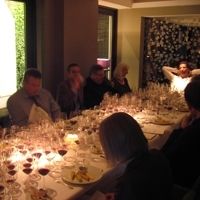
Just as the Australian wine industry battles to demonstrate that it can do more than churn out inexpensive, technically perfect, fast-fade Shiraz and Chardonnay from its rapidly dessicating irrigated inland wine regions, up pops a young Lebanese restaurateur to remind us of its greatest glory.
Marlon Abela, the son of a highly successful airline caterer and wearing white in the picture, enjoys a liquidity matched only by his love of wine. He owns a growing transatlantic restaurant empire that exists, one cannot help suspecting, at least partly as an excuse for his spectacular wine collection and his company MARC Fine Wines. He has been feeling for some time that Penfolds Grange, officially designated a Heritage Icon by the Australian National Trust, has been “unfairly eclipsed recently by more concentrated wines – from California, for example – but Grange is the first New World wine to have shown that it can last over half a century”.
Accordingly he put on a tasting at his Michelin-starred Greenhouse restaurant in Mayfair last week to showcase 22 of the finest vintages of this marvel back to the famous 1955. (There are 35 vintages of Grange on the list at The Greenhouse.) He also invited the current winemaker of Grange, the affable Peter Gago, who happened to be in London at the time. At first Gago tried to lead the tasting, held over a marathon dinner for a dozen of us round a long, dimly lit table, but soon gave up. He realised that the real pro-Grange force field was at the other end of the table where Marlon was flanked by Serena Sutcliffe of Sotheby’s wine department, who declared her undying love for this essence of South Australian Shiraz. “It’s simply not getting the price it should”, she declared, “except in Australia, and for the really old vintages.” (Grange costs upwards of £100 a bottle even for less favoured vintages, but less than half of it is made than, say, Château Lafite.)
Peter Gago is dispatched round the world regularly to beat the drum for Penfolds’ top wines, and he reckons there is a relatively small number of serious collectors of Grange, mainly in the US and Australia – but at least they drink it. One of Penfolds’ PR activities is to hold ‘recorking clinics’ around the world, for those who have the odd old bottle and don’t want it to deteriorate because of superannuated cork. So far, Penfolds have recorked a total of 95,000 bottles. “People love the theatre of it“, says Gago, “but it’s been too successful. I spend my time now telling them to drink it, not wait ‘til it falls off the perch. A lot of counseling goes on at those clinics, I can tell you. And our competitors love it, of course, because we’re educating their customers.”
Grange was the brainchild of Max Schubert, Penfolds' chief winemaker, who was sent to snoop around Europe in 1950 and, inspired by great old bordeaux, flew back to Australia mentally designing an Australian red that would last at least 20 years. There was not enough Cabernet Sauvignon to play with at the time so, with great prescience, he decided to use top-quality Shiraz instead, initially choosing vineyards at Magill and Morphett Vale (neither in the Barossa Valley at this early experimental stage), with great care. The early vintages were so different – dominated, unusually, by new oak with much riper tannins and greater extraction than the prevailing norm – that they were initially dismissed as tasting like ‘dry port’ and had to be made virtually in secret for some time. Finally, after about 10 vintages, Penfolds allowed Schubert to submit Grange 1955 to the all-important Sydney Show, where it won a gold medal, the first of 50 before it was retired from the show circuit .
I came across similarly conservative reactions when I brought a bottle of Grange 1982 back from Australia to share with members of the French wine establishment on Bernard Pivot’s popular Apostrophes tv show in 1988, only to see it dismissed as ‘un vin de pharmacien’ (a chemist’s wine). It is true that in its youth, Grange can be a bit much – all tannin, tar and camphor. It takes many years to evolve into gorgeously sweet, luscious, exotic elixir. At Marlon’s dinner we tasted from oldest (1955) to youngest (2002), and none of the wines younger than the 1991 was anything like ready for drinking, while the wines made since the 1996 vintage seemed to belong to a new and different era, with even greater care taken with the selection of fruit. “More time in the vineyards, less dusty tannins, basket not continuous press” was how Peter Gago put it, before reminding me that the Shiraz vines in the Kalimna vineyard, on which Grange depends so heavily, were planted in 1886. He also reminded us all that when they assess possible ingredients for each year’s Grange, they have no idea where the sample was grown, or even which variety it is. Gago was personally responsible only for the youngest wine of the evening, Grange 2002, a wonderfully fresh, energetic marvel that I would ideally drink between 2020 and 2040.
I had not tasted such an array of Grange since 1988, when at Penfolds’ headquarters at Nuriootpa (‘Nuri’) in the Barossa Valley, in the company of Max Schubert, I tasted back from a cask sample of 1988 to 1978, plus the then-embryonic 1971 (my, and the group’s, favourite in London the other night), 1966 and the famous 1955 that already seemed to be waning in 1988. Two bottles of each wine were opened at The Greenhouse – often from different sources, much to Peter Gago’s trepidation – and only one of the bottles of 1955 was in good health. It was so gamey and gentle, apparently waving a rather weak farewell, that I foolishly allowed one of The Greenhouse’s unsurprisingly attentive waiters to remove my glass. Fortunately, my neighbour Jean-Marc Heurlière of MARC Fine Wines was wiser and I was able to admire the extent to which it almost miraculously gained richness over two or three hours in the glass.
Twenty years ago, incidentally, I was told that the reason Grange is as intensely flavoured as it is, is that Max Schubert had been told on joining Penfolds that he had to a) learn to smoke and then b) make wines powerful enough to penetrate the atmosphere in the company’s then smoke-filled dining rooms. But while Grange has always been intensely flavoured and fairly heady, it is not designed to be Australia’s most concentrated nor its most alcoholic wine. The 1971 that was the favourite of six of us recently (the 1955 attracting four votes and the 1976 two) has the extremely modest alcohol level of 12.3%, and Peter Gago says they are even now aiming to have Grange below 13%.
"You don’t need the alcohol", Peter Gago told me, "these grapes [for older vintages] would have been picked early, as we do nowadays, because these vines are in balance. I wish the AWRI would work on this and show how to get flavour earlier with balanced vines."
One of the London wine trade’s more demanding jobs must be looking after Marlon’s personal wine collection. He had already arranged to have Hermitage La Chapelle 1978 and Guigal’s La Turque 1990 served blind at appropriate points in our tasting. (To my shame, I has tasted the latter only three nights before and didn’t identify it, even though I thought it was a Guigal La La, because it seemed so very much lighter in the context of the Granges.) But towards the end of dinner, when we could in no way be said to have been thirsty with no fewer than 48 bottles opened for the delectation of the 12 of us, Marlon got on his mobile and ordered up the legendary Penfolds Bin 90A 1990 from his cellar. I left before the very end but for all I know they opened a couple of bottles of Nacional 1931 too.
See my full tasting notes on all 22 vintages of Grange.













