29 September 2012 This is a longer version of an article also published in the Financial Times.
See my full account of the tasting and tasting notes back to 1896.
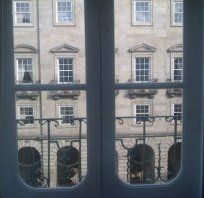
My second-floor room in the Carris hotel was a mere bottle's throw across a cobbled street from the historic Factory House (above), effectively clubhouse for the British port shippers in Oporto, northern Portugal. When I woke at 7 am one morning the week before last, I could see the Wedgwood blue ballroom swarming with people already hard at work decanting the three bottles of each of the 19 great vintage ports we were to taste that morning. When introducing the tasting at 11.30, Paul Symington warned the roomful of tasters that this exercise was a one-off. That morning half of the world's stock of Cockburn 1896, for example, would be opened, and there would be only four bottles of the 1912 left after our predations.
Cockburn's is the best-known name in port, thanks to Cockburn's Special Reserve, a wine I would guess is hardly ever drunk by the tight-knit group of port producers in Oporto and the Douro Valley upriver of the port city. But in the first half of the last century, Cockburn vintage ports were regarded as the finest in the world and Cockburn's new owners and erstwhile competitors, the Symington family, are determined to restore the company's reputation from mass market to fine wine.
A Reserve ruby selling at around £10 a bottle all over the world nowadays, Cockburn's Special Reserve was launched in 1969 when Babycham producers Showerings of Shepton Mallet had taken over Harveys of Bristol (to whom the Cockburn and Smithes family had sold their family's port shipper in 1963) and decided they needed a port to rival the branded sherry that was then their cash cow, Harveys Bristol Cream. Until then the isolated port trade had pottered along hand-selling top-quality vintage ports perhaps three times a decade and satisfying the mass markets in France and the UK in particular with bulk shipments of young ruby and tawny.
Showerings decided to apply their well-honed marketing techniques to a branded superior ruby, and it rapidly became the world's best-selling port, thanks to the money and wile invested in advertising, even on television, and deals negotiated with the world's biggest retailers and distributors. By 1975 the company was so confident of the future that it invested heavily in a production plant in Régua in the Douro Valley, unbowed by the revolution that had shaken Portugal to the core only the year before.
But as Cockburn invaded the mass market, its reputation for fine wine waned. Its vintage port producing record was eccentric to say the least. The company decided to ignore 1977, an incomparable year 'declared' as a vintage by virtually every other port shipper, releasing a lacklustre 1978 instead. In the 1980s, the story goes, when the team in Oporto contacted head office in the UK, by now part of Allied Domecq, to suggest that a given year was good enough for a vintage port to be declared, they would be instructed instead to put all their efforts into ramping up production of the precious baby Cockburn's Special Reserve.
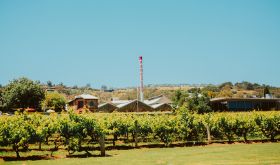
The owners had particular faith in the upper reaches of the Douro, way upstream of the Cima Corgo where most of the other top shippers bought their fruit, and accordingly in 1978 bought 169 ha of land in a side valley at Vilariça, now 126 ha of vineyard. They bought a further 261 ha in 1989 when they acquired Quinta dos Canais, the estate that had always made a major contribution to Cockburn vintage port and now has almost 100 ha of vines, mainly Touriga Nacional and Touriga Franca.
When Allied Domecq was dismembered in 2005, Cockburn was handed round drinks conglomerates like a hot potato, first to Pernod Ricard then to Beam Global, the company best known for its bourbon. Beam's knowledge of and interest in fortified wines was skeletal but it was convinced that the Harveys Bristol Cream and Cockburn's Special Reserve brands were worth something. Accordingly, the offer of the Symington family, already responsible for Dow, Graham and Warre ports, to make the wines for them was welcomed. In 2006 the Symingtons took over all the vineyards and the lodges of Cockburn and, next door, Martinez, a port shipper Harveys had acquired before Cockburn, but Beam were disappointed in Cockburn's performance. In July 2010, in a Heathrow hotel the day before Rupert Symington was due to go on holiday, Beam finally agreed to sell the brands and all the remaining stock to the Symingtons.
Already in 2006 Michael Symington, by then retired, had told the next generation currently running this substantial port producer that Reggie Cobb, the old co-owner of Cockburn, would be 'turning in his grave' at the idea of the upstart Symingtons having taken control of his precious jewel. Fortunately by then, the autocratic co-owner John Smithes, responsible for winemaking decisions, was no longer around to lament that their fierce competitors had become owners.
The acquisition boosted Symington's proportion of port production from 16 to 20%, grew their vineyard holdings to nearly 1,000 ha and ensured that Cockburn did not fall into the hands of their arch-rivalsThe Fladgate Partnership (which had already added similarly diminished port shippers Croft and Delaforce to its stable of the glorious Taylor and Fonseca). But the problem was that with only the disappointing vintage ports of recent vintages in general circulation, the Symingtons didn't really have a clear idea of how Cockburn vintage port tasted in its heyday.
Earlier this month, they therefore organised a substantial retrospective tasting of Cockburn's most admired vintage ports, tactfully omitting the disappointing most recent years but starting with bottles from the small trial of undeclared 1977 that the Oporto team could not help making, way back to the famous 1896 vintage. Several dozen of us from all over Europe accordingly gathered in the Factory House in a valiant attempt to help the current generation of five Symington cousins to discern the style of wine they should aim for in future vintages.
The night before we had limbered up in the Cockburn/Martinez lodge, where current managing director Paul Symington admitted he still feels like an intruder. We saw just some of the huge black wooden cider vats that were shipped out in the Showering era when it was decided to switch to stainless steel in Somerset. And we marvelled at this, the biggest lodge in Oporto's port suburb Vila Nova de Gaia with one nave between thousands of 'pipes' (barrels) 100 m long and, unusually, its own cooperage
The Symingtons were all a bit nervous in advance of this 'voyage of discovery' because none of them had tasted any Cockburn older than 1950, but they need not have worried. I'd been lucky enough to enjoy a slightly similar retrospective tasting put on in London in the 1980s (perhaps an attempt by the Oporto team to convince the Harveys management of the worth of Cockburn at its best?) and the 1908 was every bit as glorious as I remembered it.
'We can't flick a switch', admitted Paul Symington, 'but with this tasting we want to see what was the essence that made Cockburn great in the late 19th and early 20th centuries.' For Peter Cobb who attended the tasting and had worked for Cockburn, his family firm, from 1960 until his retirement, the secret was in the 1967, a vintage declared almost exclusively by Cockburn instead of the 1966. 'They sought finesse, which is why they also favoured 1935 over 1934 and 1947 over 1948.'
I asked Paul Symington after the tasting to describe the Cockburn house style he felt had been revealed and he suggested 'a slightly austere dryness and bitterness like orange marmalade, no blockbusters'. Certainly the Symingtons' debut vintage Cockburn 2007 has a lift and freshness that distinguishes it from the more massive ports dominated by grapes grown in the Cima Corgo – and the family are presumably bucked by the fact that, after winemaker Charles Symington's fine tuning of the Cockburn's Special Reserve recipe, it was the only Reserve quality port to be garlanded in each of the three major UK wine competitions this year.
TOP VINTAGES
1908
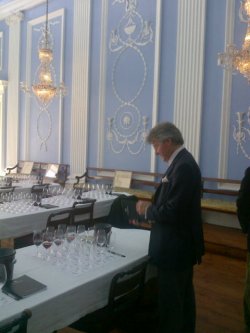
Still as fresh as a daisy and living proof that vintage port really is worth waiting for. Arguably the greatest Cockburn vintage. The wine, served by his grandfather, that lit the flame for my fellow wine writer Steven Spurrier (pictured above in the ballroom before the tasting).
1963
The vintage whose greatness saved the port trade that had been on its uppers throughout the 1950s. Still divine.
1927
Legendary vintage which may have contained a mix of ripe and underripe grapes – but at 85 years old it works.
2007
A great debut for Cockburn under new management.
See my full account of the tasting and tasting notes back to 1896.