David Schildknecht writes: As a crusader (sometimes in these pages) for diversity in German wine and liberality in German lawmaking and winemaking , not to mention as a reader of the civil and liberal Die Zeit for nearly a decade longer than I have been a student of riesling, I was as delighted as I was surprised to find this newspaper's editor not only addressing the opening of the VDP's Mainzer Weinbörse, but eloquently furthering our common cause.
Thank you, Jancis, for publishing von Randow's text in its "received" translation. Before I realised you had done so, I had already determined, given my close sympathy with these issues, to somewhat better convey the spirit and humour as well as the meaning of von Randow's text. I trust that neither he nor the VDP will take offence at, nor find error in, my translation. I have edited out several paragraphs largely dealing with the practices of the wine trade inside Germany.
I should like to take exception to one point made by von Randow as regards Karl Marx. Marx inherited a small vineyard just outside Trier in the Grünhäuserwald (above the Maximin Grünhaus vineyards in elevation though surely not quality) and frequently referred to himself in letters as a wine grower, not to mention Riesling drinker.
DS's translation of von Randow's speech:
I have decided to direct my remarks this morning explicitly at the vintners in the room. All of you gathered here have contributed to my personal happiness and the wellbeing of my friends.
We wine drinkers empathize with your work more than you might imagine. We empathize with your work in the vineyards and in the cellar, and packaging and labelling concern us as well. And whoever drinks your wines wishes you continued success. Karl Marx wrote that the relationship to market commodities is bereft of all personal connections. He was wrong about that. But then, it was more likely Friedrich Engels who was a passionate wine drinker.
The likes of us who inhabit the bottom of the food chain get a sense that the wine industry has been exerting itself for ages to generate rules and regulations. All of these commendable efforts have left their marks, like tree rings. If you want to properly grasp their inter-relationships, you would do well to first fortify yourself with a glass of wine.
Because the fact is that the Germans, when they establish a new regulation, don't do away with the old ones. For that reason I can look forward to a wine labelled, for example, "2010er Kleinklecksdorfer Rieslinghölle feinherb Tolles Gewächs Selection certified ¼Bio, genetically unmanipulated; contains sulfites; (old vines, best barrel, three stars) VDP."
I would say: All that still just manages to fit on a label.
The professionals and experts view this as a deplorable situation against which - well, how shall I put this? - new rules should be brought to bear. So the slogan is: cut down this jungle! Give consumers, simple, clear designations so that they can tell what awaits them. That's how the official propaganda would have it.
It may surprise you to learn that I am of a different opinion.
Certainly I am delighted at all attempts to establish unofficial, voluntary standards of quality. I am also a big fan of certification.
If "VDP" is on the label, for example, then I know that VDP is in the bottle and I can buy with confidence. Similarly if "Great-" or "First Growth" indicate the best sort of workmanship applied to the best vineyards. Naturally as a consumer - which I am - I can only welcome this. By the same token, in my capacity as editor of a liberal newspaper, I must necessarily represent the view that wine nomenclature surely requires no special legal regulation: the statute governing fraud is quite sufficient.
But above all I would wish that all those endearing, confusing, flickering, notably archaic inscriptions on the label not disappear. They reflect the tradition, the diversity and the sense of place of German wine. If some secrets still require airing for instance that in certain wine regions a Riesling Spätlese is quite a bit sweeter than a Riesling Spätlese halbtrocken, let us accept these as the endearing gestures of a jester. Our neighbors the French do not get riled about such things. For them it's clear as day that a Jurançon is sweet if it isn't labeled "Jurançon sec". And why shouldn't elite vintners in Germany cultivate the same diversity as for instance those in Burgundy with their dizzying little word games?
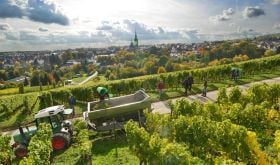
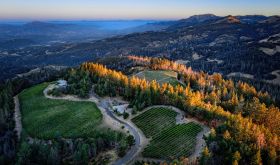
It is hardly an accident that the Burgundians developed the concept of terroir. And whoever wants to discover why a wine tastes as it does and not some other way, and why it is dressed in all that puzzling terminology, will have to concern him- or herself with terroir, with that nexus of physics, chemistry, biology, technique, culture, and history. "Terroir" is fundamentally a geographical concept. Geographers don't typically ask "Why is this or that one way and not another?" Rather, they ask "Why is this or that one way in this particular place and not elsewhere?" A complicated question, as you can tell. It is a question about the whole of nature, culture and place.
But, as a matter of fact, there is someone from whom the wine drinker can obtain an answer to this question. And that is the vintner.
Nothing beats a winery visit. I know, visitors can sometimes be disruptive, particularly when they fail to grasp the difference between a production facility and a local watering hole. Yet, it is the personal relationship of the wine drinker to the vintner that turns drinking pleasure into the redemption of that promise for which those lovely labels mentioning people and places are mere coupons.
When I drink your wines [dear vintners], I think of you. Of you, who are as different from one another as the terminology of wine and vineyard names, one acerbic and another mellifluous, many of you dry, and all of you varying in amplitude.
People are diverse; wines should be, too. Thus, wine terminology is entitled to be equally diverse.
As vintners, you are all familiar with biology. Now, taxonomic distinctions in botany and entomology are at least as time-worn an inheritance as those of oenology. This doesn't disturb biologists because they have learned: terminology that counts today as modern and in line with current thinking is tomorrow's rubbish . Accordingly, biologists keep their fingers clear of semantic reform and get on with their real work, the science of life.
What I am propounding might sound like a rejection of innovation. But not everything that is new represents an innovation, and not all innovations make sense. Not every innovation deserves applause. That applies as well to technological innovations in the wine cellar. With specialized, industrially manufactured enzymes and yeasts it is possible to steer the aromas in wine in specific directions, as precisely as a computer program. This happens with increasing success, but it erodes diversity.
Whoever is proficient in the vineyard and the cellar is capable of producing good wine – but equally capable of succumbing to the temptation to produce, not the typical, namely that about which the geographer asked "why here of all places?" but only that which the market happens to be guzzling.
You may be thinking: "That's easy for him to say, he doesn't have to sell wine."
I am quite aware of that. But I still have to drink it.
And I would like my words to contribute to the recognition by a certain segment of the consuming public that the diversity and typicity of German wine deserve to command a price that will ensure the survival of this pleasure.
The VDP is a small, radical minority. Its member vintners - and a handful of like-minded friends from outside your association - are few in number, yet represent a greater diversity than all of the rest combined. I congratulate you on this.
And if I had a glass of wine in my hand right now, I would lift it and cry out "Long live the diversity of German Wine!"