Charlie Leary writes while completing his PhD in history at Cornell University, Charlie Leary became an organic farmer and artisan cheesemaker. After designing and teaching the first class on modern Chinese history at Tulane University, he devoted himself to business, opening restaurants and hotels in the US, Canada, Costa Rica, and France, also serving as the sommelier. He has recently returned to research and writing, now focused on wine. Charlie writes regularly for Tim Atkin MW and Jane Anson’s Inside Bordeaux, among others. He currently conducts research on Bordeaux history, including the philosopher Montesquieu’s role as a winegrower. This work has also uncovered two new examples of women wine traders in the eighteenth and nineteenth centuries. His guide to wine education programs worldwide, Leary’s Global Wineology, was published last year.
The Vigneron Philosophe
Who is my favorite wine person, who once drafted to a friend, “I am looking forward to taking you to the countryside, where wine proves an excellent antidote for melancholy”?
Why a long-passed French nobleman, the “Baron de la Brède,” who relished winegrowing, the trade, and wine people his entire life. Over the past year, I’ve gotten to know him well by pouring through everything that he penned about wine. You may recognize him by another name, Charles Louis de Secondat de Montesquieu, better known as a brilliant philosopher, favorite read of the United States’ Founding Fathers (including the great vinophile Thomas Jefferson).
Baron de Montesquieu had multiple modes of being—the chief judge of Bordeaux’s highest court; the bon vivant of Paris salons; the correspondent of kings and princes; the serious philosophe, who tried to wipe out corruption and despotism with his pen—but the way of being he loved the most, that at once relaxed him and let his entrepreneurial talent shine forth, came from wine.
Unfortunately, his grandson burned most of his business records and other documents that might have shed more light on Montesquieu “the wine person.” What still exists remains fascinating.
He owned, through inheritance and purchase, a lot of vines. Near Chateau la Brède in Graves he had at least 11 hectares of vineyard, including his favorite estate wine Rochemaurin, where he produced white wine and claret. He loved Pessac wines, and bought a new vineyard not far from Haut-Brion in the 1720s. “I have a patch of moorland in the parish of Pessac quite near Haut-Brion . . . I would like to clear part of it to plant it with vines,” he wrote during a nasty public dispute with the Intendant of Bordeaux, Claude Boucher. Montesquieu opposed a royal edict forbidding the planting of new vineyards, an experience that contributed to his later views on absolute rule and despotism.
That Montesquieu’s theories about climate and national character contributed to the modern French concept of terroir is also less remarkable knowing he was a vigneron. In Martillac, he produced wine from 53 hectares of vines. He also had vast vineyards in Entre-deux-Mers and still more farther afield. Stories abound of him trapsing off to care for the vines, a floppy white hat on his head, wooden stakes on his shoulder. In the 1720s he wrote a questionnaire for other vineyard owners, aimed at gathering information about vineyard practices, grape varieties, soils, and topography. He knew his different terroirs produced wines of different characters, which he directed to well-chosen international markets.
He also made the wine itself, famously commenting to Madame Dupré de Saint-Maur: “I am busy here making nectar, the misfortune is that Hébé will not pour it into my cup!” A stuck fermentation perhaps?
Some historians have suggested Montesquieu made the majority of his money from seignorial rents, but this is doubtful. He said, "What I love about being in La Brède is that it feels like my money is beneath my feet." His cash flow came from the annual harvest, an unpredictable business. In 1751, he wrote to Madame Dupré de St Maur: “I have finished my harvests. Imagine, all my fortune depends on three days of beautiful sun, also in the least amount of clouds I will see.” One of my favorite quotations concerns cabbages. Referring to the War of the Austrian Succession that disrupted Bordeaux’s wine trade, he wrote to a close friend in 1742: “I am very much afraid that, if the war continues, I will be forced to plant cabbages at La Brède.” He added: “our wines will remain on our hands, and you know that is all our wealth.”
How much wine might have remained unsold? His production capacity was nothing to sneeze at, and the facilities at the Domaine de Rochemaurin leave no doubt about his beloved vocation. A separate room with six presses stood ready to receive the carefully-tended Graves fruit. In the old cuvier sat five fermentation vats producing up to 40 tuns (900 litres each) of red and white wine; he also built a new wine room, with five smaller vats next to two 4500-litre vessels. In Raymond, at Entre-Deux-Mers, two cellars and two vat rooms handled a capacity of 500 225-litre barriques.
Upon his death, he had 387 barriques of already sold red wine and a hundred of white waiting for his Bordeaux merchants to pick up.
Some of that wine went to his friends in high society, who demanded the Montesquieu brand while also insisting on his company. An undated letter from Madame de Tencin pleaded: “If you knew friendship and all its delicacies, my dear friend, you would not deprive me of the pleasure of asking you for wine.” President Hénault of the French Academy placed an order on November 4, 1748: “They say, my dear colleague, that this vintage is admirable. I commend myself earnestly to you, and beg you to order me some wine, as great it can be, and all the best. I promise to wait for you to start drinking it: non alia bibam mercede”(“on no other condition will I drink”, from Horace).
His father sold wine to the Scots-Irish merchant John Black II in the 1680s; they became intimate. And the familial friendship continued between Montesquieu and John Black III after he moved to Bordeaux in 1699 to join the burgeoning wine trade. Black became a successful negociant in Chartrons, capital of international wine commerce. He married a Jacobite, Margaret Gordon, and they bought a vineyard and villa in Lormont just across the river, where Montesquieu visited and socialized, decompressing in wine country splendor. Montesquieu wrote to Black in February 1750, “I find my son, and my grandson, are very happy with the friendship you give them.” He also had quite egalitarian views on women in the wine trade, seeking out “Marguerite” Black in Chartrons to conduct business. She was a pioneer female wine merchant, dispatching barrels and bottles far and wide. Madame de Montesquieu also worked at La Brede, fulfilling orders from Chartrons when Montesquieu was away.
He loved conversing with fellow wine people, which took his mind off other worldly concerns. In a 1751 letter, Black wrote to Montesquieu of his desire to finally leave Bordeaux. Montesquieu responded: “Your letter, my very dear friend, surprised me extremely. . . . This is the loss of the most agreeable pleasure I had there, which was to frequently see you and forget myself with you. I will never forget the memory, Sir and very great friend, of a friendship of forty years, and that was started with our parents, and that was always maintained.”
His experience with every aspect of the eighteenth century wine world contributed many of Montesquieu’s brilliant theories: climate and character, national progress, doux commerce, and the division of governmental power to restrain absolutism, among them. A pioneer in many respects, in 1749 he wrote to another great philosopher, David Hume, regarding a common wine-trading friend: “I beg you, sir, to pay my very humble compliments to Mr. Stewart: He would do well to come and see us again next fall.” That is, just in time for an en primeur tasting and sale of the new vintage to wealthy foreign markets.
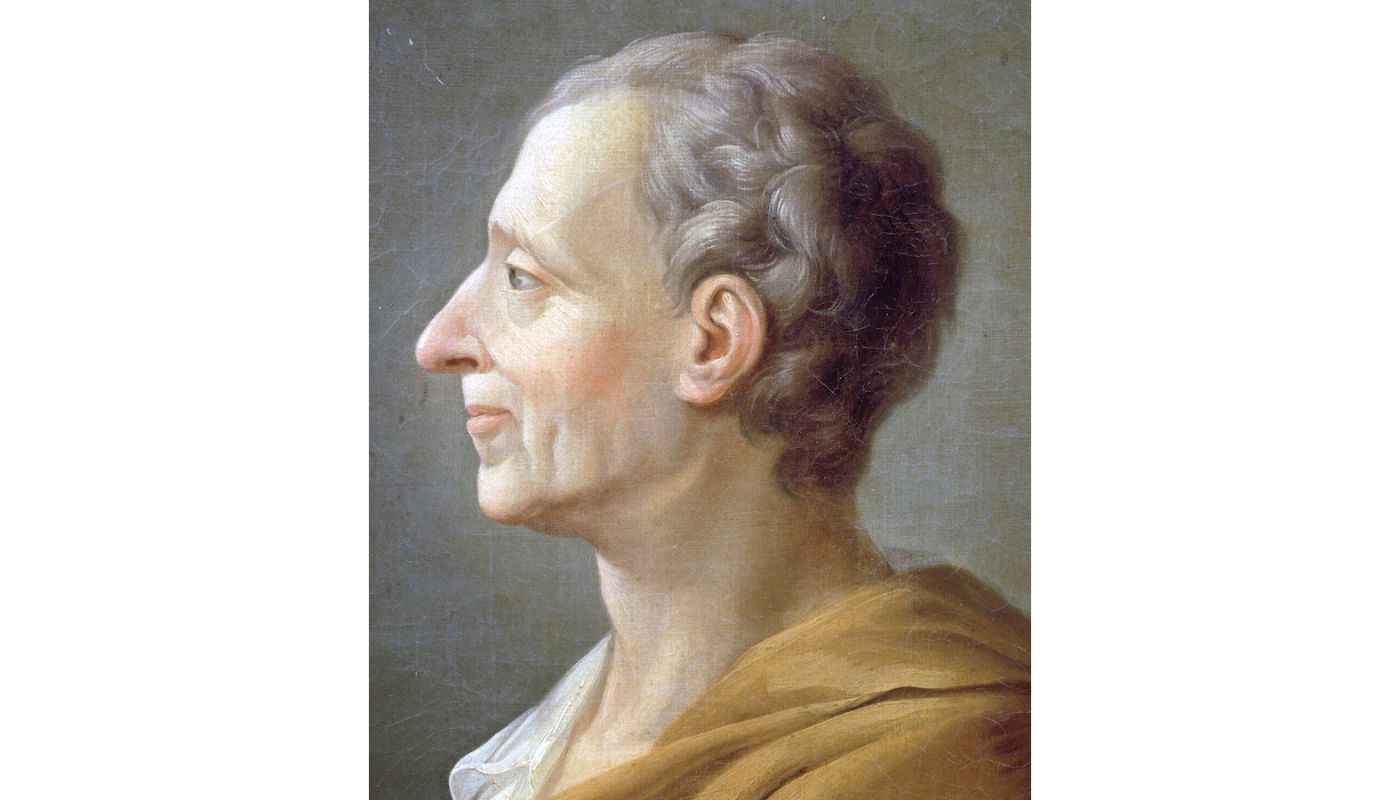
The image, a photograph of an 18th-century portrait of Montesquieu by an unknown artist, is courtesy Wikimedia Commons.
















