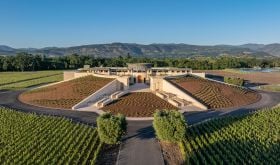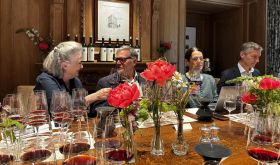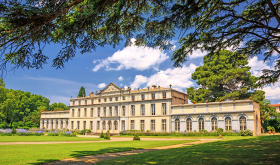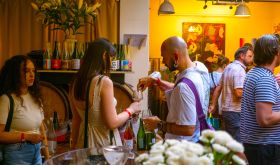
Last month I witnessed the opening of spanking new winery buildings at an estate in the Rheingau so popular that the 600 guests at the party had come from all over the wine world, and included every one of the luminaries of German wine (at play in the distance in the picture on the left). But the most extraordinary aspect of the celebrations was that there was not a Japanese face in sight. German wine has long been relatively popular in Japan but that is not why I was surprised. Weingut Robert Weil has been owned by the Japanese whisky giant Suntory since 1988, yet you would never know it.
There was no mention of the connection in any of the literature handed out at the event. The Suntory website acknowledges its three subsidiaries in the European wine business but directs you firmly to Robert Weil's own website, on which there is not a mention of Suntory or Japan. Yet in the words of the president of the Rheingau wine growers' association, Stefan Ress of the Weingut Balthasar Ress in the next village, 'what an opportunity was given to the Rheingau by Suntory's investment in Weil. Nothing better could have happened to the region'.
Weil is widely seen as the jewel of this, historically Germany's grandest, wine region. The pristine estate and its smart new cellars, not to mention its growth from 18 to 90 hectares of vineyard in the last 25 years and the impeccable quality and consistency of its wines, including a miraculous Trockenbeerenauslese every year, are all presumably made possible by the yen underpinning them, even if in Wilhelm Weil, who had to take over the family estate as a very young man at about the time of the sale to Suntory, they have an exceptional steward.
This extreme discretion, I realised on reflection, is characteristic of Japan's best-known acquisitions in the world of wine, which include some of the very finest producers of all.
In Bordeaux, Suntory owns part of a négociant business (which now has a share in both Chx Beaumont and Beychevelle) but for many years has owned the third growth Château Lagrange of St-Julien. Here, too, they have steered a property that was far from realising its potential to one that, despite its less-than-perfect location, is a model of consistent delivery, making long-lasting wines of dependable quality and harmony. The current director Bruno Eynard told me once that someone from Suntory visits every so often, adding with only slight exasperation that he always has a full-time Japanese employee who 'wants to understand everything exactly all the time; le feeling is not enough for them. But Suntory is definitely motivated by top quality rather than profit.' This determined learning process is presumably driven by the fact that Suntory have their own large winery in Japan, where very passable ripostes to red bordeaux, and white burgundy, are crafted by dedicated staff, but otherwise the French management are left to get on with things.

There is an even more hands-off approach at the other high-profile Japanese-owned wine producers I can think of. In 1988 Madame Lalou Bize-Leroy (right) acquired the Charles Noëllat domaine in Vosne-Romanée and set up Domaine Leroy in competition with the world-famous Domaine de la Romanée-Conti, whose door she was shown after a family tiff. But she was able to do this only because she was backed by her Japanese importers Takashimaya, whose name she has always had difficulty pronouncing. It is hard to think of a more headstrong wine producer in the world. I cannot imagine the Japanese managing to lay down any sort of law with her. Indeed the only evidence of a Japanese connection with Domaine Leroy is the number of bottles of its wines found in the smartest wine shops of Tokyo and Osaka. Hew Blair of Justerini & Brooks, who has been visiting Domaine Leroy since the beginning, reports that he is yet to see any evidence of Japanese influence whatsoever.
Japanese presence elsewhere in the upper echelons of the wine world is just as shadowy. Few visitors to Ridge Vineyards, California's truly iconic producer of great, ageworthy, classical reds based on ancient Zinfandel vines and Bordeaux blends from almost equally historic vineyards, know that it has been owned since 1987 by a Japanese wine lover. Paul Draper continues to run this particular tight ship and although his travels take him all over the world, he rarely visits Japan. Also in the late 1980s Markham winery in Napa Valley was bought by Mercian, one of Japan's most significant wine producers, but it is run by an all-American team.
There are California wineries such as Kenzo, Freeman, Dalle Valle and Clos Pegase that are obviously and explicitly Japanese owned or part-owned. In the case of Kenzo, most of the wine produced on its 100 acres of vineyard is exported to Japan. But I am even more fascinated by the – perhaps coincidental – way in which all over the world some of the producers of the wines I admire most happen to have Japanese owners who are as firmly in the background as the make-up artists in a kabuki theatre.
My favourite producer on the Atlantic island of Madeira, for instance, hardly in the forefront of the modern world of wine or an obvious investment prospect, is Barbeito. Ricardo Diogo de Freitas, arguably the island's most talented and certainly most dedicated winemaker, took over the reins of this relatively young family company only in 1991. He encouraged other family members to exit the bulk madeira business and concentrate on top-quality bottled wines; he now even bottles single-cask madeiras. But Barbeito needed capital to embark on this adventure. They sought and received it from the Kinoshita family, whose business had long been importing Barbeito madeiras into Japan. Yet, again, there is no evidence of any Japanese connection at their immaculate new lodge outside Funchal – just delicious evidence of yen transformed into nectar.
In New Zealand, perhaps partly because of proximity, Japanese influence is relatively strong. At least two small-scale producers of particularly fine, handcrafted reds, Kusuda of Martinborough and Sato of Central Otago, are tiny family affairs where the work is done by Japanese immigrants and their friends. But the Japanese owners of De Redcliffe south of Auckland remained very much in the background.
Japanese discretion and precision are two very positive qualities for wine in my book.
The following are stunning wines tasted recently made by companies that are, discreetly, Japanese owned.
Robert Weil, Kiedricher Gräfenberg Riesling Erstes Gewächs 2004 Rheingau
Château Lagrange 2005 St-Julien
Domaine Leroy, Narbantons 1999 Savigny-lès-Beaune
Ridge Vineyards, Geyserville 2008 Sonoma County
Barbeito, Cask 727 Malvasia 2001 Madeira