It was pouring rain, cold water dripping from the sides of the tents that were meant to keep a light drizzle off, but it was fresher outside, as the tavern was crowded with people who preferred to stay dry. To be honest, there was also quite a lot of free wine on offer inside, as it was BYO night during Austria’s Single Vineyard Summit.
I, however, was hungry, and the pizza truck was outside. Besides, I’d had enough wine for the day. The plan was pizza, then bed. But a guy in a T-shirt with a crazy-looking cartoon caterpillar on it offered me some wine while I waited for my order, and it seemed awkward to say no.
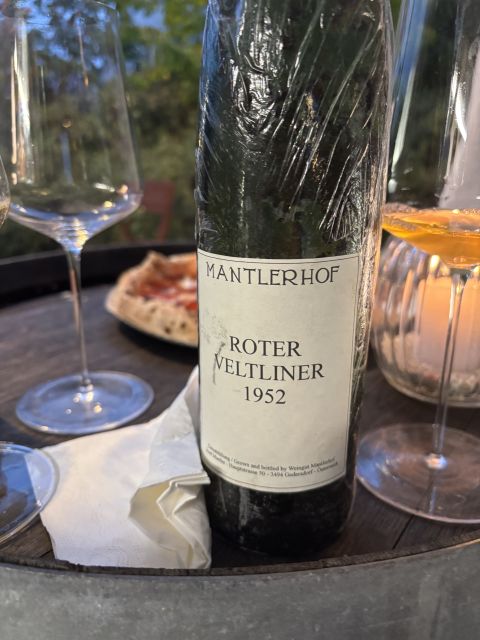
It was the right move. The guy was Josef Mantler from Mantlerhof, a winery in Austria’s Kremstal, and the wine he was pouring was a Roter Veltliner his grandfather made in 1952. The wine was impossibly youthful – full-bodied but still lively and fresh in its almost tropical fruit flavours – and gutsy enough to stand up to the spicy sausage on the pizza that eventually joined us.
I’ll be totally honest with you and admit that I never really thought much about Roter Veltliner before that moment. But when I got home, I looked it up in Wine Grapes, finding out that it’s not related to Grüner Veltliner at all, and is parent to both Rotgipfler and Zierfandler, two of Austria’s greatest, if overlooked, grape varieties. Clearly I had to have some.
I picked up a bottle from Fritsch, who’d showed their 2023 Steinberg, a deliciously ripe, peppery, concentrated single-vineyard Roter Veltliner, at that Single Vineyard Summit. Julia had tasted and scored that wine; my bottle was instead their 2024 regional bottling, labelled simply Roter Veltliner Wagram. Nevertheless, the wine didn’t disappoint, my notes on its rich, creamy texture, pineappley flavour and bright, invigorating freshness reading remarkably like Julia’s note on the Steinberg.
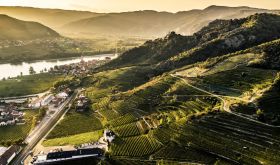
The similarity made sense when Alex Fritsch explained to me over email that the two wines come in fact from the same vineyard. ‘You have to imagine the Steinberg in slopes, and on the top there is a road’, he explained. ‘So at the top and at the bottom there’s more loess. The middle part, which is also the steepest, is usually the best section, and this will become the single-vineyard bottling.’

But in Wagram, which is famous in both vinous and geological circles for its incredibly deep loess deposits, ‘more loess’ doesn’t equate here to the most loess. At Fritsch, the Grüner Veltliner gets the deepest loess plots – Schlossberg, their top Grüner site, is on 30 m (98 ft) of pure loess. ‘Roter, meanwhile, benefits from having to struggle a bit to produce more characterful wines’, Fritsch says.
A lack of struggle is in fact why we rarely hear about Roter Veltliner any more. The variety used to be grown all over Lower Austria – Ferdinand Regner, the head of the Department of Vine Breeding at Austria’s Klosterneuburg research centre, writes in Wine in Austria that Roter Veltliner was once ‘the most important grape on the Pannonian Plain’, covering more land than any other variety in the 1920s.
But when growers changed course in the 1950s, replacing their vines with a new, higher-yielding clone called Hietl, its appeal quickly waned. Those big, juicy berries might have looked nice but they were quick to succumb to disease, and its wines were wan. Roter Veltliner was left behind, and the unrelated Grüner Veltliner instead became Austria’s hallmark variety for the 21st century.
Today, there are just 202.6 ha (501 acres) of Roter Veltliner left in all of Austria, 99.25% of that within Niederösterreich, and the majority (115 ha/284 acres) in Wagram. Alex’s father, Karl, first planted the variety at their biodynamically farmed winery in 2012, excluding the Hietl clone. Instead, Alex explains, ‘we collected scions from various existing Roter Veltliner vineyards in the region, selecting material from plants that were already showing desirable characteristics in terms of cluster structure and flavour.’
Even then, controlling vigour is an issue, as is avoiding disease, as the clusters are tight and compact, Alex says. They’ve found a combination of cordon training and cluster-splitting – removing part of each cluster to allow for more air circulation – lowers the crop substantially but pays off in better flavour and concentration.
Now with Alex officially joining his father at the winery, they are working on doubling their Roter Veltliner plantings (from one to two hectares!), selecting out the best of their existing vines for more planting material. ‘Our focus was explicitly on loose cluster architecture, which helps reduce disease pressure, and on aromatic and textural character of the grapes’, Alex says.
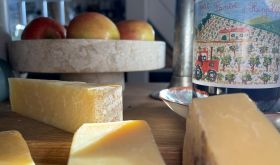
If all goes well, we’ll have more Roter Veltliner in our future. For now, encourage them by seeking it out. The Fritsch 2024 Wagram Roter Veltliner is an excellent winter white, emanating warmth in its golden hue and tropically inflected flavours (but not in alcohol – it’s just 12%), and with the heft to take on hearty dishes — perhaps a thick slice of country pâté or a roast chicken, a pork loin or creamy stew.
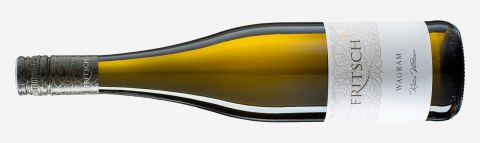
Fritsch’s 2024 Roter Veltliner is currently available for €15 from the winery; £20.10 at Shekleton Wines in Stamford, England; in the US, it’s imported by Schatzi Wines, NY.
If you can’t find this exact Roter Veltliner, check our database for more versions to explore. And read all about all the wines we tasted at the 2025 Single Vineyard Summit in Austria here!