Most Prosecco is vapid bubbly stuff created to slake the thirst of a bubble-hungry but budget-conscious world. This is not one of those – although it is remarkably well priced.
Rather, this was one of nine terrific wines that wine educator Alan Tardi poured in a recent class at New York Wine Studio that he called The Original Prosecco, to point up that there’s more to Prosecco than mass-market fizz. Tardi’s relationship with the area dates back to 2008, when he went to Cartizze on assignment for a US magazine. He’d been living in Piemonte for years at that point but hadn’t been to the Prosecco area in the Veneto. ‘When I got there, I was completely blown away at the landscape and the terroir. And particularly the complexity and diversity of the small area’, he said.
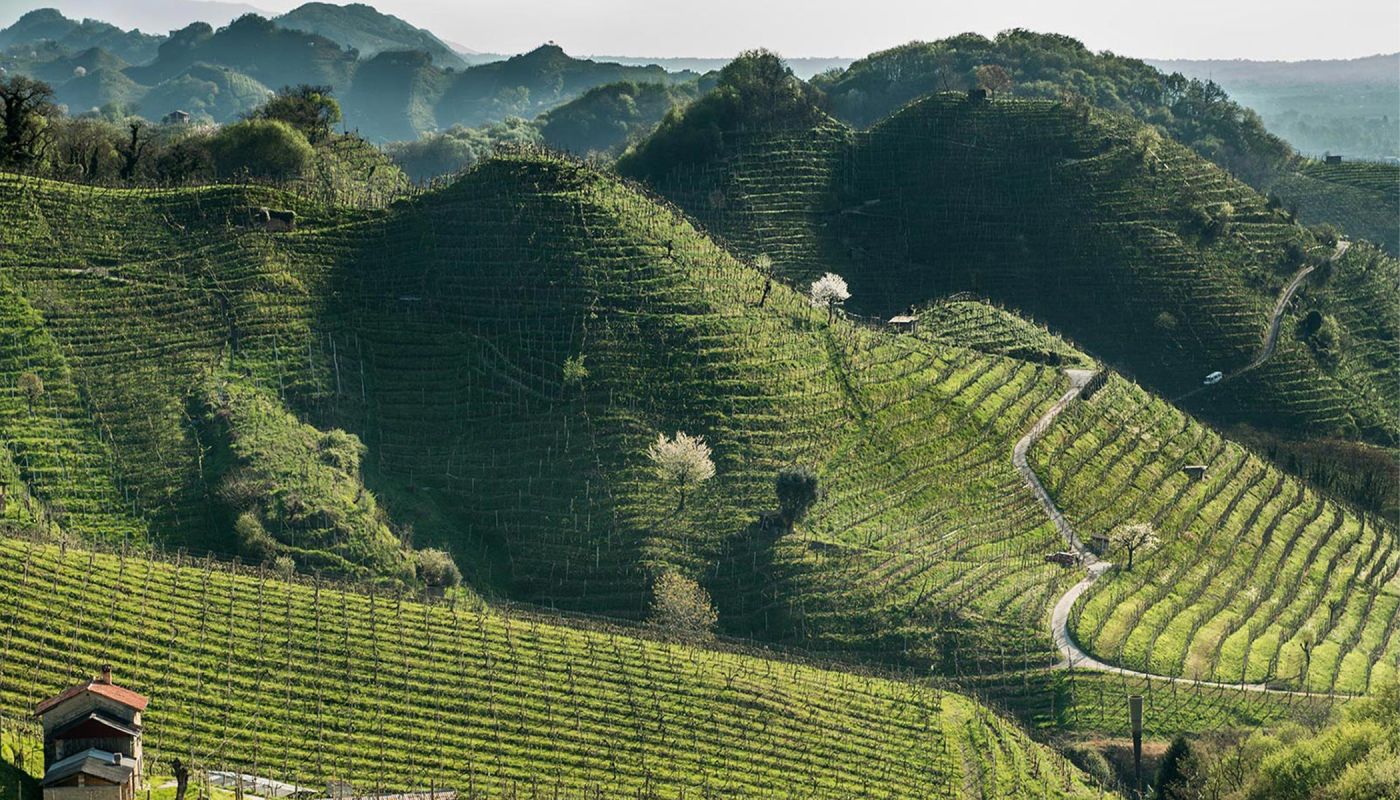
Yet the very next year, in 2009, the Prosecco DOC was massively enlarged to include more than 36,000 ha (89,000 acres) across nine provinces in both Veneto and Friuli – a far cry from the area Tardi had visited, where vineyards cling to steep, small ridges that zig and zag the 35 km (22 miles) from Conegliano to Valdobbiadene, the soils, aspects and exposures changing at every curve. It’s a craggy, wild landscape that’s indelibly green in the summertime, because of the tradition of ciglione, terraces that rely on grass rather than stone walls to hold the soil in place. (See photo below.) The area is so stunning and remarkable for the viticultural practices that have developed on these hard-to-access slopes that it was declared a UNESCO World Heritage Site in 2019.

Contrast that to the enlarged Prosecco DOC, which the official disciplinari describes thus: ‘The area of the Prosecco Denomination, located in the north-eastern part of Italy, is characterised by a flat type of location with some hilly areas.’ High-yield farming and machine harvesting, which is mostly impossible where Tardi had been, is the norm in the DOC – that’s how you get to $8 grocery-store Prosecco.
At the same time that Prosecco was enlarged, the authorities did make an effort to distinguish between it and the heart of the appellation, which they elevated to a DOCG called Conegliano Valdobbiadene Prosecco Superiore – which, confusingly, can appear with or without either the Conegliano or the Valdobbiadene part of the name as well as the Superiore, or even the word Prosecco. But either way, the difference seems to be mostly lost in the thunder of the autoclaves that ferment 721 million bottles-worth of Prosecco DOC each year.
What’s more, the DOCG suggests a homogeneity to the region that masks its complexity. ‘Conegliano and Valdobbiadene are towns but refer to areas in the east and west, and they are very different’, Tardi explains. ‘The soils are completely different, the elevation is different. Behind Valdobbiadene is a wall of mountains – the Dolomite Prealps – and you can’t really grow anything there.’ So at the Valdobbiadene end of the DOCG (the western end), the hillsides are very steep, with very shallow soils that are rich in marine content, with ancient shell fossils, as the area was once under water. ‘This tends to make the wines very saline, linear’, he finds.
The eastern side, where Conegliano is, stands out for its gentler slopes and warmer and more fertile soils made up of morainic material left behind by the Piave glacier: sand, clay, rocks and pebbles. (You can see the difference in the UNESCO map of the region, which lays out the ‘core zone’ flowing east from Valdobbiadene; a ‘buffer zone’ of lower hills extending around Conegliano; and a ‘commitment zone’ around both of them, which have signed a protocol agreeing to protect the landscape.) The wines from this end tend to be warmer, fruitier, more expressive.
However, the DOCG made one smart move, and that was to allow the use of ‘rive’ on the label. ‘It's a traditional term in local dialect that indicates a specific, well-defined (and usually quite small) vineyard site’, Tardi explains. ‘Within the prized hillside of Cartizze (107 ha), for example, there are many, many distinct (and often named) vineyard sites defined by the complex territory: slope, aspect, elevation, etc. People would refer to these particular sites as una bella Riva. Some older people still do!’ Today it’s an officially defined term used to denote a wine from one of 43 approved towns or hamlets which meets stricter yield limitations (no more than 13 tonnes/ha, as opposed to 18 for DOC Prosecco and 13.5 for DOCG), is hand-picked and vintage-dated.

The rive (singular riva) help highlight the heterogeneity of the landscape by allowing producers to showcase special parcels, and Adami’s Vigneto Giardino Rive di Colbertaldo is a particularly fine example. ‘Adami is a great producer, and they make many excellent wines. But Vigneto Giardino is exceptional’, Tardi says. ‘This was the very first vineyard that Abele Adami (already a winegrower in Valdobbiadene) purchased from Conte Balbi Valier in 1920, shortly after the end of World War I and was one of the first commercial single-vineyard bottlings of the ConVal area.
‘I spent a good amount of time in this vineyard, just hanging out being there, and indeed it feels like it is a special place with its own identity and personality, its horseshoe orientation facing south, embracing the sun and the breezes, and scaling from top to bottom like an amphitheatre.’

Adami is still run by the family – the third-generation brothers Armando and Franco and their children Fabrizio, Claudio and Cristina – and Vigneto Giardino remains their most prized plot, with vines up to 100 years old that they stake with chestnut poles. As with all their vineyards, they farm sustainably (certified by SQNPI) and without herbicides, but they take especially good care of this one, as it’s the source of cuttings for replanting this and their other vineyards.

When it comes to winemaking, they ferment with selected yeasts in stainless-steel tanks and leave the wines on their lees for at least three months and as much as a year; the second fermentation is done in tank in more than 100 small batches throughout the year, with the date of the second fermentation on the bottle. They make about 3,750 cases annually, all bottled in lightweight glass with PVC-free labels and packaging.
The care they take is clear in the wine, which has far more character than most Prosecco. It’s made in a style they call ‘asciutto’, the term the family has used for its ‘dry’ bottling well before the creation of the original Prosecco DOC in 1969, so they have been allowed to continue to use it. ‘For me’, Tardi says, ‘this is a great example of a wine that has a rather high level of residual sugar – about 18–21 g/l – but doesn’t taste sweet because of the other factors that balance it.’
What struck me when tasting it was its depth of flavour, with layers of sweet fruit, salty minerality, and rich earthiness, all carried on a raft of light bubbles and at just 11% alcohol. It’s gentle yet dynamic, and incredibly appetising. It was the one Prosecco that made me immediately hungry, wanting to whisk the bottle off to the Chinese place around the corner to try it with spicy noodles, or home to savour with some of the melon I’d picked up from the farmer’s market with salty prosciutto. I asked Tardi, who was a professional chef for many years, for his favourite pairings, and he recalled the meals he enjoyed in trattorias while he was visiting Conegliano Valdobbiadene. ‘They would often cook stuff on a spit over fire. Chicken, squab, game birds … I have visions of spits going round and round in simple but elegant trattoria with wine like this.’ So pull out a bottle next time you’re grilling, or really anytime you want bubbles with substance and extra deliciousness.

Adami, Vigneto Giardino Rive di Colbertaldo Asciutto 2022 Valdobbiadene Prosecco Superiore DOCG is imported in the US by Dalla Terra and is available in the UK through XtraWine UK Ltd. It’s also available throughout Europe, in Japan and in Hong Kong.
For reviews of more top DOCG Prosecco members can access our tasting notes database.