I was three wines in to a 20-wine blind Riesling flight when my nose pulled me back to the first wine. On the palate the acid was sharp, almost jagged, and so high it hurt. But the smell …
It was like I was 10 again.
Every summer of my childhood, my father would take me to Madeline Island for a month. He and I would spend that month in a log cabin in the middle of the woods that had one rotary phone, no TV and no internet. Town was a seven-mile bike ride away – but the only thing in town was my uncle’s bike shop, a candy store, a corner store and a bar I wasn’t allowed into. Everything else (arcades, amusement parks, other children) required a 25-minute ferry ride to the mainland … for which I would most certainly be required to have an adult supervisor. My father, occupied with reading, cooking, biking and napping, had zero interest in the mainland. The boredom was crushing.
Most mornings started at 6 am. Why, you ask? Well, because my father was up by 5.30 am and his rendition of ‘I’ll be working on the railroad’ was sung at top volume due to (a) his excitement at going out on his boat and (b) his damaged hearing from 20-odd years of managing rock bands.
By the time we got to the marina he would have transitioned to whistling. I’d wade into the freezing lake as he began bustling about with ropes and tools. The smell of the lake would fill my nose – earthy and fresh – like the dark soil and pines that grew near the shore. As my toes sunk into slimy brown mud there’d be a release of tiny bubbles that smelled slightly sulphurous. Diesel aromas would fill the air as boats went out for the day. Someone, somewhere would have a wood fire going – lacing the air with a sweet smokiness. Back in the boat, with the sun beating down on the vinyl seating, there would be a distinctly plasticky smell. And by the time we pulled out of the harbour I’d be holding a bright-green lemon-lime snow cone – my consolation prize for enduring what, as an adult, can only be remembered with a longing as sharp as the Riesling that conjured the memory.
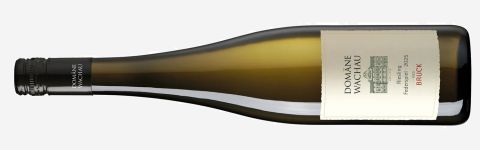
I nursed a bottle of Domäne Wachau 2020 Ried Bruck Riesling Federspiel for eight days. It showed no sign of fading.
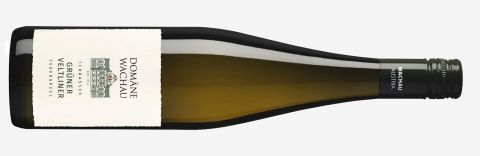
Unfortunately, the US and UK importer of Domäne Wachau, González Byass, does not offer this wine in the UK. Rather than not tell you about it, I’ve gone and dug up another very good-value wine from Domäne Wachau that can be found in the UK – the Domäne Wachau 2025 Terrassen Grüner Veltliner Federspiel. It is not the same, being round and peachy with gentler acidity – but this may well suit you better if you’re not an acid hound. Jancis chose the forerunner to this wine for her wine of the week way back in 2009 – at which time this historic co-operative had only just changed its name to Domäne Wachau.
While Domäne Wachau has existed in its current iteration only since 2008, its history is much longer. The land that the co-operative produces wine from has been planted to vineyards since at least the 11th century, when the church owned the vineyards and produced the wine. When Emperor Joseph II forcibly dissolved monasteries across Austria in the 18th century, the Starhemberg family assumed control of the vineyards. In 1938 the Starhembergs sold the vineyards and winery to local growers who established themselves as a co-operative called Winzergenossenschaft Wachau. The name was changed to Freie Weingärtner Wachau in 1990 and to Domäne Wachau in 2008.
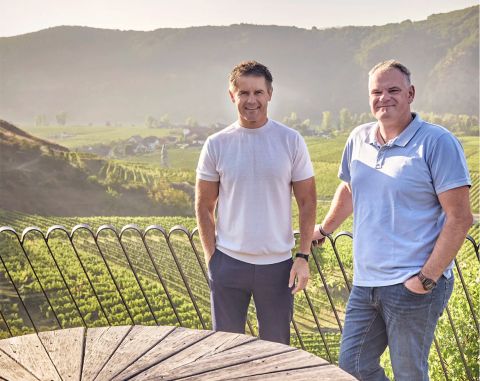
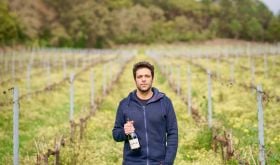
The co-operative is currently run by Master of Wine Roman Horvath and head winemaker Heinz Frischengruber. They work with around 250 growers who farm nearly 450 ha/1,112 acres (over 160 ha/395 acres of which are organic) across the Wachau.
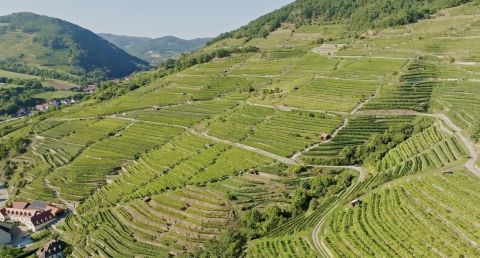
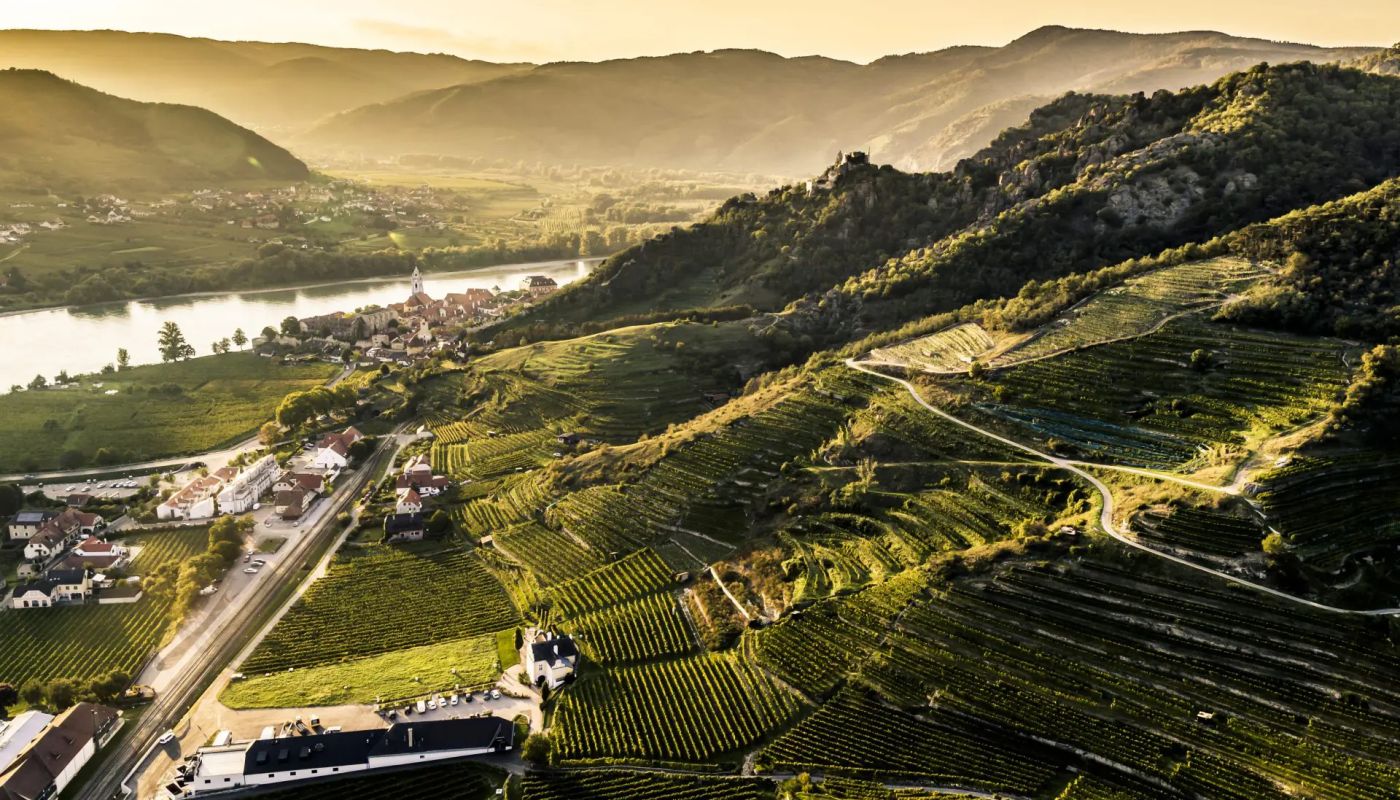
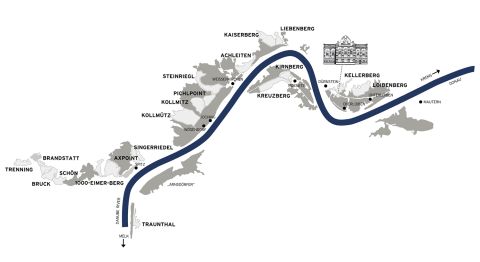
The Bruck vineyard (Ried translates to vineyard) – which produced the Riesling that caused my fit of nostalgia – is, according to Domäne Wachau’s website, where ‘the cool Wachau climate reaches its most extreme limits’. The vineyard is located down a narrow side valley off the Danube River called the Spitzer Graben, where soils are rocky and poor and conditions are harsh. The vineyard averages a 37% slope, climbing from 292 m to 488 m (958–1,601 ft). Planted areas are terraced and the stone walls are maintained by the growers who farm this vineyard. While the entirety of the vineyard is 17.38 ha (43 acres), only 13.5 ha (33.4 acres) are planted – 5 ha (12 acres) of which grow fruit for Domäne Wachau. Unlike most sites in the Wachau, the Danube River does not impact this site. Instead, the main influences here are cold air coming from the Waldviertel (the north-west quarter of Austria which is known for being one of the coldest and snowiest areas in the country) and from downdraughts off the Jauerling Mountain. The harvest here is later than most sites off the Danube – in 2020 grapes were harvested in mid October. Notably, the 2020 vintage of this wine is 12.5% alcohol – the maximum allowable alcohol for a wine labelled ‘federspiel’. However, the body is medium(-), and the acid is lean enough that this wine could not be mistaken for a smaragd.
The Terrassen Grüner Veltliner Federspiel, which is much more widely available than the Bruck Riesling, is sourced from sites all over the Wachau. The 2025 vintage saw variable conditions – swinging from a cool and wet spring to a warm June, a cool, wet July and a warm August and September. Though it won’t go down in history as the most idyllic vintage, it was a relief to growers after the flooding of 2024. This wine is beautifully balanced with 12% alcohol, 6.5 g/l of juicy, mouth-watering acidity and just one gram of residual sugar.
Both Domäne Wachau’s Grüner Veltliner and their Bruck Riesling are hand-picked and sorted before being destemmed, macerated for 4–8 hours and pressed. The juice is then fermented at 20 °C (68 °F) in stainless-steel tanks. Both wines are left on fine lees during maturation – 4 months for the Grüner Veltliner, 6–7 months for the Bruck Riesling. The wines are then blended, fined, filtered and bottled.

González Byass imports Domäne Wachau to both the US and the UK. The 2020 Ried Bruck is available in the US, Austria and Bulgaria with the best price in the US being $26.97 from Wine.com. The 2025 Terrassen Grüner Veltliner Federspiel is available in the US, UK, Austria, Germany, Slovakia, France, Italy, Spain, Sweden, the Netherlands, Portugal, Switzerland, Australia and Estonia.
Find the 2025 Terrassen Grüner Veltliner
All images are courtesy of Domäne Wachau.
You can find lots of great Grüner Veltliner from Austria in our tasting notes database.