
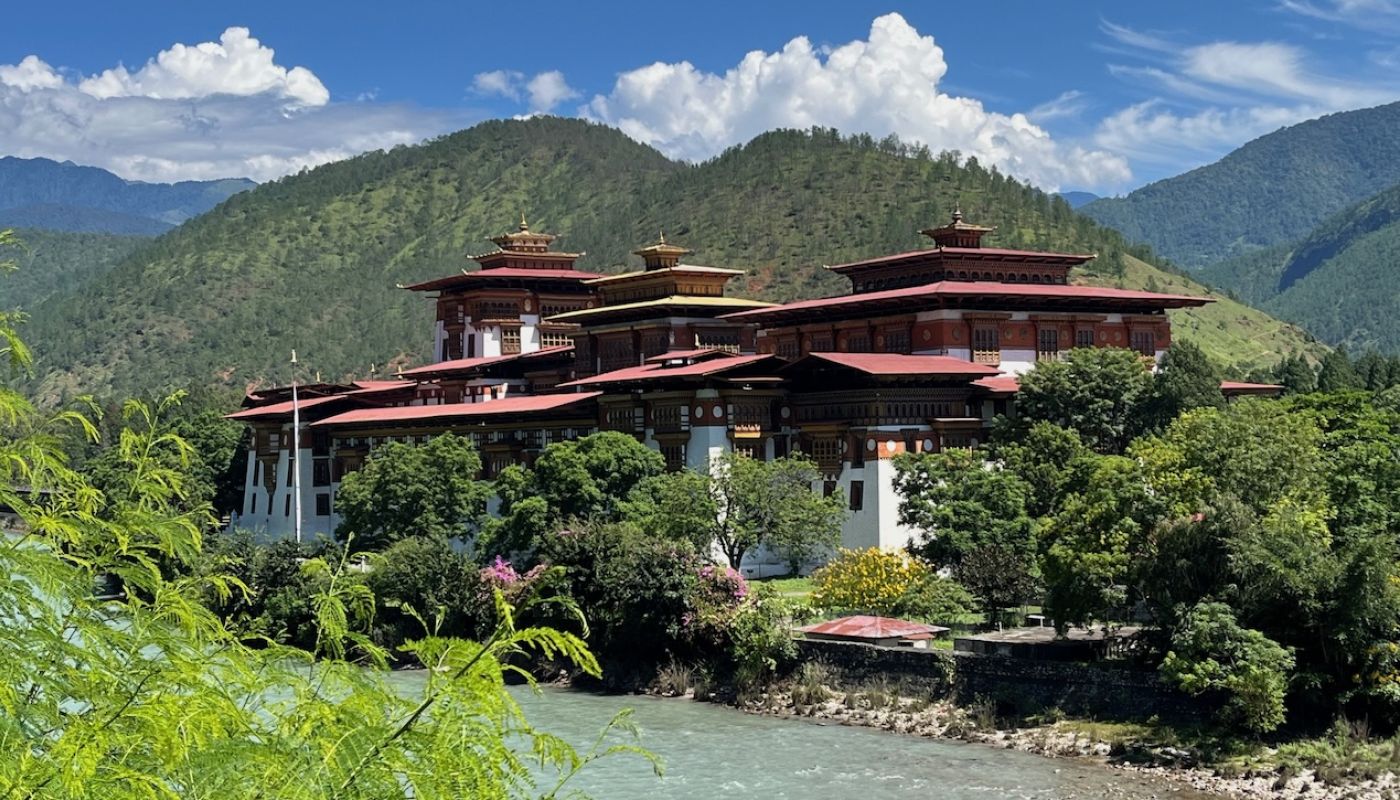
About a year ago I was at a charity auction. It was going badly. The auctioneer had lost control of the room. Then a lot involving a trip to Bhutan came up and a heavily tattooed man leapt on the stage and set the crowd alight. Such was the interest he whipped up that he ended up doubling the lot and selling each for an average of €23,000.
That man was Michael Juergens, a partner at Deloitte who five years ago laid the foundations of the Bhutan Wine Company with his partner Ann Cross. She had read a book in high school about this Himalayan kingdom famous for its Gross National Happiness model, and in 2017 persuaded him they had to make a trip there. While they were preparing for it he asked, ‘Where’s this island you want to go to again?’
Much has changed. He fell as deeply in love with Bhutan as Cross and, being sufficiently mad about wine that he is studying to be a Master of Wine, decided there was real potential for wine production there. A rabble-rousing southern Californian, he managed to convince the highest echelons of Bhutanese government that wine production would be utterly in line with the country’s current programme of sustainable modernisation. So much so that they agreed to donate the vineyard land needed by the fledgling Bhutan Wine Company.
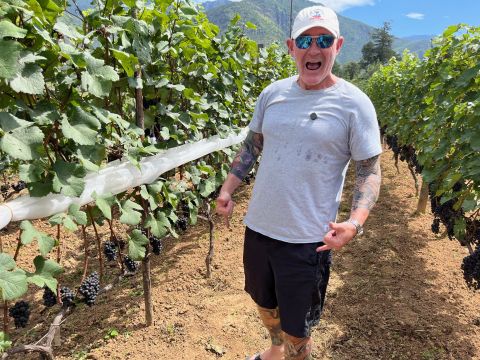
Free land in an English-speaking country with cheap labour and plentiful water and energy would have obvious appeal to many a professional accountant, but Juergens (above) and Cross were keen specifically to see what happened when vines were planted in Bhutan’s narrow, steep-sided valleys, at different elevations and with different exposures. The Bhutan Wine Company’s vineyard elevations currently vary between just 150 m (500 ft) on the border with India outside Gelephu, and 2,788 m (9,147 ft) near the capital Thimphu, one of the highest vineyards in the world.
The first vines went into the country’s rich red soil in 2019 and there are now nine vineyards across central and southern Bhutan, some only an acre or two planted in agricultural research stations such as the one above Paro shown below, many of them barely accessible. Although they are hoping to have 800 ha (2,000 acres) of vines eventually, currently only 20 of the company’s 80 ha (200 acres) are producing wine, none of it on sale yet.

The predations of beetles and deer respectively put paid to two initial plantings. (All living things are sacred in Bhutan.) One vineyard, on the site of one of the country’s ubiquitous rice paddies, had to be completely redone because the soil was so compacted. The bumpy track down to another, the Pinsa vineyard on the roaring, heavily dammed Punatshang River, had to be expensively flattened to ensure the grapes didn’t split on their way to the winery many hours west.
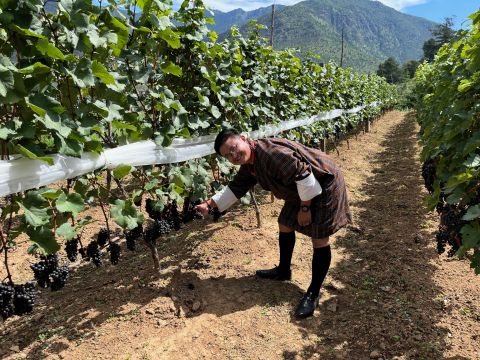
After the auction, Juergens asked me to join the advisory board of the Bhutan Wine Company. Although some wine for tourists is imported in bulk and bottled in Bhutan, the BWC is the lone outfit attempting to grow wine there. So, without feeling any conflict of interest, I agreed and have just made my first trip to this extraordinary, carbon-negative country of 800,000, mainly Buddhist and all devoted to their distinctly complex traditional costume shown below.
The company is dependent on patches of land that the country’s government, both national and local, is prepared to grant them, whether viticulturally suitable or not. I went with Juergens to inspect three possible future vineyard sites. One was on a steep, waterlogged clearing in a forest at the end of a 20-minute hike off a dirt road. Another was up a muddy lane that twisted upwards and proved too much for our small bus, followed by a substantial further steep climb on foot.
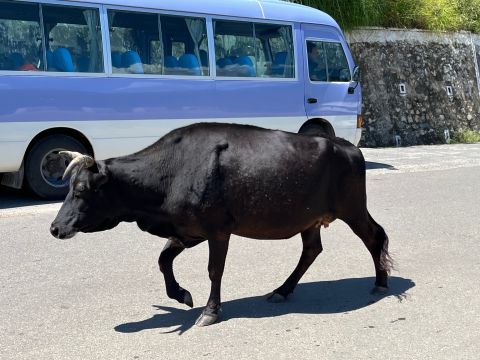
Everything at this stage is experimental. A plethora of different grape varieties has been planted. ‘We just want to see what works’, is Juergens’ mantra, along with his desire ‘to put the essence of Bhutan in a bottle’. So that would be sleepy cows on the road, prayer flags fluttering everywhere, hairpin bends, and chillies with everything.
The four extant vineyards that I saw were small and inconsistently designed, but tenderly managed by Bhutanese locals, two of them refugees from an ambitious but so far unsuccessful foreign venture to plant hazelnut trees for an Indian version of Nutella. Just before we arrived, in the middle of harvest, the French winemaker walked out.
These are by no means the only challenges faced by the Bhutan Wine Company. An early consignment of French vine cuttings was held up at the pandemic-closed border in 2021. (The country was so hermetically sealed that the Bhutanese ran out of chillies and a special mission to India for extra supplies had to be officially sanctioned.) The restrictions on the Suez Canal route meant that the tanks vital for the 2024 harvest arrived disastrously late for the first grapes. Thanks to monsoon rains, those from the company’s far eastern vineyards had to be picked in late June – much earlier than is usual in the northern hemisphere.
The grapes in the company’s highest vineyard Ser Bhum, on the other hand, down a perilous lane, across a fast-flowing stream and almost surrounded by pine forest, have never fully ripened so they are experimenting with what is effectively a plastic greenhouse over one or two of the rows.

I confess that my hopes for the quality of the wine were not that high. They sank lower when I saw the exterior of the temporary winery in a small shopping mall on the outskirts of Thimphu. Up the inconvenient flight of steps shown above, with Juergens pointing the way, and walled entirely with glass, it had clearly been designed as a retail space.
Air conditioning has been installed, a drain added, and silvered insulation applied to every wall. Once I was inside, the winemaker of a few days, Matt Brain (below), with impressive accomplishments in Napa Valley and California wine colleges and recruited in a hurry via an online ad, assured me that the winery reminded him 'exactly of the winery at Cal Poly when I was teaching there’.
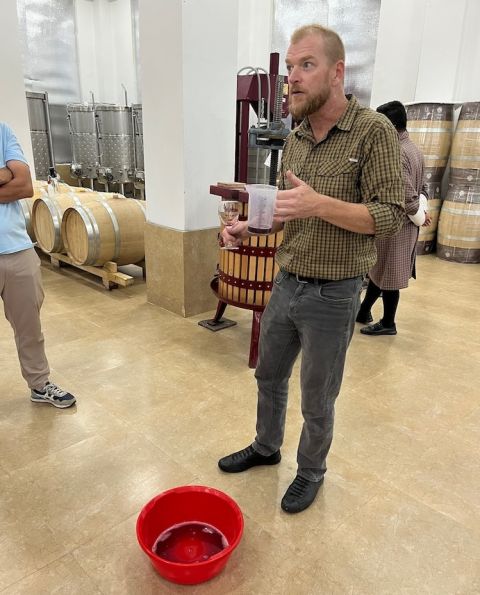
It was certainly admirably clean and tidy, tanks now in place as well as many an unused barrel and a fashionable vertical press – although Brain remarked rather wistfully that ‘hot water would be nice’. The drain had apparently been installed at the highest point of the dangerously slippery floor. ‘But we have squeegees’, Brain pointed out, before presenting a range of still-fermenting 2024s. I’m no expert in tasting wine at such an embryonic stage but I was impressed by these wines produced from typically high-elevation vines grown in mountain-fresh air. The Sauvignon Blanc, Riesling, Syrah, Tempranillo and even Pinot Noir all tasted frank, expressive and admirably varietally correct, as had the Cabernet Sauvignon grapes ripening on the vine. Quite a mix!
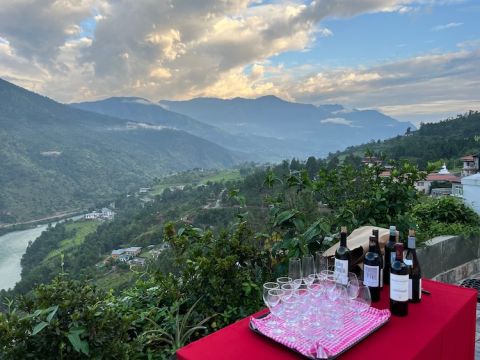
In 2023 a tiny amount of wine had been made and even this year they expect to make only about 400 cases, next year perhaps 2,000. I should make clear that I have no financial involvement in the company whatsoever, although I was a guest once I got myself to and from Delhi, the common entry point. We were admittedly looked after very well in Bhutan, Nick and I in the company of a couple from Oklahoma who had bid successfully in the Sonoma County Wine Auction for a week with the Bhutan Wine Company. Below shows aperitif time one evening above the Punakha Valley.
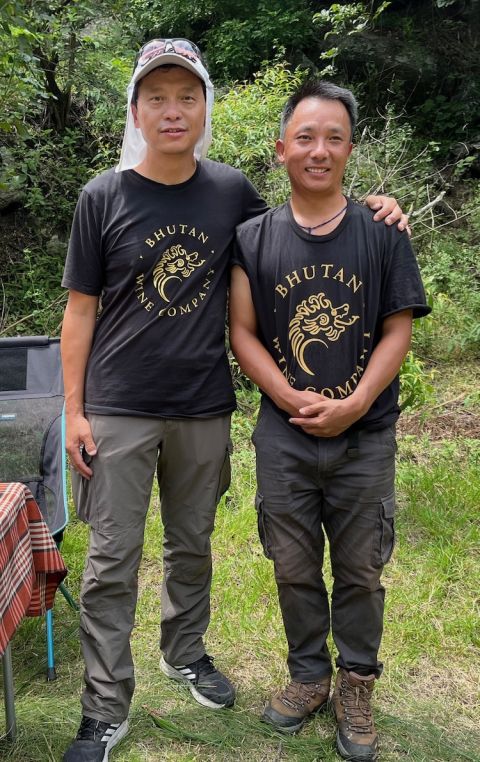
The company’s CEO on the ground is former Bhutanese diplomat Karma Choeda, seen below on the left with the Pinsa vineyard manager Pema Wangchuk, and much is organised by his well-connected wife Peldon. (The Bhutanese population is so small that would-be couples have to check that they are not too closely related before having a family.)
Bhutan is not the only new wine-producing country in the world but it is the only one I know of introducing fermented grape juice to a culture in which grape-based wine is virtually unknown. Traditional, and popular, Bhutanese alcoholic drinks are all based on cereals. So part of the company’s work is to educate the Bhutanese in all things wine. To this end the Bhutanese Wine Company opened a smart, Scandi-look wine bar in Thimphu earlier this summer, above a shop devoted to the national sport, archery.
Before the opening, the wine bar staff and Choeda were shipped to Singapore to be trained from the bottom up by the team at the wine-minded club 67 Pall Mall there. The bar currently offers selected French and Italian wines imported in bottle. The eye is drawn to a giant photograph of a bottle of the initial Bhutan Wine Company offering, a red blend sporting the golden dragon of the national flag, a copy of a golden prayer wheel round its neck and the label trimmed with one of the complex weaves of the nation’s distinctive fabrics.

The brand name Ser Kem, meaning 'alcoholic gift for the gods', was chosen after consulting monks who specialise in naming Bhutanese children.
The current main import route is from Calcutta to Phuentsholing, and Paro in the west is the sole international airport. But Gelephu is expected to take over from both once plans to develop it into a ‘mindfulness city’, international Buddhism hub and economic zone come to fruition. The Bhutan Wine Company’s lowest vineyards are here and the idea is to impose a short growing season on them and to benefit from Gelephu’s new-found status as tourist gateway.
Tasting rooms and vineyard pergolas with stunning views also feature in Juergens’ game plans, as do ‘wine-adjacent’ income streams such as exporting Bhutanese oak, the local spirit ara, wine infused with the cordyceps medicinal fungi so treasured by the Chinese, plus a franchise involving Bhutanese momo dumplings. There is no shortage of ambition.
See also my account of visiting the wine region in Yunnan on the other side of the Himalayas in China whose wine is now known as LVMH's Ao Yun.













