Had I been asked the question which one city would I most like to visit for its food, the answer would probably have been Chengdu, the capital of Sichuan province in south-west China.
It is a middling sized city by Chinese standards, that is there are over 10 million people living there, and its airport puts many of those in Europe to shame in terms of its layout and its facilities. The city's reputation as the symbol of Sichuan cooking is not only long established but also, as we were to appreciate, fully justified. Our friends first visited Chengdu in 1981 with food writer Paul Levy, then leading a group of far-sighted ‘foodies’ as China was beginning to open up.
Sichuan cooking is famous for being hot and spicy. This is in part due to the fact that the region is mountainous and the heat and spice are thought to get rid of all the ailments induced by the cold air. Its food derives the heat and spice from the presence of chilli oil, the lightly tingling Sichuan pepper, garlic, chilli peppers, ginger and star anise. This combination of ingredients not only leaves my lips quivering but also, and I am not sure if I am alone in this, brings a tingling sensation to the top of my head.
We were to spend just over 24 hours in Chengdu, a period that happily left enough time for a dinner and a lunch. Having arrived just after 3 pm, our appetites were whetted by some very attractive spicy nibbles in our room, including a particularly mouth-watering, bite-size version of a turnip cake at the St Regis Hotel, provided by Carson Zou, the obviously talented head chef of their Yan Ting restaurant, before we headed downstairs at 6 pm for our first foray into the car-filled streets of Chengdu.
Here we were met by Young Shi, Jancis’s Chinese minder, and Cathy Cai, the general manager of Kairun Wines, which specialises in importing some of the best Italian and German wines into China. Young Shi had deferred in all matters to do with the food of Chengdu to Cathy, who has earned this position having moved here as a young girl with her parents from Shanghai many years ago. It was her decision that we should eat at the XanuXanu restaurant and she, it transpired, had visited the restaurant twice in the run up to our dinner to ensure that the menu would live up to expectations.
The restaurant is in the old heart of the city, a grid of narrow pedestrian alleyways, and in fact the name of the restaurant translates as ‘the broader alleyway’. Our car stopped close to the restaurant, allowing us to walk the final five minutes and inspect the many food stalls. While some were selling familiar ingredients such as the skewered meats below, it was the sight of quite a few offering the roasted head of an animal that seemed the most conspicuous. These were, in fact, rabbit heads (Sichuan consumes 70% of China’s total rabbit population) and these heads make for an inexpensive (they sell for 6 yuan or 60p), highly nutritious snack.

The internet had revealed nothing about our destination, which, initially, appeared unprepossessing. We turned into a corridor full of tables and chairs above which edible, but otherwise overlooked, pieces of smoked pork were hanging from the rafters right over some of the tables, a leftover from the spring festival that had marked the end of the recent Chinese New Year.

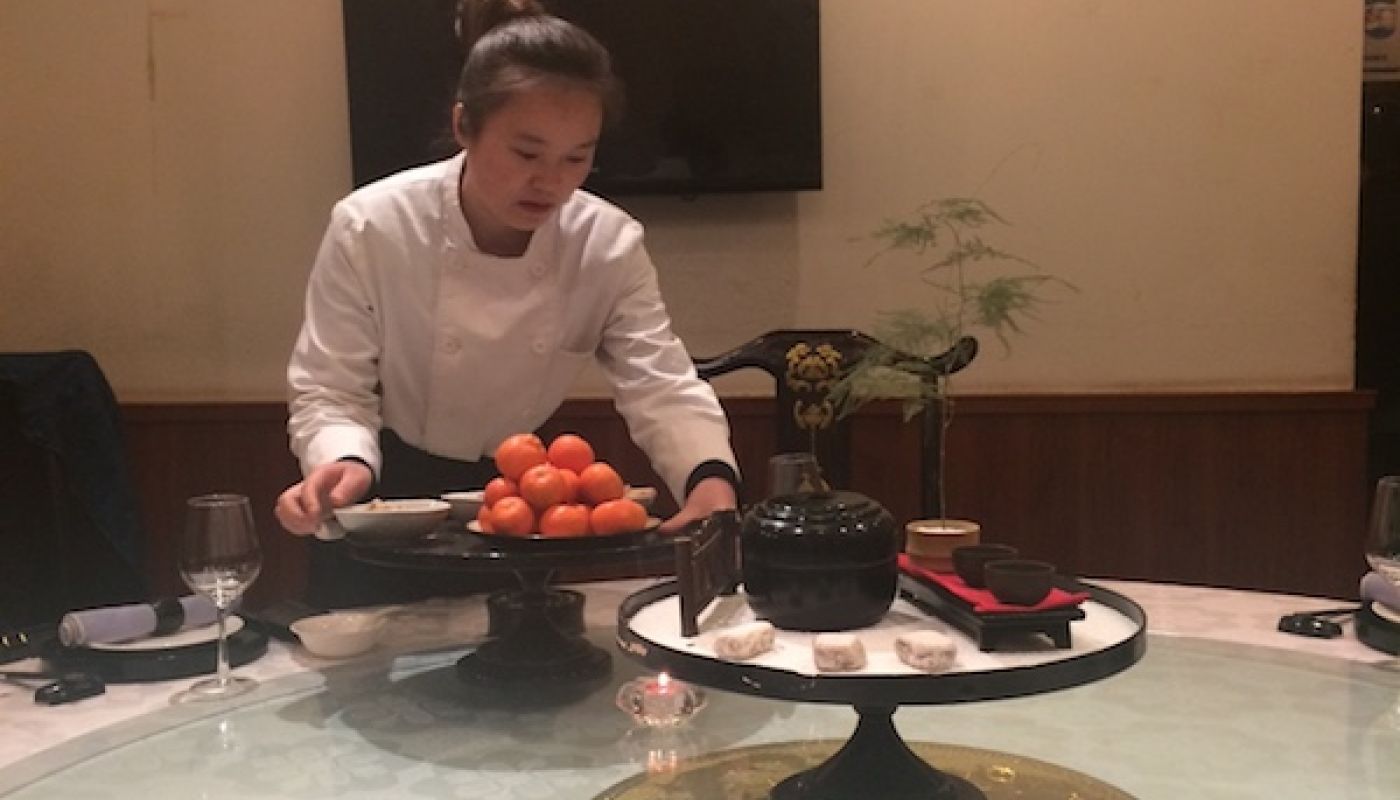
Then we were led into the private dining room for 10 shown top right, the table was laid with local tangerines and nuts and the fun was about to begin. Our dinner began with four cold dishes, each typically Sichuan, and one of them is perhaps the reason that this region’s cooking has got the reputation it has. There was a dish of sweet and sour duck with chilli; another two small bowls containing broccoli and French beans with spicy Chinese celery; another dish of cold noodles; but first of all there was a spicy, sweet dish of slices of chicken that was incredibly hot. This was our first dish and it was the most mouth numbing. Was this a practical joke to see quite how much heat we could take? I don’t know but the same thing was to happen at the following meal when the hottest dish, this time of sea cucumber (incidentally imported from south America as it is more chewy), sautéed with tofu and widely laced with Thai red chilli was the second dish. Were we being tested? If so, I’m afraid we failed miserably.
Our first dinner turned gentler when Miss Liu Yan, the considerate restaurant manageress, entered with a whole river fish whose flesh had been carefully cut into slices. Once shown around, the fish was then taken into the corridor and placed in liquid to form a soup that was subsequently served in two distinct servings. The first was as a nourishing broth, not too hot, the second with the young shoots of a green vegetable that had been brought from the farm that afternoon. Sichuan cooking depends, as does every style, on the sourcing of the best ingredients and then their fastidious preparation.
We were then treated to a great food and wine pairing. A local freshwater fish, known colloquially from its habit of sticking to the rocks under water, was served with tofu and Diel’s 2012 Pfalz Pittermännchen Riesling Auslese, whose 7.5% alcohol and crisp acidity made it refreshing with just a hint of sweetness. Towards the end of the meal two very typical Chengdu dishes were served: one of slices of dried pork with young garlic shoots and a black bean sauce; the other, mah po tofu, named after the pockmarked wife of the restaurateur who supposedly first created this dish, that combines mild tofu with all the spicy ingredients that make up Sichuan cooking. While Miss Cai extolled the virtues of Chengdu, her assistant went off to pay the bill of 300 yuan per person, about £30.
The following morning, having driven 40 minutes north of the city to become, I was told, the first white person since Michelle Obama to cuddle a six-month-old panda (my verdict, heavier than a human baby and more preoccupied with her bamboo shoot at the unmissable Chengdu Research Base of Giant Panda Breeding), we drove a further 30 minutes to the south for lunch at The Best Partner’s (www.cdqhx.com).
This imposing corner site has since 2002 fully justified its name via the provision of three separate services that go to the heart and soul of many who live here. It provides 18 private dining rooms of various sizes; 25 rooms for mahjong; and a further 11 for foot massages. All spread over 5 floors and under the management of Rui Zhang, who spent 5 years studying at UC Davis in California.
Lunch began with a mild offering of slices of pork belly rolled around chopped vegetables and garlic, a dish invariably served at home, with cups of 2008 Puer tea. The tea became an essential aspect of my meal as the dishes came hotter and hotter. First up was the Thai chilli with the sea cucumber and tofu that was happily served before a delicious meat-based broth that was then home to leaves of Chinese cabbage and changed colour as the flavours developed.
Then a catfish, served ZiGong style, a reference to the town nearby renowned for its ginger and hot-pot dishes, followed by sautéed cabbage with small pieces of pork. Then came a bony dry braised, yellow croaker followed by a couple of typical snacks, Zhong’s dumplings and another of wontons, followed by a sweet dumpling that had a liquid centre of brown sugar syrup. By this time, my lips and head were on fire.
The bill was about the same as for the previous night’s dinner. And my conclusion was very similar. That the chefs based in Chengdu fully justify their culinary reputation. That the food of Sichuan can be impressively hot. But that once past the first, overwhelmingly hot dish on any menu, it all calms down a bit.