
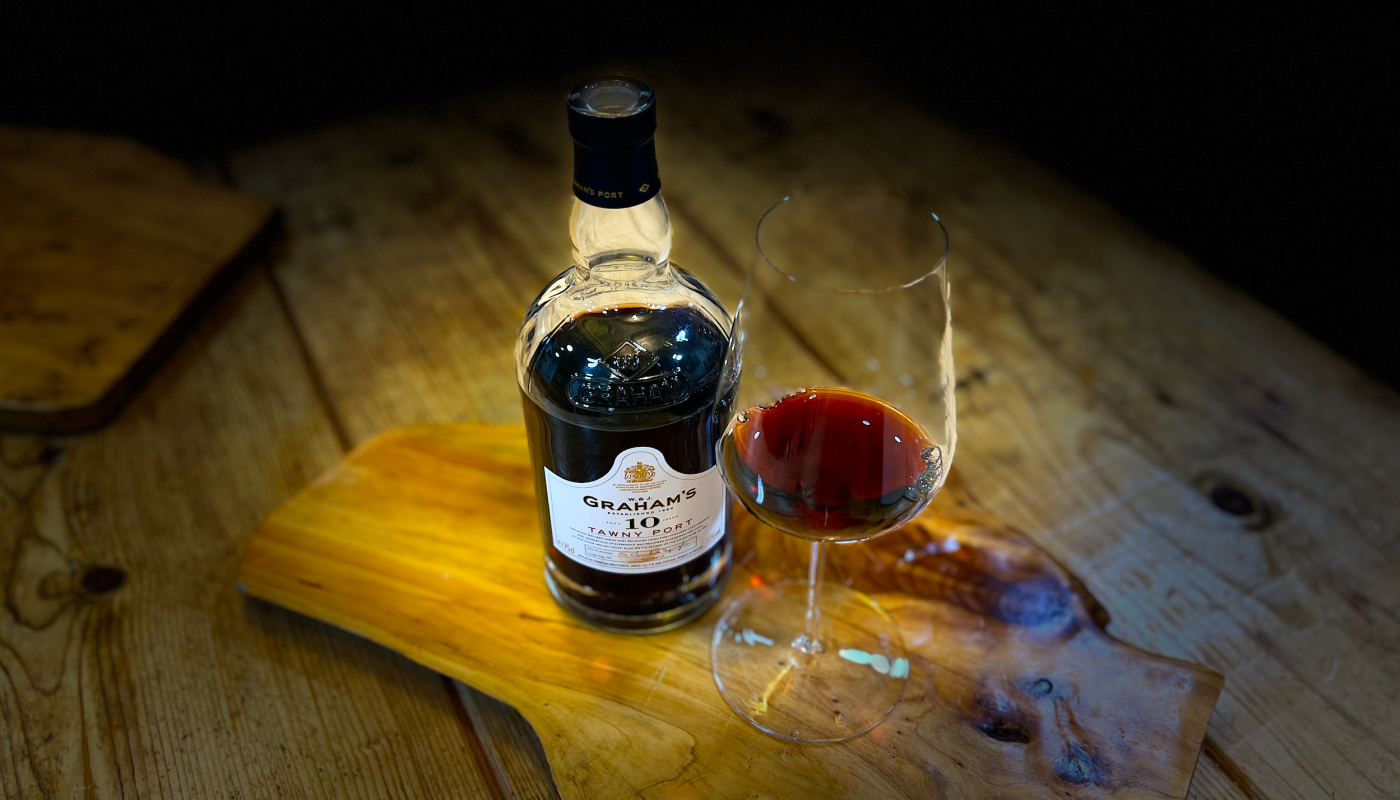
If it wasn’t for debts, I might not have this bottle of wine on my desk …
The Glaswegian Graham family had a bustling textile trade spanning India, Scotland and Portugal. For practical reasons the family decided, in 1808, to open an office in Porto. Sons John and William were sent to Portugal to run things on that side of the business while their father managed things back in Scotland. In 1820, a cash-strapped Portuguese client negotiated with the brothers to settle a debt with wine. They agreed to accept 27 pipes of port in lieu of payment, and sent the barrels home to Scotland. Father wasn’t best pleased, but in the end, the sale of the port proved to be so lucrative that the brothers decided to branch out into the port trade as well.
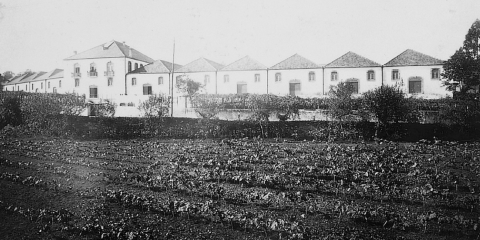
Over the years, the company thrived, and in 1890, they bought Quinta dos Malvedos as well as a lodge in Vila Nova de Gaia, which they promptly demolished to build an even bigger one (which survives today).
Alas, poor management and two world wars took their toll, and the company started to struggle. By the 1960s the quinta was badly run down and the spectre of debt loomed, this time on the Graham side of things. But in 1970, the Symingtons bought Graham’s. Thanks to their timely intervention, the Quinta dos Malvedos was saved and restored, and so was the Graham’s legacy. Today, Graham’s is still one of the iconic brands in the Symington portfolio, still making beautiful ports.
Jancis tasted this scrumptious tawny in November, a few weeks before I did, and described it as ‘delicate’, writing that you could almost drink it as an aperitif. I couldn’t agree more. The perfume on the nose dances between damson, rose-hip syrup, cranberry coulis and cassis. Its cheeks are flushed, in classic Graham’s style, with charming, forward sweetness of red-berried fruit. But the sweetness is chivvied into line by acidity that is mouth-watering, structural, precise and almost cleansing. I get exactly why Jancis compares it with Verdelho Madeira.
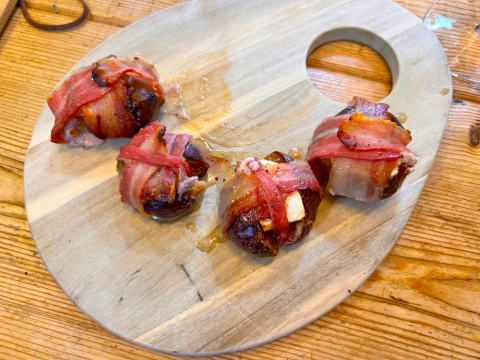
Graham’s website suggests that you pair it with sweet things such as tiramisu, fruitcake and apple pie, but I disagree. Of course it will go with sweet things, but as an aperitif it is far more interesting. We tried it with baked bacon-wrapped figs stuffed with Gorgonzola cheese, and the two together were so sinfully good that I wondered if I should have put a bit of sackcloth on the table, as token atonement. Taking the aperitif (ergo canapé) suggestion very seriously, and testing it as far as our table could manage with the festive season in mind, my husband Brad and I sacrificed our waistlines for the greater good of our readers.
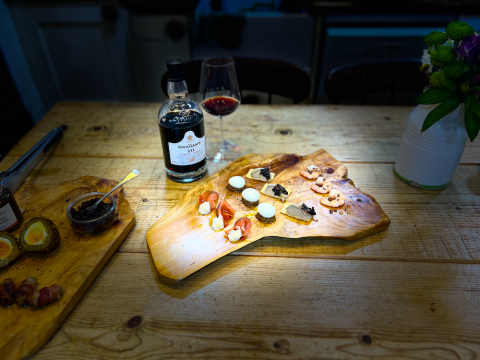
You might be as surprised as we were to discover that prawns (with a slightly sweet, tangy Sichuan dressing) were remarkably good with this particular tangy, tingly tawny. Smoked salmon rather less so. Quails’ eggs on Fortnum & Mason’s figgy wholegrain mustard were definitely more than tolerable. Chicken-liver pâté with a composta cipolle (caramelised onion compote with balsamic vinegar) was utterly, speech-defyingly divine.
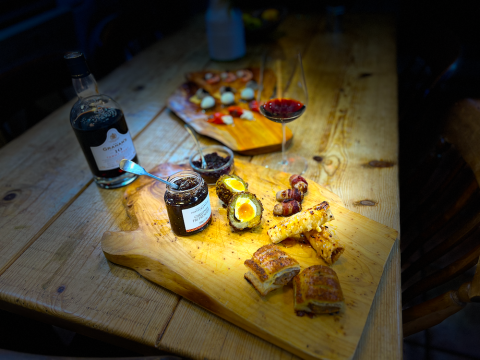
I suspect that any bacon-loving Brit would not be remotely surprised when I say that ‘pigs in blankets’ (for the uninitiated, this is a very Christmassy English tradition involving chipolata pork sausages wrapped in bacon) were bloody brilliant with tawny port, especially when teamed with cranberry jelly. Scotch egg worked just fine, the feta and honey filo cigars were excellent, too, although they were even better when sprinkled with some spicy chilli flakes.
Not pictured, but also a fantastic pairing was a side nibble of smoked, spicy mixed nuts. We found that introducing just a little sweetness to the canapé (honey, sweet chilli sauce, maple syrup, any kind of confit or jam) meant that the pairing with the tawny port went through-the-roof yum.
The port was delicious served room temperature, but personally I liked it best with a 10- to 15-minute fridge chill on it. We also played with mixing it (separately) with a splash of soda water, tonic water, and brut nature English sparkling wine, and all three made wonderful iterations on the aperitif theme, offering options across the spectrum of alcoholic strength, flavour intensity and quenching quality.
If you really want to serve this tawny with sweet things, by far the best pairing I found was Italian biscotti. Save a bottle for after Christmas. Run yourself a deep bubble bath. Light a candle. Pour a glass. And lean back into the steaming water while you dip an almond cantuccini into the ruby-russet glow of this beautiful wine. Let 2025 disappear in a pool of sweetness.
It is extraordinarily good value. I picked up my bottle in Waitrose for a mere £20 (it is currently reduced from £24), but it’s widely available in several supermarkets (as low as £18 in Tesco if you have a Clubcard) and also a number of independent wine merchants. You can also, very usefully, buy a dinky 20-cl bottle at The Whisky Exchange for £9.95, which would make a rather fun stocking filler. It’s widely available in the US as well, with prices starting as low as $19.99 (Urban Wine & Spirits, RI). It can be picked up in Austria, Belgium, Canada, the Czech Republic, Germany, Hong Kong, the Netherlands, Portugal, Singapore, Slovakia, Spain and it can even be found in the British Virgin Islands (where, presumably, you’d be drinking it on ice).
For more port and other fortified delights, see Jancis’s most recent round-up of strong stuff.