Conspiracy theories are by definition undebunkable. Indeed, undebunkability is woven into the very fabric of their being, because any argument against a conspiracy theory is simply accused of being part of the cover-up. For instance:
‘The moon landing was faked and all the evidence to the contrary is counterfeit.’
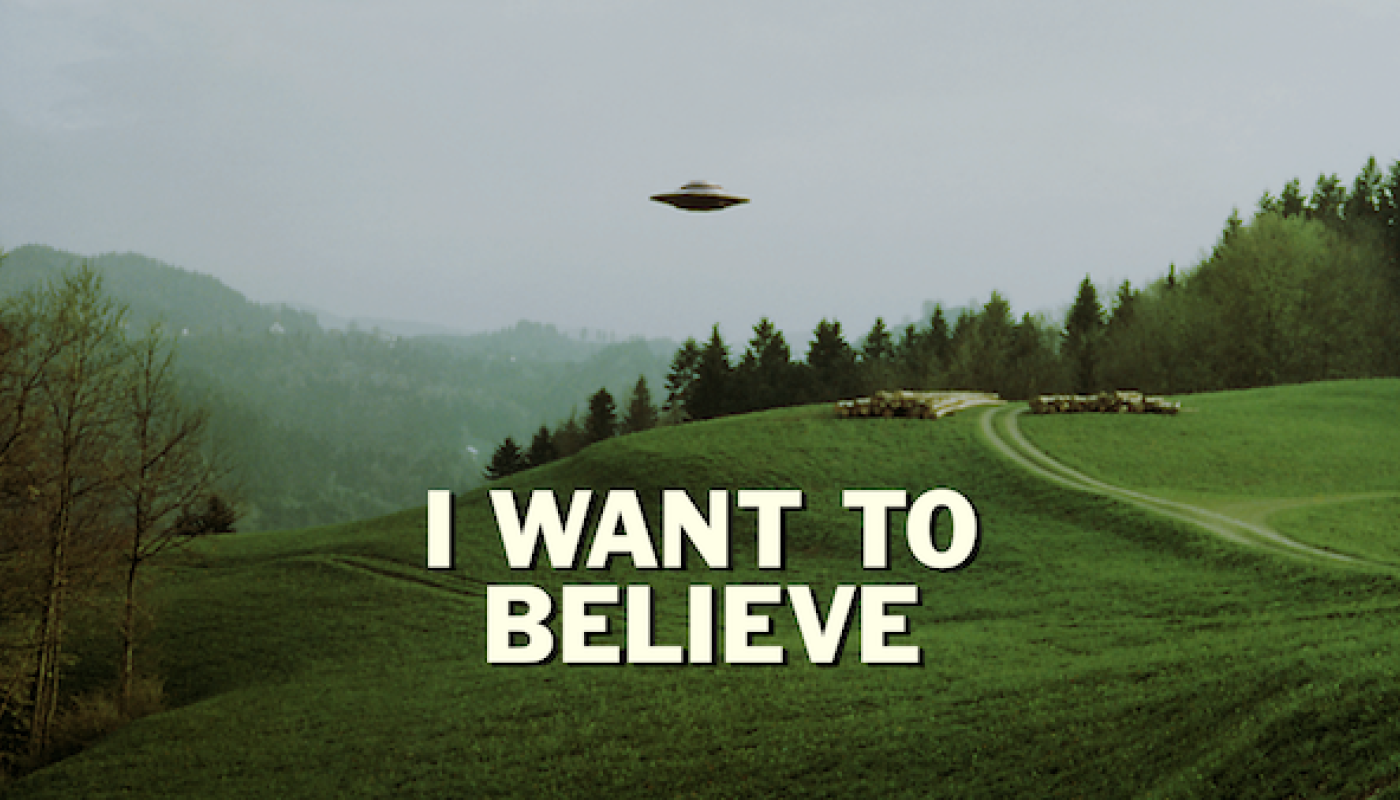
‘Aliens landed at Area 51 and the denials of the US government only confirms their existence.’
‘Undebunkability is a real word despite its absence from any dictionary.’
One of the most prominent conspiracy theorists today is Adam Curtis, whose portentous but entertaining feature-length documentary films can be found on the BBC iPlayer. (Watchable within the UK only. Suspicious! What are they trying to hide from the rest of the world?)
They all share a calm and confident narrative which creates a persuasive argument – even when propounding the most bug-eyed paranoia. Describing his latest film, HyperNormalisation, Curtis says:
‘These stories are woven together to show how today’s fake and hollow world was created. Part of it was done by those in power – politicians, financiers and technological utopians.
'But it wasn’t just those in power. This strange world was built by all of us. We all went along with it because the simplicity was reassuring. And that included the left and the radicals who thought they were attacking the system. The film shows how they too retreated into this make-believe world – which is why their opposition today has no effect, and nothing ever changes.
'But there is another world outside. Forces that politicians tried to forget and bury 40 years ago – that were then left to fester and mutate – but which are now turning on us with a vengeful fury.’
Quick! Stock up on essentials before the apocalypse strikes! And don’t forget some decent glasses and a corkscrew!
Science requires that the burden of proof lies with those presenting their theory, rather than expecting everyone else to disprove it. Pah! Science, schmience: such technicalities don’t discourage the most determinedly credulous – they want to believe, and that urge overrides rational argument.
On the vast playing field of conspiracy theories, wine presents an open goal. Here is a topic where variability is infinite, subjectivity is absolute and certainties are few. In such fecund pastures, those with the greatest determination can plant and nourish all manner of strange and wonderful theories. Allow me to introduce some of the finest specimens and try, against all odds, to debunk them.
One of the most persistent fixations is that expensive wine tastes no better than cheap wine. This is a recurrent favourite of tabloid newspapers, generating clickbait headlines such as ‘You won’t believe what these wine snobs thought of cheap supermarket plonk!’
'Proof' comes in many different guises. Experiments have been run to show that experts prefer the wine they think is more expensive, even when it isn’t; or that for untrained palates, there is no benefit to spending more on wine. In other words, expensive wine is all a big rip-off, contrived by charlatans and drunk by the gullible.
Hmm. Is that never true of Bordeaux or Napa or Champagne? Of course it is. Does that make it true for all expensive wine? Of course it doesn’t. As fine-wine prices continue to reach ever higher levels, it becomes a more visible target, but this simply reflects the world we live in. So long as there is high demand, relatively low supply and increasing wealth among the rich, wine prices will only go up. Whether their intrinsic quality remains good value at these increasing prices is ultimately subjective. An inevitable truth, albeit perhaps an uncomfortable one – but no conspiracy.
What about terroir, then? This is a European imperialist conspiracy to impose an artificial uniqueness on wine, right? Isn’t it rather convenient to claim that un-replicable factors such as soil and macroclimate are the ultimate keystones of quality?
After all, for years it was widely agreed that Chablis tasted of oyster shells, but now the consensus is that the the mineral content of rocks is not directly transferred into the grapes grown far above them after all. Is the whole concept of terroir therefore mythical?

Take Brash Higgins’ Zibbibo, for example. I tasted this in Australia last month and was seriously impressed, as Jancis and Walter have also been. The fruit comes from the Riverland, surely the most ignoble example of terroir you can find: irrigated plains where virtually any old crap – sorry, crop – can be bountiful. Or Errázuriz Single Vineyard Sauvignon Blanc, whose flinty flavour I took to be indicative of its coastal origin, but is more likely a result of reductive winemaking.
To a cynical mind, terroir is one of the most tempting conspiracies because it has facilitated so much fanciful nonsense from those who claim to have the best of it. France, j’accuse! Yet tasting the remarkable differences between two red burgundies or Mosel Rieslings, where the only variable is soil type, would seem to vindicate terroir. It may not be the mineral content of the rocks beneath literally transferring into the grapes that causes these differences, but that doesn't mean the concept of terroir is make-believe. However, for as long as it remains largely mysterious, we should be wary of ascribing every facet of quality to it. Such sloppiness is exactly what fuels conspiracy theories.
Unless of course I'm saying all this to throw you off the scent. To keep our secrets safe. But surely, as I'm a member of the Institute of Masters of Wine, the wine trade's very own Illuminati, you can trust me. Can't you?