The topic for my Master of Wine thesis originated several years earlier, starting with an anecdote shared by a winemaker: household plastic film – the type you might use to wrap a sandwich in – is capable of adsorbing TCA, the compound responsible for the musty aroma of what’s commonly referred to as a ‘corked’ wine. This knowledge quickly became my favourite party trick whenever a ‘corked’ bottle appeared at friends’ homes or in restaurants. [A trick shared by Jancis on this site in Festive questions answered – ed.]
What initially was an intriguing curiosity took on a more serious dimension when I was confronted with a recurring, low-level musty taint in one of my own wines at Château de Suronde, despite using expensive corks that had been guaranteed TCA-free. Detailed investigation revealed that the source was not the corks, but most likely the public water system, which seemed to have contaminated a wine vat itself.
This experience highlighted how quick we are to blame corks for musty taints as there is so little awareness of the multiple possible sources of this taint. In fact, TCA is just one of several compounds called haloanisoles that can taint a wine. Being an engineer as well as a winemaker, I wanted to understand why and how haloanisole contamination develops and ultimately affects wine – not just so that corks don’t take all the blame, but also so that we can better address haloanisole issues in the industry.
The first step might be replacing the term ‘cork taint’ with ‘halo taint’, helping to broaden the concept beyond corks when addressing these problems.
What are haloanisoles?
Haloanisoles (HAs) are a family of compounds that are considered faults in wine, of which the most widely known is 2,4,6-trichloroanisole (TCA), though there are four haloanisoles that are relevant to wine: TCA, TBA (2,4,6-tribromoanisole), TeCA (2,3,4,6-tetrachloroanisole) and PCA (pentachloroanisole). Haloanisoles are problematic in wine as they develop a dominant musty, mouldy odour at very low levels – in the range of nanograms per litre (ng/l). Human detection thresholds vary widely, depending on tasting experience and personal sensitivity, ranging from 3 to 10 ng/l for TCA and 2–7.9 ng/l for TBA. (1 ng/l is a million times smaller than 1 mg/l in which most wine compounds or faults are typically measured.)
In addition to their characteristic musty odour, TCA and TBA have been found to act as olfactory suppressors, masking, for instance, fruity or floral notes, even if the specific taint is below its human detection threshold. Therefore, even if the taint is not explicitly perceived, it can still negatively affect the wine.
How do haloanisoles occur in wine?
While natural-cork closures are a known potential source of TCA, there are several other potential sources of contamination. Each haloanisole has a halophenol as a precursor, which can be methylated by fungi into a haloanisole and then be aerosolised, spreading throughout the air in the winery. Contamination can occur via air, walls and ceilings. For instance, tribromophenol (TBP), the precursor for TBA, can be present in wineries as a fire retardant in building materials. Contamination can also spread via equipment and materials such as plastic tanks or pipes or wooden barrels or pallets.
|
Overview of haloanisoles and halophenols in wine and their sources |
||
|
Name |
Abbreviation |
Source |
|
2,4,6-Tricholoanisole |
TCA |
Corks cleaned with bleach Chlorinated water Chlorine-based cleaners TCP methylated by fungi |
|
2,4,6-Trichlorophenol |
TCP |
Biocides containing TCP used to treat cork trees |
|
2,4,6-Tribromoanisole |
TBA |
TBP methylated by fungi |
|
2,4,6-Tribromophenol |
TBP |
Fireproofing agents on wood Spray foam insulation Methyl-bromide fumigant (eg in shipping containers) |
|
2,3,4,6-Tetrachloroansole |
TeCA |
TeCP-containing biocides methylated by fungi |
|
2,3,4,6-Tetrachlorophenol |
TeCP |
A major component of PCP biocides |
|
Pentachloroanisole |
PCA |
PCP biocides methylated by fungi |
|
Pentachlorophenol |
PCP |
Biocides containing TCP used to treat cork trees |
|
Source: Keng A, Botezatu A (2023) Uncorking haloanisoles in wine. Molecules, 28(2532). |
||
Haloanisole taints originating from the winery can affect an entire batch of wine. But discovering them can be tricky: there is no legal obligation to measure haloanisole or halophenol levels, and winery staff can become accustomed to the smell through nasal fatigue or adaptation. Taint in the winery can also remain below the detection threshold until combined with another source, such as a cork.
How prevalent are haloanisole problems?
There is very limited data available on haloanisole issues in wineries, but there have been several studies that provide some insight.
A study carried out by the CIVB (the Bordeaux wine bureau) analysed bordeaux wines sampled from domestic and export markets between 2008 and 2011. Of 9,143 bottles, they found that 1.93% had a confirmed haloanisole taint. The analysis showed that for 23% of tainted wines the problem was entirely or partially caused by environmental (non-cork) contamination. The study also found that 1% of wines sealed with technical cork closures (which are designed to be TCA-free) had a TCA taint.
Another study looked at high-quality Spanish red wines and found that 16.1% of 966 wines were tainted with haloanisoles and/or halophenols. A wide variety of compounds were detected, including the anisoles TeCA, TCA, PCA, TBA and the phenols TCP and TeCP (which could turn into haloanisoles in the right conditions), indicating a wide variety of problems in many different wineries.
Analysis carried out in Australia by AWRI Commercial Services between 1999 and 2009 found numerous cases of both TCA and TBA in Australian wines. In addition, data from the International Wine Challenge show that wines rejected for ‘cork taint’ are most frequent among cork-closed wines but are also present in wines with other closures, suggesting contamination sources beyond corks.
As awareness of the effect of haloanisoles is only recently becoming more widespread, musty taints attributed to TCA in earlier reports may in fact have been caused by TBA or TeCA, which would not have been detected by TCA analysis.
Avoiding haloanisole problems
It is always better to prevent than cure, and especially in this case as there is no easy solution to reduce let alone eliminate the taints. So, when a taint appears, the winery should analyse the source of the problem, taking samples of the air, water, equipment and bulk wines to analyse for haloanisole contamination.
In some cases, contamination can be linked to a one-off problem, such as cleaning products or contaminated water, which can be resolved by eliminating these products or installing a water filter. In other cases, contamination is the consequence of a structural problem in the winery, such as building materials or equipment.
Once a winery is certain there are no existing problems, best avoid future problems with good ventilation, limited humidity and a water filter. In addition, it’s important to store packaging materials, corks, cardboard and wood away from the wine-production area and to avoid using chlorine-based products (eg for cleaning). Finally, it’s a good idea to screen any wood material that comes into the winery, from building materials to barrels.
Any wineries dealing in bulk wine should test the wine before shipping or bottling it to ascertain that no winery problem exists and that any subsequent taints originate from other sources.
Unfortunately these wine and winery tests are very expensive, but they can help prevent a lot of issues afterwards.
Reducing haloanisole taint in wine
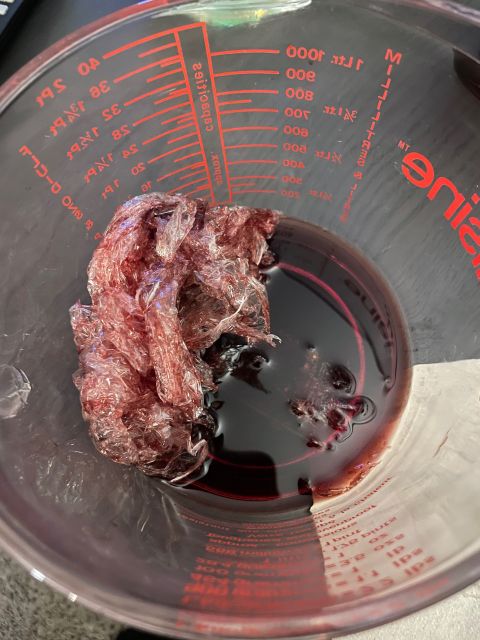
Reducing haloanisole taint is an emergency solution, but once a wine is contaminated, it is possible to reduce the taint, although each technique I tested has its drawbacks. For my research paper, I compared three commercially available techniques that have been shown to be effective in reducing haloanisole taint without causing other major changes to the wine: a zeolite filter, food-grade plastic wrap (pictured below, after draining the wine) and yeast hulls.
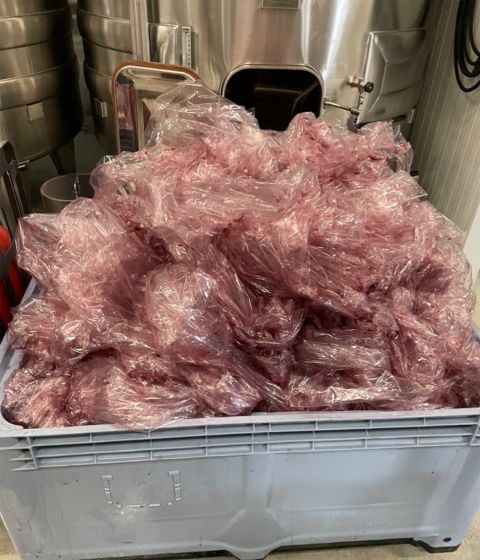
In the end, I found that the particular zeolite filter I used was the most effective in reducing taint associated with the three haloanisoles I looked at (TCA, TBA and TeCA) and the easiest to use, but it is expensive, requires very tight filtration of the wine and can reduce colour intensity.
However, food-grade plastic wrap turned out to be even more expensive and less practical for winery use. Yeast hulls are very easy to use and inexpensive, but they take the longest time to apply and are the least effective. At the same time, neither of these two techniques needs tight filtering or affects wine colour.
For a winemaker, deciding which path to take depends on the level and type of taint and the value of the wine. It’s best to test the chosen technique on a small sample of wine, analyse haloanisole levels before and after treatment, assess the impact on the wine and consider the financial and logistical implications. Only then is it possible to compare the value of the wine after treatment with the cost of discarding the wine, diluting the wine, or selling it as is (if the taint is low).
Conclusion
For wineries, I hope that this broader understanding will contribute to more open conversations, better diagnosis, more effective prevention and more informed decision-making when haloanisole taints occur.
For wine drinkers everywhere, I hope this also makes clear that you can indeed find a tainted wine under screwcap or technical cork. If you encounter a tainted wine, it is always good practice to report it back to the winery. If it is a recurring problem, there might be a winery issue to be addressed.
And I would encourage everyone to try my party trick with household food-grade plastic film. It doesn’t work with all brands of film, and it is not as effective as the film I have used in my research, and it will take away from the original aromas as well, but it is a lot of fun to compare the wine before and after.
A bit of magic and some regained wine pleasure after all.
Kathleen Van den Berghe MW worked in construction and real estate as a civil engineer before taking over Château de Minière in Bourgueil in 2010 and Château de Suronde in Quarts de Chaume in 2016. She gained her MW in 2025. You can download her entire research paper, ‘A comparative analysis of different techniques to reduce haloanisoles in contaminated wine’, from The Institute of Masters of Wine website.
Images not otherwise credited are the author’s own.