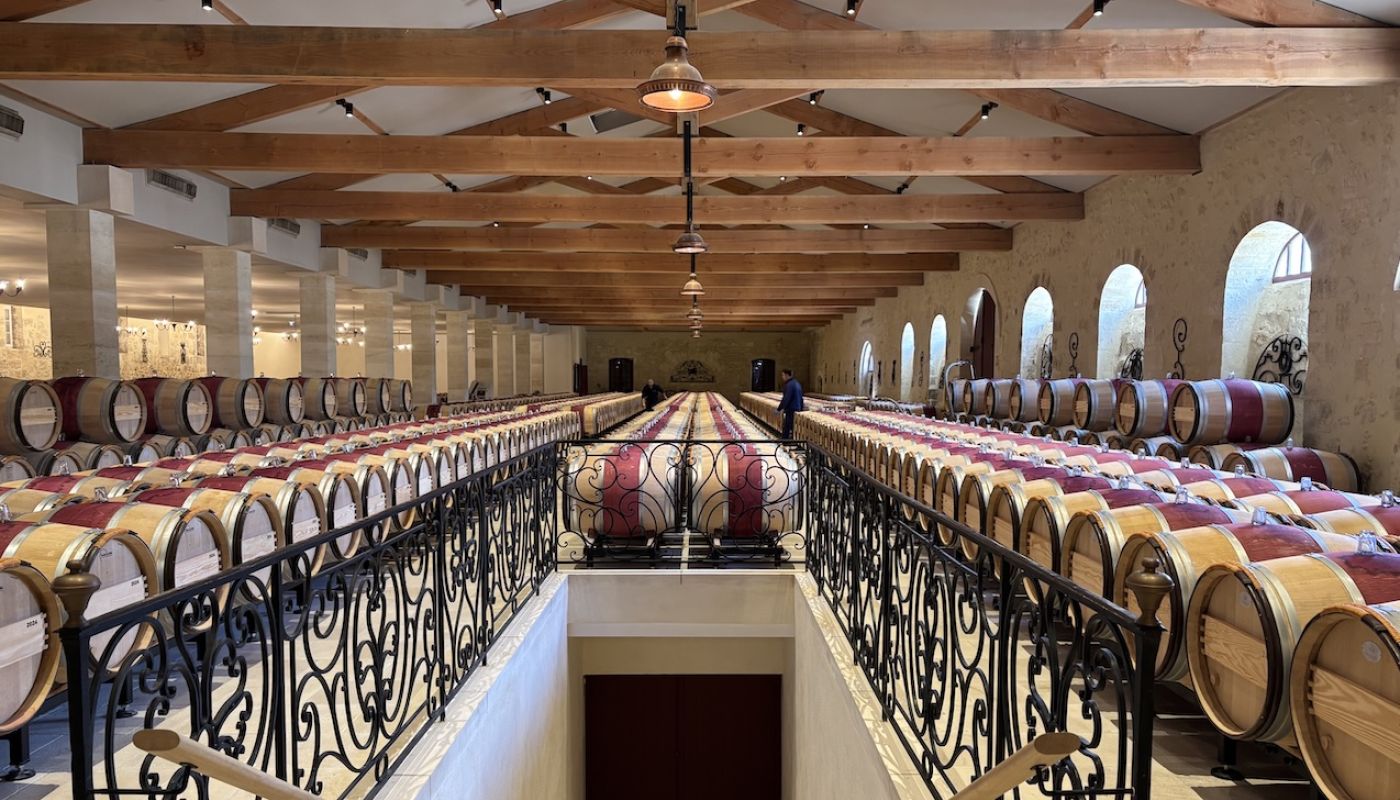
Scott Becker of the ambitious Realm Cellars in Napa Valley is no fool – although he claims he got into Harvard only because his interviewer was tickled by the fact that Becker was applying on a satellite phone as a US Air Force captain in Afghanistan. I caught up with him and his wife Meaghan as they passed through London on their first in-depth visit to Bordeaux for three years.
I asked him to let me know how they got on and was intrigued by this passage from a long email written on the plane home: ‘From a pure winegrowing perspective (ignoring commercial realities for a moment), I find Bordeaux so interesting and compelling these days. Generally speaking, I met producers who are incredibly thoughtful and intentional about their craft, who try to take a long view, who are endlessly curious about the science and what it takes to make better wines. There’s a sense of stewardship, a desire to better understand the unique character of each vineyard, each block. Napa Valley certainly has elements of this, too, but not with the same breadth that I find in Bordeaux. The number of experiments, the level of investment … in top bordeaux these days is incredible. I can only think of two or three Napa wineries which employ someone dedicated entirely to R&D, for example, and I must’ve met six or seven of them in one week in Bordeaux.’
I’d always assumed that more of the wealth evident in Napa Valley – Bordeaux’s most obvious counterpart with its emphasis on Cabernet Sauvignon – was dedicated to research than it clearly is. So I thought I’d talk to one of the leading wine researchers at Bordeaux University, famous for its close contacts with local producers – admittedly a specialist in winemaking rather than the viticultural matters that are clearly becoming increasingly important.
Axel Marchal, 42, was made an associate professor of oenology at the age of 33 and a full professor three years later. He’s from north-east France, so his first encounters with wine were not with bordeaux. ‘Personally I really love burgundy’, he confessed, adding, ‘I’ve spent too much money buying it’. Nevertheless, he plans, unlike many wine enthusiasts, to buy some of the 2025 bordeaux currently being offered en primeur, ‘because the wines are very nice and there are some good buys’ – although he admits that the overall perception of Bordeaux’s famous system of selling futures is ‘not very good’ currently.
He started out studying chemistry in Paris but was sufficiently fascinated by wine to join the university tasting team and compete against Oxbridge’s and other blind-tasting teams. Curious, he decided to devote a year to studying vinification but six months at Bordeaux first growth Château Latour was enough to persuade him to change his PhD topic to wine, specifically perceptions of sweetness in dry wines, under the legendary wine academic and wine producer Denis Dubourdieu. Marchal found that, among other things, certain compounds released by oak and the enriching effect of yeast lees (autolysis) can make wines with no residual sugar taste sweet. He still works closely with another of Dubourdieu’s acolytes associated with Bordeaux University’s prestigious ISVV (Institut des Sciences de la Vigne et du Vin), Valérie Lavigne, oenology editor of the 5th edition of The Oxford Companion to Wine. Like Marchal, she has a number of consultancies and not just in France.
I asked Marchal which of his research projects, generally nowadays conducted with PhD students and usually focused on taste, he was most proud of. One very early one conducted just after his own PhD turned out to be financially valuable to the university. His research showed that sessile oak can be more suitable for wine than pedunculate oak thanks to an enriching compound shortened to QTT, even though the two species are mixed in the forests and a barrel will typically include staves of both. The university owns the patent on the method developed to identify each species and has been able to sell it to French coopers Seguin Moreau. Their QTT barrels made exclusively from sessile oak can now be found, for instance, chez first growth Château Haut-Brion.
Five years later, in 2016, came the discovery that grape stems can be particularly rich in the sweet compound astilbin, with effects on the currently fashionable technique (de rigueur before the development of destemmers) called whole-bunch, or whole-cluster, fermentation, whereby only a portion, or possibly none, of the grapes are destemmed before fermentation. Marchal analysed stems from different plots of the Burgundy grand cru Clos de Tart, which has had a direct effect on winemaking there.
But it is perhaps his 2022 project which has so far had the greatest effect, certainly in Bordeaux, of making red wine more approachable in youth. It was traditional to keep pumping the embryonic wine, or must, over the cap of grape skins that float to the top of the fermentation vat – quite a brutal process designed to extract colour and chewy tannins. But Marchal and associates have shown that more important is keeping the must at a temperature of 28–30 °C (82–86 °F). This encourages the release of certain useful compounds that soften the tannins, so they are still there, doing their job of preserving the wine over many years, even decades, but they’re much less aggressive on the palate.
All these discoveries are communicated to producers, or at least Bordeaux’s most proactive winemakers, first by research papers published (usually in English apparently), and then the results are presented orally at congresses such as that organised regularly by Bordeaux’s generic body, the CIVB. And the local Association des Oenologues de Bordeaux has a one-day conference that may be attended by up to 500 oenologists.
As those of us who have followed the evolution of red bordeaux over many years have noticed, the prevailing style has changed considerably. Marchal admits that when he arrived earlier this century he was not that happy when, as a consultant, he was involved in the production of some pretty ripe fruit bombs. ‘But now the wines are very different, with more freshness and less extraction. Twenty years ago, I was totally out of fashion but I’m much more comfortable now.’
He’s currently investigating umami, the savoury taste especially celebrated in Japan, in conjunction with some Champagne producers who are interested in the effect of long-term ageing on lees and the perception of umami. By no means all the work at ISVV is focused on Bordeaux; the staff cooperate with the wine research institutions of Adelaide in Australia and Geisenheim in Germany. Marchal is working on Chardonnay flavour, while a colleague is doing the same for Riesling – neither a white-wine grape associated with Bordeaux.
As we were discussing white wines, I wondered why, with all this scientific expertise, it took so long for any useful work to emerge on the notorious ‘premox’ scourge of white burgundy made from the mid 1990s and for many years afterwards. ‘The first step is to admit a problem’, said Marchal carefully, ‘but lots of producers were reluctant to. What’s very different with this topic is that it’s so multi-layered. The relevant compounds are known but it’s a very complex problem with many different parameters.’
I asked how Bordeaux’s vines have been coping with the recent extreme heat. Marchal reports they are still looking green and healthy, perhaps thanks to the very wet April and May. He’s unconvinced that irrigation, currently much discussed in Bordeaux, is the answer in drought years. Would people be happy about precious water supplies being used to produce wines at €100 a bottle? Meanwhile, he regrets how the Bordeaux vinescape has been changing – as one would expect of a wine region that has shrunk from 115,000 to 85,000 ha (284,000 to 210,000 acres) of vineyards in just a few years to address changing demand.
Just as the wines are getting better and better, they are being bought less and less.
Bordeaux overachievers
These are the most recently tasted, currently available reds – other than the obvious first growths and equivalents – that I scored at least 18 out of 20 and reckon are drinking well now.
Ch Langoa Barton 2015 St-Julien 13%
£65 Hedonism, The Wine Rooms Cambridge
Ch Pontet-Canet 2005 Pauillac 13%
£117.59 Atlas Fine Wines, £134.99 The Surrey Wine Cellar
Ch Grand Puy Lacoste 2005 Pauillac 13%
£120 Wine Trove, £125 Uncorked
Ch Ducru Beaucaillou 1970 St-Julien 13%
£132 Barber Wines, £200 in bond Wilkinson Vintners
Ch Smith Haut Lafitte 2016 Pessac-Léognan 14%
£141.75 York Wines, £155 The Suffolk Cellar
Ch Canon 2005 St-Émilion 14%
£185 Nemo Wine Cellars
Ch Léoville Las Cases 2001 St-Julien 13%
£213 Berry Bros & Rudd, £225 Roberson Wine
Ch Montrose 2016 St-Estèphe 13.5%
£199 The Perfect Bottle, £215 Mumbles Fine Wines, £240 Highbury Vintners
Ch Hosanna 2010 Pomerol 13.5%
£210 Vintage Drinks, £235 Nemo Wine Cellars
Ch Cos d’Estournel 2005 St-Estèphe 13.5%
£222 Huntsworth Wine Company, £234 Ancient & Modern Wines, £250 Hedonism
Ch Figeac 2005 St-Émilion 13.5%
£240 Wine Trove, £310 Hedonism
Ch Palmer 2005 Margaux 14%
£248 Bordeaux Index
Ch Angélus 2016 St-Émilion 14.5%
£369.91 Vinatis UK
Ch Lynch Bages 1989 Pauillac 13%
£409 CRS Fine Wines, £416.67 in bond Wilkinson Vintners
Ch Palmer 1989 Margaux 13%
£480 Bordeaux Vintners, £535 Hedonism
Tasting notes, exact scores and suggested drinking dates can be found in our tasting notes database. For international stockists, see Wine-Searcher.com.
Back to basics
Where to find value in Bordeaux |
| As I’ve been saying and writing for several years, the best-value wine in the world is a well-made petit-château red bordeaux. A petit château is one that was not included in the famous 1855 classification of the 61 châteaux whose red wines were sold at the highest prices by wine brokers then, but is a recognisable estate where wine is made from the vines grown there – typically in the Médoc. There are so many of them, and their produce is, unfortunately, so surplus to demand now that red-wine consumption has been plummeting in France, and weakening elsewhere, that life is extremely difficult for these producers. They employ many of the same winemaking methods as much more famous names, including time-consuming ageing in expensive barrels, and yet their wines fetch only a fraction of the price. A useful way of identifying the best of these petits châteaux is if they are labelled as a Cru Bourgeois, but there are many others, too. UK retailers which take more trouble than most to nose out the best inexpensive red bordeaux, some under £10 a bottle, include Haynes Hanson & Clark, Tanners and The Wine Society. |