At a rare event in Manhattan, a dinner party in a friend’s apartment, I sat across the table from Alan Stillman, a man who has managed to retain an excellent sense of humour despite 40 years in the restaurant business. Over the osso buco we agreed to meet later that week in his company’s newest restaurant, Quality Meats, on W 58th Street to discuss how he had managed to keep smiling for that long.
Stillman, 69, is chairman of the Nasdaq-quoted Smith & Wollensky Group (although his business card describes him as chief cook and bottle washer) which operates 16 predominantly steakhouse restaurants in nine different cities across the US with annual sales of $160 million. His annual beef bill alone is over $20 million.
Part of Stillman’s success has been based on choosing novel, unusual but ultimately memorable names for his restaurants. The names Smith and Wollensky were chosen at random from the telephone book; another steakhouse, Maloney & Porcelli, is named after his company’s liquor lawyers; while Stillman’s greatest naming coup is now on about 950 sites around the world. Thirty years ago he created the first ‘TGI’s’ the chain known by its longer name as ‘Thank God it’s Friday’ .
“I thought of TGI’s as a way of meeting the young, attractive women who lived on the block,” he explained with a fulsome smile. “There was a dismal bar with a bullet hole in one wall which I took over without any experience for $10,000. The thing about names of restaurants is that they can be awkward and even weird but they have to be lots of fun as, above all, they must be memorable.”
Stillman sold TGI’s when there were nine outlets, a decision which has subsequently left him with no regrets, and looked around for another opportunity in a business he had come to enjoy. “Looking back I realise that what I did then was 99% good luck. But as you develop as a restaurateur what you learn allows you to reduce that element of luck to about 50% in every new opening. I honestly think it never falls below that. It’s a risky business with a lot of failures every year.”
The opportunity Stillman spotted was in the steakhouses that had become a mainstay of New York over decades. “There were a few good steakhouses back then but they were principally only serving two kinds of wine, red or white. I realised that there was a gap in the market to sell the best steak possible along with really good wine and happily my hunch proved right. And then when I went to France a few years later I saw that the top restaurants there were selling only French wines so I decided to follow their example and we have only sold American wines in Smith & Wollensky restaurants ever since. There have been three significant changes in this business since I started. Our customers’ palates have become increasingly sophisticated as people eat out more frequently and the sheer number of restaurants today for customers to choose from is far greater than ever before. But the key to success remains the same. You have to upgrade the competition, to do what you do better than anyone else.”
Stillman expounded on this by referring to taste. “A restaurateur’s taste is obviously ultimately crucial to the success of his restaurant but only if you can separate your taste so that it does not swamp any aspect of the business. You have to put your good taste to work so that ultimately the customer leaves happy, having enjoyed the same pleasurable experience as they would have done in the theatre or cinema.” But where new restaurants crucially differ from new theatre, plays or even books, in Stillman’s experience, is that they take much longer to get established. “Not all new restaurants get reviewed and often it will take two to three years to get your name into all the guide books which obviously means it takes time to spread the word,” he continued.
But how easy, I asked, was it to take the Smith & Wollensky brand out of New York? “Initially, it was difficult because I could get round my seven restaurants in Manhattan in a couple of hours. Now it took much longer and I had to learn to trust our general managers and chefs in these cities much more. And also these cities are very different. Success, in my experience, has little to do with the inherent disposable income available but rather that some cities are more cosmopolitan than others. Houston does much better than Dallas, for example, and in Miami Beach, Las Vegas, Chicago and Boston where we have the bigger 400 seater restaurants we do very well. But it is definitely far more difficult to spread your brand in Philadelphia than in Chicago, for example.”
But no restaurateur, however experienced, can buck a trend and this is why Stillman was so keen to meet me at Quality Meats. “This used to be the Manhattan Ocean Club which we have run for 20 years and every year it used to turn in sales of over $10 million a year. Then 9/11 came along and sales fell by 25% and didn’t improve no matter how much we fiddled with the format. I had to do something more drastic,” Stillman explained.
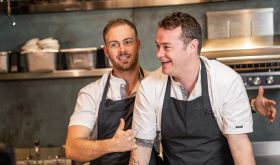
Responsibility for the redesign was handed to Stillman’s 26 year old son, Michael, who had come to realise that restaurants could be an outlet for the History of Art major he had taken at Brown University. And with what appears to be the same innocence as his father began TGI’s Stillman Jr decided to look to downtown Manhattan for inspiration. Out went the more genteel décor normally associated with Upper West Side restaurants and in came white tiles, exposed brickwork and beams and an altogether more industrial look. There is a charcuterie bar close to the entrance and one private dining room, a key to any restaurant’s popularity in Stillman’s opinion, is hung with butchers cleavers, firmly fixed to the wall I was relieved to see.
Aside from the norm, Quality Meats’ menu also includes a first course of roast bone marrow which prompted me to ask Stillman two questions about New York steakhouses: when will they begin to serve offal and why has one never opened in London? His response to the offal question was quite negative, that currently New Yorkers’ tastes are still too conservative but to the second far more optimistic. “I would love to come to London and we nearly did a deal with The Savoy several years ago but now even though we couldn’t sell US beef I would love to have a go.” .
In the interim Stillman faces a new challenge closer to home: there are now two Stillmans in the business. And while his father got up from the table to straighten a picture on the wall he thought looked crooked I took the opportunity to ask Michael how they were getting on. “Well,” he replied, “all we do is argue, so it can’t be all bad.”
Quality Meats, 57 W 58th Street, 212-371 7777, http://qualitymeatsnyc.com
Smith & Wollensky, 797 Third Avenue, 212-753-1530, www.smithand wollensky.com
Other notable New York steakhouses:
Peter Luger Steak House, 178 Broadway, Brooklyn, 718-387-7400
Willie’s Steak House, 1832 Westchester Avenue, Bronx, 718-822 9697.
Wolfgang’ s Steakhouse, 4 Park Avenue, 212-889 3369