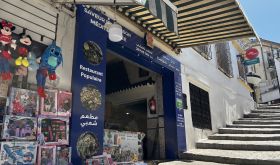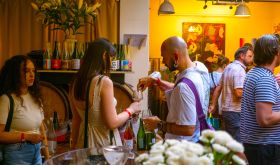
The scene outside the atmospheric Antica Bottega del Vino in Verona, Italy at midnight a fortnight ago was friendly and peaceful. There were over 30 people on the narrow cobbled street outside, all of whom had thin-stemmed Riedel glasses of wine in their hands. Most had been drinking all day at the Vinitaly wine fair but, despite all the alcohol, there was not a trace of ill-humour, bad behaviour or aggression, even when a car driver dared to inch his vehicle through the crowd. All just either laughed or dutifully moved out of the way of the intruder.
My appreciation of all this was, however, promptly spoilt by the comment of a 22 year old recent Oxford graduate. Looking round the peaceful scene, in obvious contrast to what he had witnessed during his three years at a British university, he commented, “I wonder whether I will live long enough to see such a friendly atmosphere outside a pub or wine bar at midnight in the UK.”
The potentially disruptive power of alcohol – branded in a recent report as even more damaging than several drugs currently listed as Class A – has to be a cause of shame to anyone living in Britain. For someone such as myself, who has profited from the sale of alcohol, whose wine-writer wife [that’s me – JR] continues to do so and who has children this concern is obviously heightened.
And yet as I strolled back to my hotel from this enoteca, past numerous similar establishments in Verona’s city centre, it struck me that there is a fundamental reason why these customers’ wine, probably twice as strong as British beer, was being absorbed and enjoyed seemingly so peacefully. This has nothing to do with any of the measures currently employed so heavy-handedly by the UK government either via taxes, health warnings or licensing laws, and everything to do with something that all those in the drinks industry could easily underwrite to ameliorate this damaging situation. That something is food.
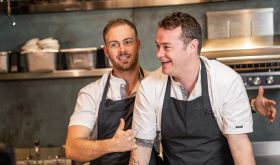
Few of the stands at Vinitaly failed to offer small baskets of food for any visitor to help themselves to, whether salami, breadsticks or on the Emilia-Romagna stands, small chunks of delicious Parmesan. As a result no-one tasted without eating. Behind the counter of Antica Bottega del Vino was a blackboard offering an array of small plates of food and a couple of chefs working desperately hard to keep up with the demand from those waiting for a table.
Italians have long been past masters of ‘l’aperitivo’ but just quite how far-advanced their management of young drinkers currently is struck me only as we walked into ViaRoma 33, an ultra-modern café and bar directly opposite Verona’s medieval Castelvecchio.
It was 7.30pm and the bar was typical of any in a busy, prosperous European city on a Friday evening. The tables were packed with customers, of whom many were women, in their early 20s celebrating the end of another working week. Everyone was drinking, either wine or cocktails that were being poured freely (i.e without a measure) by the Scottish barman who, after we had ordered our drinks, invited us to help ourselves to any of the food that was on the bar or on the buffet in the corner.
On the counter were plates of nuts, olives and a variety of vegetable crudités. For those who had gone straight to a table, a couple of waitresses circulated with plates of food that one chef was compiling while others went directly to the buffet with its trays of salami and cheese; two chafing dishes keeping hot a pasta dish and slices of pizza and tiered fruit dish with tangerines, sliced melon and pineapple. All were there for the customers to enjoy free of charge, a not entirely altruistic inducement to stay which appeared to be highly successful since by 10.30pm when we walked past the bar again it was completely full. Again, as at Antica Bottega del Vino, there was no sign of unruly behaviour. And all this while they were drinking good wine at two to three euros a glass, a fifth of the current price in the UK.
I am sure that this comparison is not as black and white as it would appear. But what this Italian experience does address is not just the medical fact that alcohol is absorbed into the blood stream more slowly and less dramatically whenever it is accompanied by food – a feature which distinguishes not just Italian but also a wider European approach to alcohol than that acknowledged in the Anglo-Saxon world – but a practical one, too. Since we only have one mouth, we cannot physically drink and eat at the same time and therefore as a consequence the presence of food effectively limits the speed with which anyone can drink.
I learnt this as a restaurateur whenever organising a reception or party. Unless a strict limit was fixed on the amount of bottles to be served there was invariably an embarrassing discussion with the organiser after the event because, not surprisingly as it was free, more alcohol had been consumed than anticipated. The solution I stumbled upon, sometimes but not always accepted by the client, was always to increase the amount of food that was being offered. While their guests were eating, I tried to convince them, they could not be drinking and the overall bill would be no higher.
The move away from even a single drink with lunch is only exacerbating the situation because with often only a little food inside them many are falling into pubs and wine bars shortly after work, further enticed by a Happy Hour offer, to enjoy a glass of wine or beer as quickly as possible. The eight-deep queue at the All Bar One in Canary Wharf I witnessed at early one weekday evening recently, where there was no food on offer on the bars, was clear proof of this phenomenon.
Today drinks companies are surely making sufficient profits out of our young drinkers to look for new and imaginative solutions to a problem that affects everyone in the British hospitality industry. Travel from the UK across Europe over the past 30 years has been one of the most significant factors in the greater appreciation of good food and cooking. Now it is time for all those who benefit from the sale of alcohol in the UK to realise that the widespread availability of free and simple, or copious but inexpensive bar food could do more to solve the socially disruptive and costly problems increasingly obvious around Britain today. A united approach would probably achieve this in less time than it has taken to convince many young Europeans that it is now possible to eat so well here.
EATING AND DRINKING IN VERONA
Antica Bottega del Vino, Via Scudo di Francia 3,
045.8004535 www.bottega.it
(Also at 7 East 59 Street, New York, 212.223 2724
ViaRoma 33, Via Roma 33, 045.591917
Trattoria Al Pompiere, V.lo Regina d’Ungheria 5
045.8030537
Locanda Castelvecchio, Corso Castelvecchio,
045.8030097, www.ristorantecastelvecchio.com