There was a time when Clerkenwell, the district of London just to the north west of the City, the financial district, was predominantly Italian.
From the 1880s, a time that saw massive immigration from Italy, until the outbreak of the Second World War when many of the men were deported or interned, this quarter reverberated with Italian voices, Italian coffee bars, Italian wine and Italian music. Until recently, however, the only vestiges of Italian influence have been the church of St Peter’s on Clerkenwell Road and Gazzano & Son, the Italian delicatessen on Farringdon Road.
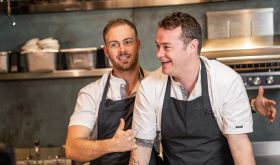
But over the past three months there has been a major renaissance of Italian food in this area, led perhaps less than surprisingly by two young British chefs.
First, came Luca, on the site of the former Portuguese restaurant Portal, opened by Isaac McHale, the Glasgow born chef who has made such a success of The Clove Club in Shoreditch. Then in mid January, Stevie Parle, who learnt at the elbow of Ruth Rogers at The River Cafe and went on to open The Dock Kitchen and Rotorino, has opened Palatino on the ground floor of a plush office timeshare.
The two chefs appear not to have collaborated although their menus share several characteristics. Like many menus today, they are printed on a single sheet of A4 paper with their offerings broken down into the relevant headings. Luca’s is printed on white paper and is made up of snacks, of which the Parmesan fries are unmissable, then antipasti, pasta, main courses and dessert. Palatino’s menu, printed on grey paper, has the same headings but in Italian.
In a successful attempt to break up what is a large space, with two private rooms on the left (in one of which a chef was hastily rolling out more ravioli after this dish, filled with pumpkin and chestnuts, had proved particularly popular), McHale has copied the layout that has proved so popular at The Clove Club. As you walk in there is an open kitchen that supplies the obviously already busy bar with dishes that range from hams cured in Wales and Shoreditch to salads of romaine lettuce, pancetta, and croutons and a warm bun filled with ox pastrami, horseradish and a walnut sauce. Walk past these hard-working chefs and you are in the restaurant proper.
And as you do so, you confront the first of two surprises. This is a luxurious fit out, down to the light fittings, the quality of the leather on the banquettes and the chairs that, in imitation of Harry’s Bar in Venice, are slightly lower than normal. As Jennifer Brown, the lively manageress, explained, ‘Isaac crowd-funded The Clove Club so everything was achieved on a very tight budget. Here, he has had more financial freedom.'
The second surprise comes with the dishes on the menu, or perhaps I should say the lack of surprise. There is no tasting menu. There are no wine pairings, despite the quality of the all-Italian wine list and the knowledgeable, very smartly dressed, sommeliers. Here, you are left alone to enjoy what they aspire to – British seasonal ingredients through an Italian lens.
Four revealed themselves immediately. There was a couple of roast Orkney scallops with Jerusalem artichokes and ‘nduja, the spicy Calabrese pork spread; spaghettini with Morecambe Bay shrimps, a particularly good combination; crisp Wiltshire trout with a walnut sauce and horseradish; and Cornish sea bass alla puttanesca, that Italian sauce in which tomatoes, garlic, onions and anchovies seem to marry so well with capers.
But this emphasis seems to have come at a price. Everything was too precise, and much more conventional than the Clove Club’s inventive menu. The spaghettini were too well arranged on the plate; the fish cut into too regular portions; the hazelnut ice cream was made too rich, with too much cream, so that the salted caramel sauce was superfluous. Nothing at all seemed remotely random, an attribute I seem to look for in Italian cooking. Once this is corrected, then Luca will fulfil its owners’ ambitions.
Palatino’s ambitions are somewhat more commonplace. The restaurant is located on a bright corner site of a building developed by www.foraspace.com, who describe their approach as ‘pro-working’. Despite this, someone has had the bright idea to entice Parle into the space in a relationship that he describes as a management deal, ‘a bit like an hotel’ whereby he and his team need to satisfy the occupants, so they will open for breakfast in a month, but are free to attract anyone and everyone from outside.
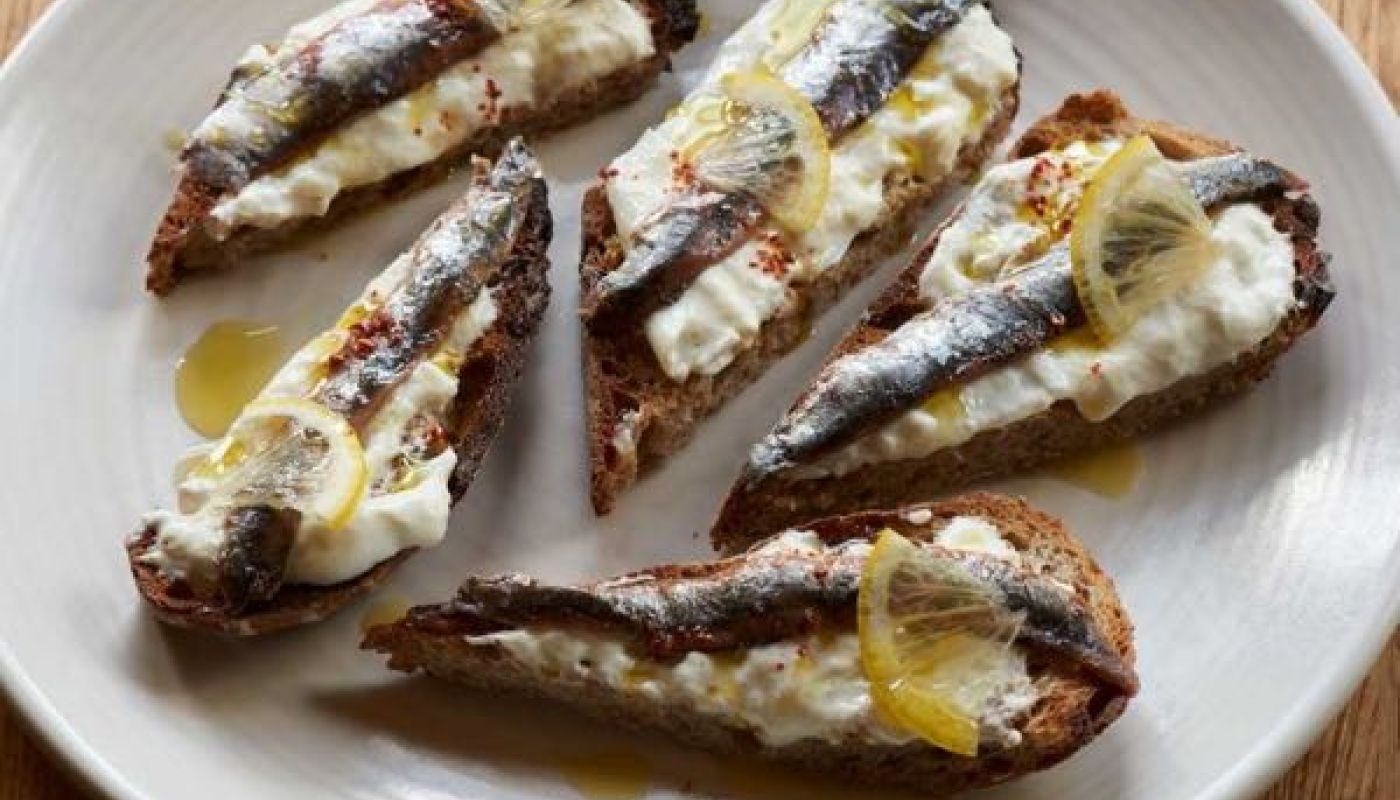
To judge from my two meals there, Parle’s cuisine, ably executed by Richard Blackwell, who has followed Parle eastwards, should have little difficulty. We began with two antipasti: triangles of toast topped with anchovies and stracciatella (Italian curd cheese), pictured, and fried sage leaves with honey vinegar – a delightfully simple snack – before moving on to tonnarelli (like spaghettini but even thinner) cacio e pepe and Parle’s excellent gnocchi alla Romana, inspired by Marcella Hazan. Then somewhat more conventionally we moved on to two dishes where the excitement lay in their accompaniments: the onions, pine nuts, raisins and vinegar with the sea bream and spinach, sage and marsala with the veal saltimbocca.
And while each restaurant offers a differing aspect of Italy, Luca the more sophisticated, Palatino the more casual, for anyone seated with their back to Palatino’s open kitchen, there is another aspect of the Italian way of life on offer – two very popular football pitches.
Luca 88 St John Street, London EC1M4EH, 020-3859 3000
Palatino 71 Central Street, London EC1V 8AB; tel 020 3481 5300