Vine-growers in the southern hemisphere are grappling with their earliest vintage ever, just one more effect of climate change. For us wine drinkers the most striking has been the rise in alcohol levels. They may not be the only factor, but hotter summers have played a key part in boosting average percentage alcohols from 12-12.5 in the 1980s to 13.5-14.5 today.
Growers have observed to their dismay that grapes have been accumulating the sugars that ferment into alcohol much faster than they have been accumulating all the interesting elements that result in a wine’s flavour, colour and structure or tannins, the phenolics.
This is highly inconvenient. Who wants to drink a wine that can offer little other than alcohol? Some Australian producers seem recently to have reacted simply by picking grapes earlier and bottling wines with lower alcohols and higher natural acidities – but there can be a shortage of flavour.
A more common ploy, particularly in warmer wine regions, has been to keep grapes extra-long on the vine while the phenolics catch up, even waiting until they start shrivelling into raisins, and then not just adding acid, a common practice for grapes ripened under an unforgiving sun, but also subjecting the wine to arguably intrusive techniques to reduce the alcohol.
Not all growers are happy with this. Some have been experimenting with cunningly timed irrigation that pushes phenolic ripening closer to sugar ripening, but wine regions afflicted by this problem tend to be increasingly short of water so this hardly seems a satisfactory long-term solution. Others believe that adding water to the finished wine makes more sense than adding water to vines in the ground.
Michel Chapoutier of the Rhône Valley, for example, has stated in public that in hot vintages many a Châteauneuf-du-Pape could be improved by judicious ‘humidification’. The Chileans, concerned about increasingly potent grape musts, have recently altered their wine regulations to allow up to 7% water to be added to them (although winemakers can be sent to jail for doing so across the Andes in Argentina). Adding water, within limits, has long been officially allowed in California, and is permitted in Australia ‘as an aid to mixing an additive’. If all this is done with the aim of making a better-balanced wine, I for one have no objection.
It seems rather more sensible to me than the expensive physical techniques such as the spinning cone and reverse osmosis that are now routinely practised for, and presumably add to the cost of, Napa Valley Cabernet Sauvignon, for instance – although the unusually cool 2010 and, especially, 2011 vintages resulted in wines that were, perforce, much less ripe than usual.
I recently met a newcomer to the Napa Valley with other ideas about how to solve the ripening problem. Philippe Bascaules arrived at Francis Ford Coppola’s historic Inglenook winery from Château Margaux in Bordeaux in 2011. After observing the two, much more normal, succeeding vintages he has become convinced that better-balanced wine would result if the vines could be persuaded to ripen earlier.
To that end he has changed the pruning schedule completely. Napa growers generally prune later than their French counterparts, in February and March, to minimise the risk of frost blighting young buds, and to halt the spread of vine trunk diseases. But Bascaules, who has presumably been given a blank cheque by Coppola, insists, ‘I don’t accept this thinking that we have to ensure the health of the vines. The focus should be the quality of the wine.’
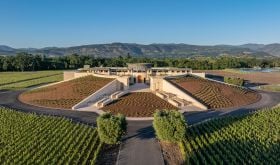
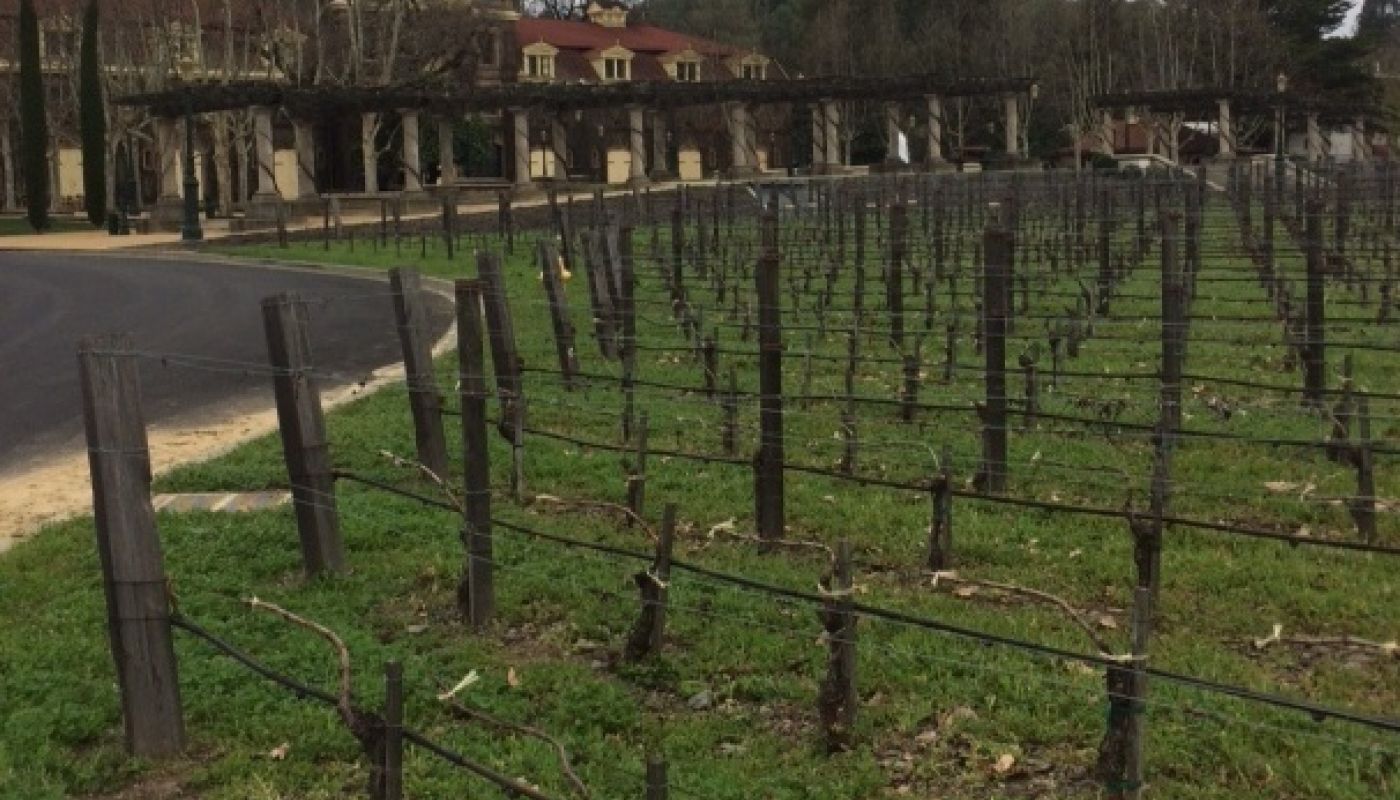
Accordingly, after trials with the 2013 and 2014 harvests, all his vines are now being pruned from December (note the neatly pruned vines in front of the historic winery above last month when neighbours had vines that were budding but still unpruned) and he has every confidence they will ripen, with good phenolics, in late August or September, much earlier than this neighbours’. ‘I’m convinced that day length is very important. There’s a big difference between September and October. Two weeks ripening in October, when it can be very cold between 7 pm and noon, really doesn’t change a lot.
‘I remember in 2011 I discussed the ripening process with the team and they said part of the product is to have shrivelled berries but I don’t accept that. They lose the taste of the place and the variety. We can make this sort of wine anywhere if we have warmth but I really think it’s not interesting. I want to pick before this stage but I want good tannins.’
Some locals are sceptical of this dramatic break with accepted practice, but I must say that I was very impressed by the top 2013 red from Inglenook, Rubicon, a wine with great poise and unusual energy that was shaped by earlier pruning and picking dates.
Another Napa Valley Cabernet that has long managed to walk the tightrope between power and elegance is Corison, where Cathy Corison reckons age of the vines and picking earlier than most hold the key – a bit like neighbours Spottswoode. The Novak matriarchs who run Spottswoode reckon that a well-placed break in the Mayacamas Mountains that ensures a cooling breeze from the Pacific helps too.
The same is true of Lou Kapcsándy, who pounced on the State Lane vineyard when it came up for sale at the turn of the century after years of buying its produce as Beringer’s Private Reserve Cabernet. Before replanting it he got a specialist to interpret all of NASA’s satellite data on the exact angles of sunshine, and the direction of winds off the San Pablo Bay, before working out the optimum orientation of his vine rows. The aim, according to this expatriate Hungarian, was to ‘protect them from sunburn, dehydration, excessive sugar build-up resulting in out-of-balance ripening between sugars and phenolics, and to prevent raisin and stewed plum flavours as well as to control alcohol levels in the finished wine’.
He refuses to say how much this cost but says it was ‘the best money I ever spent’. Since the final answer was magnetic north-south, I can’t help wondering whether he could have saved himself a great deal, but the results are certainly impressive: Cabernets that are muscular without being brow-beating. Like Coppola, he too has sought Bordeaux first-growth expertise, in the form of his consultant Denis Malbec, ex Château Latour.
One way of reducing final alcohol is relying on ambient yeast – sometimes confusingly referred to as 'wild yeast' and including a wider range of genera and species – for fermentation rather than the more common specially selected ones which tend to be more powerful. Australia’s ever-pragmatic wine scientists are trying to isolate yeasts that convert sugars into alcohol less efficiently so that lower-alcohol wines result.
But for many growers the world over, what makes balanced wines is balanced vines, which tends to mean old vines, dry farmed. And those who have adopted biodynamic viticulture, the completely barmy-sounding hands-on nurturing of individual vines according to phases of the moon, report that vines thus reared ripen well-balanced grapes much earlier and more completely than their conventionally farmed neighbours. Perhaps this really is the answer.
Respected wine producer Ted Lemon of Littorai in Sonoma and Burn Cottage in Central Otago, New Zealand, practises biodynamic viticulture in both hemispheres and is convinced this is the case. He has been monitoring the vogue for making lighter, fresher wines in California and suggests that the trend started with the recession at the end of the last decade ‘when no one was selling any wine anywhere so they thought they might as well experiment’. He also quizzed America’s increasingly powerful sommeliers, those few who have been working the floor since this period as opposed to moving on to being ‘wine directors’ or wine celebrities, and found that every single one of them volunteered that food has lightened up considerably since then, suggesting that lighter wine accompaniments are increasingly in order.
LOW IN ALCOHOL, HIGH IN FLAVOUR
All these are wines I firmly recommend which happen to be lower in alcohol than they taste. Of course I could have cited many a 13.5% red…
WHITES
Sweeter German Rieslings (7-9%)
Vinho Verde (9-11%)
Franck Peillot 2013 Roussette du Bugey (12%)
Vine Trail (though I tasted only the 2012)
Emrich Schönleber, Mineral Riesling trocken 2013 Nahe (12%)
£85 for six bottles in bond, Justerini & Brooks
Luis Pato, Maria Gomes 2013 Beiras (12.5%)
About £10 Bottle Apostle, Butlers Wine Cellar, Corks of Cotham, Highbury Vintners and other independents
Samuel Billaud, Montée de Tonnerre Premier Cru 2012 Chablis (13%)
£180 a dozen in bond Lay & Wheeler
PINK
Circumstance, Cape Coral Mourvèdre Rosé 2014 Stellenbosch (12.5%)
£8.95 ND John, £9.75 Camber Wines, £10.99 Slurp.co.uk
REDS
Miguel Torres, Reserva del Pueblo Pais 2013 Maule (12%)
£7.50 The Wine Society, £9.75 Noel Young
Montes, Outer Limits Cinsault 2014 Itata (13%)
£15.99 Noel Young
De Martino, Gallardia Cinsault 2014 Itata (13%)
£66.10 for six Exel Wines
Alpha Estate, Xinomavro Hedgehog Vineyard 2010 Amyndeo (13.5%)
£14.90 Maltby & Greek and other independents
Cono Sur, 20 Barrels Cabernet Sauvignon 2011 Maipo (13.5%)
£14.95 The Wine Society
Stockists on wine-searcher.com