Terroir, varieties, 4,000 years of heritage; following in the path of wine, there’s another drink that’s been quietly making inroads in the gastronomic scene.
Tea has long been a drink of cultural significance and status in the East. Emperors had their own personal allocations and the aristocracy and religious hierarchy emphasised their status with it. When tea arrived in the West, it was the preserve of the wealthy for much of its European history. Still today, the finest teas from craft producers can change hands for several thousand pounds a kilo and the popularity of fine tea appears to be rising once again in the West. There’s little market research in this top 1% of the market but we and others friends in the industry have noticed a significant increase in interest and sales.
Its rise has been helped by the growing confluence of Eastern and Western gastronomy, plus new eating habits such as vegetable-centred dishes (which match with tea), lower-calorie dining (tea has none) and an attitude of less but better quality when it comes to alcohol consumption.
For the keen wine drinker, this is my beginners’ guide for easily converting your wine knowledge into tea knowledge so you can buy and talk tea with confidence.
Styles and colours
We begin with the plant. Just as almost all wine comes from the vine species Vitis vinifera, all tea comes from a single species of evergreen shrub: Camellia sinensis . Don't believe the peddlers and purveyors of such drinks as chamomile 'tea'. It isn't a tea. It's another plant entirely. See below for more on varieties.
All ‘colours’ of tea (white, green, oolong, black) come from the same species, although there are different varieties within that species, as explained below. The difference is how the leaves are treated and allowed (or not) to oxidise. (In some older literature you can still find references to black tea being the result of fermentation but this is inaccurate.)
Black teas are fully oxidised. The leaves are allowed to react with the air and moisture to turn from green to brown. The reaction is similar to any green leaf in the kitchen or leaves that fall in autumn.
Oolong teas are partly oxidised. The leaf is allowed to react a little, and then is fixed with heat. In colour, they are in between a green and black tea; and in flavour they have the broadest spectrum.
Green teas are not allowed to oxidise. Heating the leaf at the outset stops the oxidation reaction from taking place. Think of spinach. In a salad, it will eventually turn brown. If heated, it will stay green. It’s the same with tea. When buying a green tea, find out how it was heated. A Japanese green tea is always steamed, which makes the leaves taste mellow, savoury and vegetal. An Indian or Chinese green tea will often be heated with a dry heat, causing a fruity, sappy or nutty character.
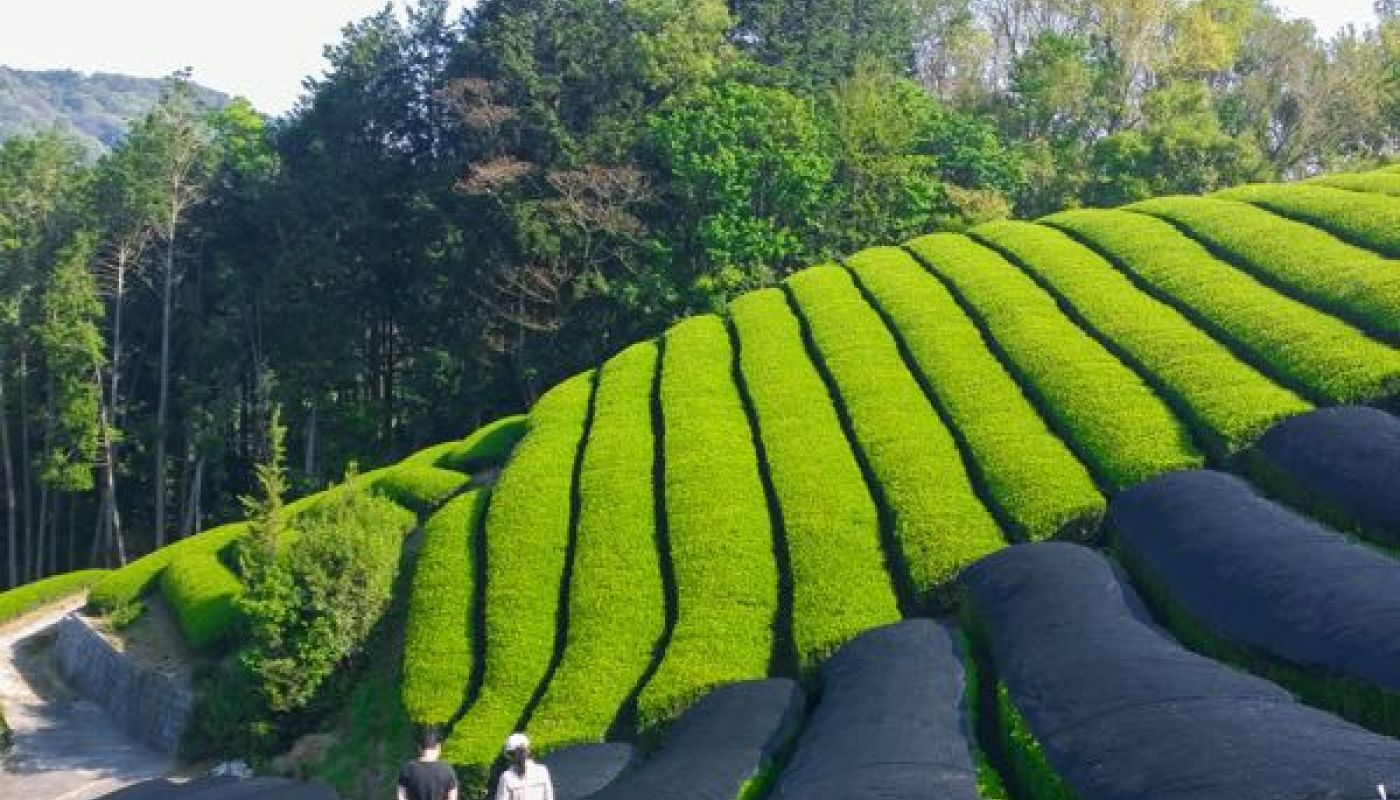
While netting in vineyards is usually to protect the grapes from birds, and only occasionally to protect them from sunlight, this photo of a tea garden in Kyoto shows netting being used to shade the tea plants. Shading is important for premium teas such as Matcha, Kabusecha and Gyokuro. It reduces the photosynthesis and thereby changes the nutrient balance in the leaf, increasing the level of amino acid L-theanine. This in turn enhances the umami notes in the tea.

White teas are the lightest and least processed of all. A white tea is just picked and dried. It’s common for tea estates to make quick white tea by rapidly machine-drying the leaf at a high heat, but this isn’t a true white tea. A true white tea is kept below 60 °C (140 ºF) so the oxidation reaction isn’t stopped. Instead, the moisture is slowly removed before the reaction takes hold. When buying white tea, always check the drying method.
Terroir
As with wine, the geographic characteristics of each garden will affect the taste of the tea and the style of tea each region is good at.
Darjeeling, Assam, Nepal, Japan, Taiwan, China, Ceylon, Kenya, Tanzania, Turkey, Vietnam, Argentina, Korea and Laos are some of the many places on Earth where tea is commercially grown and there is great diversity within each one, as there is between and within wine regions. (The photo below stars Bhagee the tiger, who apparently comes and goes in this tea garden in Makaibari, Darjeeling, in the Indian state of West Bengal.)

Higher elevation slows the plant’s growth and increases the flavour complexity. Darjeeling’s higher-elevation gardens (up to 6,000 ft/1,800 m) produce delicate and very complex black teas. By contrast, the lower-elevation gardens in Darjeeling (from 1,000 ft/300 m) produce much more simple teas, often at a correspondingly lower price.
Soil type also has an effect. For example, in central Kenya (where the photo below was taken), the volcanic andisol soil gives their black tea a very expressive, slightly iron-like character.

If you are looking for lighter, complex teas, choose, for example, Darjeeling or Taiwanese oolongs from higher elevations. The same is often true for light green teas. As a rough guide, heavier and simpler flavours are often better from lower elevations.
Varieties
Within the species Camellia sinensis there are two main varieties: Camellia sinensis sinensis (China type) and Camellia sinensis assamica (Assam type). These have been selectively bred, both vegetatively and by seedlings, to create many further varieties, each one suited to a different style of tea or growing conditions. Among the descendants of Camellia sinensis sinensis, you might come across Okumidori and Sae Midori, which are two extremely good varieties grown in Japan. Both are used for savoury green teas, but whereas Okumidori has a silky smooth body and clean finish, Sae Midori is full on, a touch earthy and mushroomy. While the varieties grown in Japan make excellent green teas, they make very inharmonious black teas.
For fine black teas there's the attractively named AV2 (also descended from Camellia sinensis sinensis), a very trendy variety grown in Darjeeling which produces excellent floral teas. This contrasts to the T78 variety (they're very good at creative names in Darjeeling), known for its peachy and gentle spicy character. There are also others like Qin Xin (also spelt Chin-Shin) used for mountain oolongs in Taiwan, for example. The photo below shows Qin Xin leaves gradually unfolding, opening more with each infusion. K1, Panitolas and Da-yeh are examples of Assam type descendants.

So when you are buying very good tea, ask about the variety. A top-quality batch will usually have its variety chosen and advertised for good reason.
Seasons, batches and vintages
For a wine drinker, the most important thing to remember when buying tea is that grapes are fruits but tea is a leaf; so, whereas wine generally has a single harvest season each year (except in more tropical regions), tea is harvested for most of the year. The result is a much wider variation in quality and flavour from one season to the next. Each growing region has its own best season.
In Darjeeling, you should buy from the 1st flush (April to mid May) or 2nd flush (mid May and June). When the monsoon season starts, the rain is heavy, tea growth is quick, and the quality drops. This is when the lower-quality Darjeeling blends are picked. If your tea just says ‘Darjeeling’, the chances are that it’s a blend containing monsoon-season tea. Premium seasons are usually marked on the label.
In Assam, the seasoned tea drinker will drink only 2nd flush teas, when the rich depth and malty notes are at their peak.
Japan produces its best teas in the spring, with a corresponding drop in quality as the year progresses.
In Taiwan, spring and winter tend to produce the most complex teas, while there are some special teas also produced in the summer.
Even within each season there will be variation from one batch to the next. Most batches will be bought and blended. The exquisite ones will be kept as single batches, so once you’ve established that your tea is from a premium season, look for an indication of the batch number. At Lalani & Co, we specialise in individual batches.
Can you have a vintage tea? The answer is yes. Just like wine, most teas are best drunk within a few years but a small proportion of them will develop with age. Taiwanese oolongs are excellent when fresh but at their best when aged. Yunnan in China is famous for making teas for ageing. Well-made white teas will also develop character with time. We’re seeing increased selling prices for vintage teas that have aged successfully, as the market appreciates the more complex flavour and rarity.
On the other hand, Japanese greens and 1st flush Darjeelings are still best fresh, so drink them young.
As with all fine food and drink, exploring and tasting is the most important part of learning. Now you know the questions to ask, I hope you will explore this wonderful side of the drinks world and find your tastes in fine tea. This is certainly an exciting time to become a tea drinker.