For obvious reasons, I am often asked about the perks of my job. Many outsiders might imagine that the most agreeable one is the frequent chance to taste great wine, and the constant inflow of bottles over my doormat. But, perhaps like book reviewers, we wine writers can become horribly blasé about the free samples sent to us in the hopes of a favourable review.
Another obvious advantage of being a wine writer is the excuse to travel to some of the most delightfully bucolic corners of the world, a world that now extends far beyond Europe.
But I think the aspect of my job that I treasure most is the fact that I am allowed to visit some of the planet’s most admired and dedicated wine producers. Miraculously, it sometimes seems to me, I have an entrée to people and places that money alone cannot buy. I’m thinking not just of the long-established saleroom favourites such as Domaine de la Romanée-Conti in Burgundy but newer, more cultish names such as Screaming Eagle in the Napa Valley, Giaconda in Australia and Dry River in New Zealand, as well of course as some of the most recherché small châteaux in Pomerol. I love these visits so much only partly because during them I get the chance to taste some of the best wines of the world. Another huge benefit is that the producers of these nectars tend to be such unparalleled and fascinating characters.
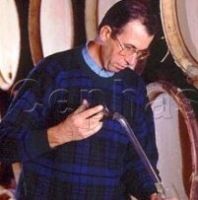
Perhaps the single most intriguing winemaker I visit is Jean-François Coche of Domaine Coche-Dury in Meursault, pictured here by Mick Rock of Cephas.com. His lone grand cru white burgundy, Corton-Charlemagne, can sell for thousands of pounds a bottle and his top premier cru, Meursault-Perrières, has also been known to fetch four-digit prices in pounds per bottle, but he is miraculously unworldly. He really does care for little other than his precious vines and the barrels that he tends under the most modest of modern villas on the outskirts of the village.
For some wine producers, international adulation is one of the most attractive benefits of their work. They tour the world, study the performance of their wines in the salesrooms and generally bask in the glory reflected by their wines. By contrast, Jean-François Coche gives the impression of having an unusually short focus – one that barely extends further than the perimeter of his vineyards. In my experience he submits most unwillingly to being visited, preferring to group the few very longstanding customers he is prepared to receive so as to economise on time. And, far from courting the attentions of wine writers like me, he is an almost grudging host. On my penultimate visit I was left, unacknowledged, waiting in his courtyard for a good half hour after arrival while he drove off in his little 2CV van on some urgent wine- or vine-related errand. His address is deliberately obfuscated in most wine guides I have come across but even so he is probably used to the loitering of uninvited strangers. If he is particular about whom he will receive, he is equally so about when. Basically, appointments have to be made when it is too dark for him to be working the vineyards.
Last time my visit was steered so as to coincide with that of his London importer and a couple of customers from Provence. He told us sternly that we should try to avoid visiting him in November in future. That month is too busy. He issues a little ballon, a sort of squashed brandy glass, to each taster, grabs the wine thief necessary for siphoning barrel samples out of each bunghole and a none-too-glamorous red plastic bucket, a watering can for topping up and a mallet for driving the bungs back into place.
Strangely, in view of how valuable his wines are, he is one of the very few Burgundy growers who definitively does not want you to pour the remains of your precious wine sample back into the barrel. This is his kingdom, with his rules, you are very firmly reminded throughout the visit. No photographs. No dramatic preamble about the characteristics of the vintage as at most domaines. No spitting except in the portable spittoon, painfully carried between cellars (I really must offer to buy him another). No question about which wines you taste. If one has just been fined, or racked from one set of barrels to another then the visitor, importer or no, does not get to taste it. And no gainsaying the order of tasting. He lugubriously announces, just once, the name of each new wine. The contrast between his dogged routine and the hushed reverence that any fine wine collector would have for even a drop of his Perrières could hardly be greater.
When he does loosen up is at the end of the tasting once all of his reds (so much lighter than his whites) have been tasted. Then, if you are very good, he will go to a small stash of half-bottles in the corner of the cellar and select one, two or even, in the case of my last visit, four (because both halves of his Corton 2005 were surly) to be savoured as a reward after all the young wines from barrel. Guessing their identity correctly might just ensure a repeat visit. I hope. Visiting here really does have a suggestion of visiting a religious shrine – and not just because of Jean-François’ particularly monastic demeanour.
Perhaps the most extraordinary property to visit is Château Rayas in Châteauneuf-du-Pape (see Visiting Château Rayas – video). The increasingly lauded Paul-Vincent Avril at Clos des Papes, whose prices have soared particularly steeply in the last few years, probably has to deal with many unwanted visitors since his rambling house and cellar are right on the main road through the village. Château Rayas on the other hand is well hidden away on the plateau above it, a spider’s web of rough tracks and clumps of pine trees. There is a single signpost to Rayas and even that is rusted and well off any proper road. I went back there recently for the first time in more than 20 years. Since the death of the eccentric Jacques Reynaud, who ran this top-performing but unbelievably ramshackle property, his nephew Emmanuel Reynaud has taken over and I was expecting to see much evidence of a new broom. Instead, I would hazard that no broom has been within several miles of this extraordinary winery, where the floors are open earth and the traditional large casks are grey and cobwebby with age. ‘Dustissimo’ is my tasting note on the building, but my tasting notes on the wonderfully eloquent, pure liquids drawn from those dusty barrels were thick with superlatives. It is a real mystery, and somehow rather cheering, to taste such overwhelming evidence that the vines are so much more important than any winemaking textbook with its insistence on winery hygiene.
'We hate new oak,' Reynaud told me with a broad smile, before expressing an equal distaste for the modern habit of summer pruning. 'I have neighbours who cut off one bunch in every two to try to concentrate the fruit. That’s like cutting off a leg and expecting to walk better. I like all that’s natural.'
And so do I. I glory in the naturalness of these giants of the wine world and how lucky I am to experience it.
See hundreds of tasting notes on Rhone 2007s and 1,350 tastng notes on Burgundy 2007s.