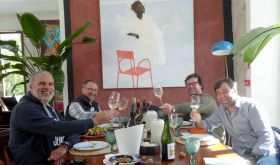
After a hard day networking and discussing such topics as North Korea’s Mysterious Geopolitical End Game, Regulation and Financial Market Competition and Simple Cell Solutions to Complex Problems, wouldn’t you find a wine tasting rather agreeable? It was perhaps not so surprising then that the two tastings I was invited to host as part of the ‘working dinner’ programme at this year’s World Economic Forum at Davos were so popular.
Indeed it was the popularity in previous years of such similarly off-piste topics as sex (officially called Relationships and Self-Esteem) that inspired the organisers of the Forum to add wine to their roster of events in 2007, a less challenging alternative to playing Anatoly Karpov at chess.
I found it quite enough of a challenge to come up with suitable themes for the plutocracy gathered in this high altitude alpine resort (snow boots essential). It seemed likely that typical participants are regularly treated, or treat themselves, to some of the most sought-after modern wines. I decided therefore to feature a bit of wine history, some seriously mature but, I hoped, delicious wine that is too old and rare to feature regularly on restaurant wine lists.
Since red bordeaux is the wine style that is most widely available to demonstrate the charms of fully mature wine, Classic clarets was the title of my Thursday evening tasting. I enlisted the help of Reid Wines of Hallatrow near Bristol who specialise in small lots of old and rare wines. Several bottles of each of Chx Cheval Blanc 1975, Figeac 1970, Branaire Ducru 1970, Cantemerle 1962, Lafite 1962, Giscours 1959, Haut Bages Libéral 1959, Haut Batailley 1953 and Latour 1952 were accordingly despatched up the mountain and through the mind-boggling security checks to be savoured by the first 40 participants to sign up.
Rather unexpectedly these included the Ukrainian prime minister Victor Yanukovych, two of his ministers, his chief of staff, his translator and five more Ukrainians including one extraordinarily youthful-looking magnate who had volunteered to sponsor both my tastings. Others included an Israeli pioneer in stem cell therapy (about whose work I happened to have recently recorded a documentary narration), wine collectors from all over the US and an exceptional number of fellow wine-loving journalists (oxymoron here?) who had presumably signed up purely as a gesture of support.
What was so delightful for me was to see the reactions of those who had never tasted old wine before. Fortunately, all but one oxidised bottle of Lafite were sound – an unusually high strike rate for wines of this age. They were also extremely different from the red bordeaux of today, having been made in an era when the grapes would generally have been picked much earlier, producing wines lower in alcohol and higher in acidity. Much less was understood about wine science then. Mastery of the second, softening malolactic fermentation was novel, for example. And many of these wines, particularly those from the notoriously tannic vintages of 1975, 1970 and 1952, would have been pretty unappetising in their youth. This was certainly true of the 1975s, the first vintage I, incredulously, tasted in its infancy.
But with 30 to 50 years in bottle they had mellowed in virtually all cases to the most charming, delicate, subtle wines. The only disappointment, not unexpectedly, was the distinctly decrepit Haut-Bages-Libéral 1959 which was the only wine that had not been bottled at the château but by a Dutch merchant. Each of the wines had its charms, the Figeac 1970 still firm, the Cantemerle 1962 very pretty at first, the Giscours 1959 winningly sweet and the Haut Batailley 1953 wonderfully gentle and mellifluous. But when I asked for votes (the PM having left for another engagement by this time) the favourites were the super-opulent Cheval 1975, followed by the still-youthful Latour 1952 and then third equal, the thrillingly complex Lafite 1962 and the decidedly charming Branaire Ducru 1970, the bargain of the lot at £32.50 (plus VAT) a bottle from Reid (see here for more detail on this wine). The Latour was the most expensive wine at £275. My Ukrainian neighbour was particularly taken by the Lafite, and couldn’t believe that it could be had for hundreds rather than thousands of pounds a bottle.
If this first tasting was based on looking backward, I decided to look forward with the second tasting, an eclectic collection of wine styles and provenances in keeping with the Forum’s theme this year of the shifting balance of power (eastwards) together with a few instructive plums chosen from the Reid list.
Information technology has always been hugely important to Davos. The biggest, smartest and most convenient villa next to the organically grown Congress centre is given over to Bill Gates and his entourage. Virtually all the lions of the online jungle were there to strike fear into the hearts of the leading newspaper publishers and editors also assembled. It seemed appropriate therefore that we had two wines made by refugees from the IT business, Roc d’Anglade Blanc 2004, a Chenin Blanc grown near Nîmes and treated as though it were white burgundy, and Sula Sauvignon Blanc 2006 grown in the Indian state of Maharashtra which is currently offering sizeable financial incentives to encourage wine production, presumably hoping to capitalise on the Indian wine market’s current annual growth of around 30 per cent.
We also tasted the best Indian red to have come my way, Grover, La Reserve 2003 made from Cabernet Sauvignon grapes grown in the hills above Bangalore (another technology connection here) and vinified with help from the ubiquitous wine consultant Michel Rolland. To complement this I chose the Hong Kong-owned Grace, Chairman’s Reserve 2004, a blend of Cabernets with Merlot from Shanxi province that is so far the most convincing representative of the rapidly growing Chinese wine industry.
None of the participants at this second tasting, who this time included a high proportion of Kuwaitis, came anywhere near to guessing that even by 2003, the last year for which we have official statistics, China had become the world’s sixth most important grower of vines and tenth most important producer of wine.
Spain of course is the country with the greatest area of vineyard, even if the worryingly dry climate there means that Spain has far fewer vine plants than either France or Italy. Because Spanish wines are currently so fashionable I included one of the more celebrated new wave Spanish reds in Alvaro Palacios, Finca Dofi 1997 Priorat, but we compared it with the wine that could be said to have opened the door to the outside world for modern Spanish wine, Torres, Gran Coronas Black Label 1970, the Catalan Cabernet blend that ‘beat’ all other Cabernet-based wines, including many glorious bordeaux, in the notorious Wine Olympics organised by Gault Millau in Paris in 1979. I had been worried that perhaps it would be too old by now but this wine, like the California wines of the Judgment of Paris that inspired the Wine Olympics and were tried again last May, had hardly deteriorated at all, unlike the corks that stoppered it.
We also voted on favourite wines in this ragbag of notable wines, dividing them by colour. The New World selections did particularly well with South Africa’s pre-eminent white bordeaux blend Vergelegen White 2005 Stellenbosch’s being beaten into second place only by the most venerable wine of the lot, Blandy’s Gran Cama de Lobos Solera 1864 Madeira that was absolutely stunning, and included to remind the tasters how glorious this virtually forgotten island wine can be. (Solera means that this continually refreshed set of casks of wine was begun in 1864.)
Among reds, New Zealand’s flagship Felton Road, Block 3 Pinot Noir 2004 Central Otago was also extremely popular, beaten only by maturity in the form of the Torres Black Label 1970.
Best value however, it was agreed, was the Vignerons de Maury, Cask 905, Solera 1928, a strong, sweet Roussillon blend that had been deepened and polished in cask for many decades in the local co-op and is sold by Reid at only £11.50 (plus VAT) a half litre. See this week’s wine of the week.