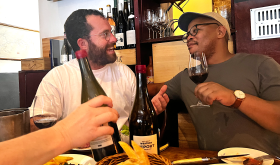
Jennifer Lynch, Bachelor of Wine Marketing, arrived in London last month from her native Adelaide in South Australia. The drop in ambient temperature was 30 degrees centigrade but she seems to be thriving on her three-month stint at the specialist wine store Philglas & Swiggot in well-heeled Battersea, south London. She won her fare, her guaranteed (paid) job and accommodation chez her employers Mike and Karen Rogers by writing the winning application for this, the first annual Philglas internship for an Adelaide marketing graduate.
This might just be a very clever move on the part of the Rogers, who are currently travelling round Australia while the likes of Jennifer are minding their three stores around London. Australia is alone in how seriously it takes wine marketing. The University of Adelaide has the largest wine business and marketing school in the world with a total of 600 students including postgraduates. Jennifer was one of an intake of 100 in her year, although apparently fewer than 25 actually graduate, so high is the dropout rate among students who imagine the syllabus is all boozing rather than the separate and demanding disciplines of commerce, economics, marketing, viticulture, oenology and sensory analysis (the boozing bit – now officially banned for students under 18, which would have ruled out Jennifer in her first year).
The only other internationally recognised academic qualification in actually selling wine rather than making or tasting it is the MBA course run by the University of Bordeaux which numbers just over 10 students – a number naturally limited perhaps by the cost of travelling to four or five countries in order to complete the course. (I have since been informed, see your turn, that 20 students have also taken a similar course in Italy – see www.mib.edu/wine.)
Such is the status of the Adelaide course that the South Africans, whose wine industry habitually casts an envious eye across the Indian Ocean, now run a wine marketing course in partnership with Adelaide at the University of Cape Town. It is perhaps significant that the Australians, whether officially schooled or not, are recognised as past masters at marketing their wines and have seen their global market share zoom skywards over the past decade whereas the French have noticed a decidedly contrary trend.
But how, I asked Jennifer, can the relatively small Australian wine industry, dominated by a handful of big companies, possibly absorb as many as 600 wine marketers? She laughed ruefully. “Lots of grads are hugely overqualified. Many of them end up just working in a bottle shop. We’re all starting to be worried about the opportunities because in Australia retail is contracting – massively so, with almost all wine sold by one or two big chains, or cellar door. There are only five independents left in Adelaide. You hardly ever see a job in marketing advertised – it’s all word of mouth, and then there’ll be 50 applicants for every job.”
The contraction of Australia’s wine retailers is the direct result of a savage and systematic policy of discounting to encourage Australians to buy their wines in quantity, with routine volume discounts and special promotions to encourage bigger orders. “Some brands that used to sell at $20 are now down to $12,” Jennifer shook her head. “It’s just mad”.
One of the first things she noticed when she was plunged into work at Philglas & Swiggot’s wine shop in Northcote Road was that the customers there spent heavily but didn’t ask for discounts. “We’ve been taught at uni that UK consumers are very knowledgeable but it’s fantastic to experience it and be able to talk to people about wine. It’s the best bit about being here. In Australia when I worked in a bottle shop, I’d be working with a much narrower range of wines, and South Australians tend to be very patriotic about their state. When I was doing a tasting for Angove’s, they’d refuse to taste the Best’s wines because they came from Victoria. South Australians all know someone in the wine business, and they’re all worried about pricing and consolidation.”
Life may be tough for wine marketing graduates in Australia but it’s even tougher at the moment for some grape growers. For some time now a sizeable proportion of the grape crop has been left unpicked on the vine, simply because supply so dramatically exceeds demand. “It’s all a bit scary,” admitted Jennifer. “There are still lots of vines going into the ground and lots of lawyers and people getting into wine as a second career. Do these people not read the papers?” The only plus point about the grape glut is that at least all these new plantings and their produce need some expert supervision, so that there are jobs for Adelaide’s graduates in wine production if not for those in wine marketing.
I suppose it is the job of a good marketer to understand market forces, which is presumably why Jennifer Lynch is so delighted to be in Europe where there is a desperate need for more marketing expertise in the wine business. The French can make wine beautifully, but are not so hot at actually selling it. She studied French for eight years, is trying to practise it with some of the French staff at Philglas, and I sense she is just itching to be given an assignment such as “go sell Bordeaux”.
I asked her how she would advise a French wine producer and she said immediately, “de-mystify! Adding things like back labels and better labelling in general will help them enormously. I’d also suggest a certain level of consumer education perhaps to teach less knowledgeable consumers the 'subtitles', those associations such as red Bordeaux with Cabernets, red Burgundy with Pinot Noir and so on. The French need to reduce their restrictive viticultural and winemaking practices. Not to abolish their heritage and tradition by any means as I think it's something they can use to their advantage, but they need to change their angle of perception. They need to increase experimentation and rejuvenate the French wine industry. I think there is a new generation of younger producers in France who are already stepping up to the challenge.”
She is hoping to explore Europe’s wine regions once her three-month stint in London is up. Every night chez Rogers a couple of wines, usually new to her, are served. When I asked what had stood out so far she whipped a notebook out of her handbag, leafed through all the tasting notes in it and came up with a Pinot Grigio Ramato from Specogna, Pieropan’s very special Soave Calvarino, Fontodi’s Flaccianello Tuscan red and a 1964 burgundy. But Australian wine seems to be closest to her heart.
She included three bottles to include in her luggage for the big trip: Balnaves Sparkling Cabernet, a Murdoch Coonawarra Cabernet and a Paracombe Cabernet Franc from the Adelaide Hills. All South Australian, I note.
I asked Mike Rogers, whose previous career admittedly involved exporting Australian wine to Europe, why they decided to offer their internship to someone from Australia specifically and this, kindly emailed from sunnyQueensland, is his reply:
“The Australians always seem to be the ones reaching out and seeking to learn from others. The Australians are the most active in experimenting with new ideas and in our experience they are the most likely to embrace new challenges in a positive way.
“We feel that Australia has been the most active force in developing the enthusiastic wine culture that exists in the UK today. Australia has been an inclusive force in wine rather than an exclusive force and as a result it has expanded the middle market enormously (£8 to £20 per bottle) by clever branding, good information flow and exciting wine styles.
“This brings us on to your question about what Australia has contributed to the European wine market. We see the "inclusive" approach as having popularised many erstwhile unfashionable wine styles, which has subsequently resulted in European producers gaining positive spin-offs. Riesling (Germany and Austria), dessert wines (wines like Brown Brothers Orange Muscat and De Bortoli's Noble One have spawned many more fans of dessert wines than would have been the case if we were left to rely on the "exclusive" Sauternes and other traditional European appellations).
“The Australian policy of providing down-to-earth information about its wines has empowered consumers to ask questions about European wines and to discover enough to persuade them to try wines that would otherwise have remained a closed book to them. In a nutshell we feel that the Aussie approach has been to take a frightened, shy and intimidated wine consumer and empower him to experiment with European wines with increased confidence.
“This may all sound a bit over-stated, but in our experience it is not. Our customers have in many cases used Australia as the "training wheels" of their wine drinking ride and with the confidence gained they have taken off the wheels and are prepared to ride over the roughest of ground such as Irouleguy, Montsant, Wachau, Nahe and the whole of Italy!
“People often stray off-piste and find disappointment as well as excitement and the great thing is that they seem to regard Aussie wines as the safe home to come back to when all else fails. Even the confirmed Bordeaux or Burgundy drinker will be keeping an eye on what Australia is doing at the top end of the market.”