
We are publishing free for everyone three of Tam's 40+ book reviews that so entertained Purple Pagers over the recent holidays. She chose the three to share more widely and this provocative book about champagne is the first. The guide to all of her reviews is at last free to view; we realised only last weekend that we had inadvertently failed to make it free. Very many apologies.
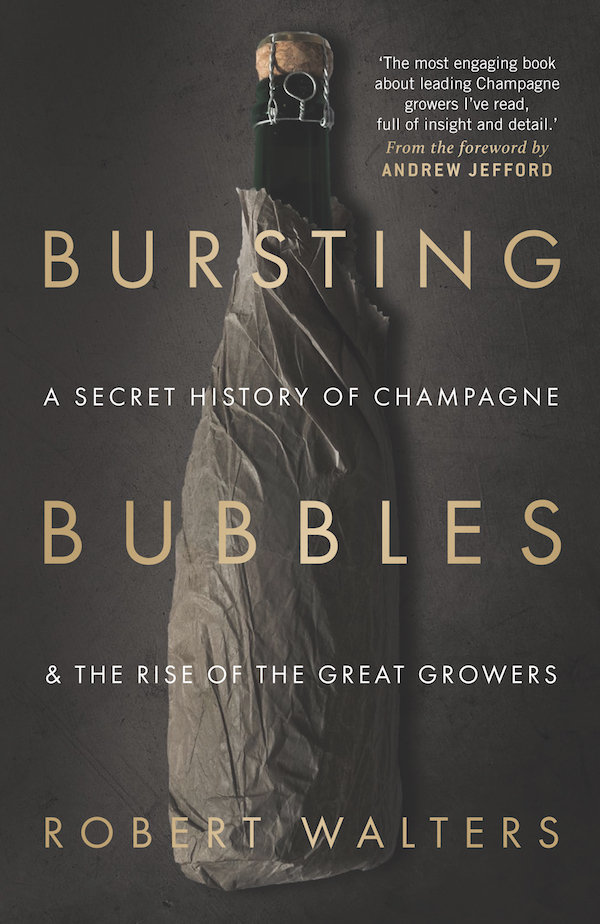
Bursting Bubbles
A secret history of Champagne & the rise of the great growers
Robert Walters
Published by Quiller
ISBN 9781846892547
£19, $25, AU$40
This book is going to piss some people off.
I thought about phrasing that more elegantly, but changed my mind.
‘For too long, we, the wine community, have gone easy on Champagne. We have bought into the countless myths espoused by the marketeers of the region, and we have ignored the shortcomings of many of the wines.’ That’s what he writes in the epilogue, which gives you an inkling of what he’s written on the previous 220 pages. So, either he’s written the things that everyone else has been too polite, or scared, to say. Or else he’s written a pack of tripe.
Rob Walters is the owner of Bibendum Wine Co (Melbourne, Australia), imports fine wine into Australia, owns a vineyard (visited by Jancis last month) and makes wine in Victoria, and writes for The World of Fine Wine. This book, I’m told, is based on a series of articles that he wrote for the latter.
It begins with characteristic Aussie bluntness: ‘Where the author pre-empts several lines of criticism, comes clean about his motivations and forewarns the reader that he is not without self-interest’. Thus starts the Disclaimer. It’s not a wine guide, he warns, and directs readers who are looking for something comprehensive to Peter Liem, Michael Edwards or Tyson Stelzer. Further warning: ‘Let me be completely transparent; I am a wine merchant. I buy and sell wine … I import the wines of most of the producers covered in this book. I am therefore far from impartial. On the contrary, I am completely self-interested. Having said that, I have not written this book in order to sell more wine – I could have spent my time far more effectively had that been my goal. Rather, I have written the book because I believe that the story of the great growers of Champagne is one worth telling and because I believe that the producers I have highlighted are making the most exciting wines in their region.’
That bias, squarely set out right at the beginning, should be a decision point for every reader, in my opinion. If you take issue with the author’s impartiality, stop reading. No point in going further and then ranting about it. I think that’s fair enough.
His two other disclaimers are along the lines of: the producers may disagree with me; and this book is not an exercise in grandes marques bashing.
Skeletons and dirty laundry dealt with, we can move on to the prologue and other things.
The foreword is an unusually beautiful one written by Andrew Jefford, who is one of the most considered wine writers of our time, and while I don’t usually pay a great deal of attention to forewords, one written by Jefford is something I’d pause to read. He describes this as ‘the most refreshing, pretension-pricking … book on the subject I’ve read’.
If anyone has read The Luminaries, by Eleanor Catton (and if you haven’t, read it!), then you’ll know what I mean when I talk about Walters' strange contents page. The book is divided into 20 ‘parts’ (not chapters) with headings that read as if they’ve been lifted from a Victorian novel. For example, Part II: ‘In which we drive along a haunted racetrack in search of a singular grower and discover, not for the first time, that all is not what it seems in the world of Champagne’. The ‘parts’ are interspersed at irregular intervals by 10 myths. It’s a sort of travelogue-cum-search for truth, corny as that sounds. Walters describes the book as ‘two parallel journeys’: one is geographical, from north to south, stopping in on ‘great growers’ (as Walters describes them) along the way. The other journey is more of a zigzag, across and through the history of champagne the drink, Champagne the place, and champagne the concept. These two threads run concurrently through the book, the chapters/parts alternating between his visits to producers and his exploration of how champagne came to be.
What Walters essentially does is put the well-known, well-worn Champagne stories to the test. He tackles some of the obvious myths – such as Dom Pérignon, the real birthplace of sparkling wine, flutes and coupes – and does so in more detail than any other book I’ve read so far. He also examines some less obvious myths, with intriguing conclusions, such as small bubbles equal quality, bubbles come from imperfections in the glass (they don’t; they come from stardust, and I’m not kidding), and great champagne comes from chalk soils (try onyx instead). There is the matter of grand and premier cru villages, and, in fairness, all the good champagne writers have flagged this as a deeply flawed classification. Then there are other, very pretty, bubbles he aims his pin at…
The Avenue de Champagne in Épernay is dubbed Avenue de Disney, ‘cultural pop’, ‘sugar-coated’. His tourist visit to Moët is brought to an abrupt end as staff discover he is professional and take rattled exception to his Dictaphone. Quoting Rod Phillips, ‘Champagne was, in many respects, a product of the new industrial world’, he describes the vin du diable despised by the Champenois – a wine born not out of natural evolution or a burgundian reverence for the terroir, but a wine ‘born of economic desperation and the rising fashion for a gimmick wine among an elite clientele’, a wine shaped by unsold, unwanted bottles of still wine and cheap grapes piling up and rich négociants looking for any opportunity to make money. He writes, ‘It is impossible to understand Champagne and its history without grasping that it was the traders, the négociants, the business people of the region, and not the growers, who launched and drove the success of sparkling champagne.’
The radical divide between viticulture and vinification in Champagne is only comparable, he argues, with Cognac – a distilled spirit. ‘The separation of grower and producer is another radical shift from the ideals of fine wine regions across Europe and, in fact, the rest of the world.’ He makes comparisons with Australia and other places where cross-regional blending is common, and still finds Champagne wanting, because, as he points out, this type of large-scale, multi-vineyard, region-wide blending with little regard for ripeness and little direct contact with the suppliers is reserved for basic wines in other regions.
He takes a very hard look at the vineyards: the glitter of ground-up glass, batteries and tins from the years of gadoues (night soil), but also the continuing and widespread practices of blanket chemical applications. Soil scientist Claude Bourguignon’s warning in the eighties that there would 'soon be no more life in [the soils of Burgundy] than there is in those of the Sahara’ was heeded by scores of top producers elsewhere, not just in Burgundy. Champagne, he implies, has largely ignored this. He mentions the ‘gentle’ efforts of the CIVC to encourage environmental improvements, but, like Crum, points out the tiny proportion of vineyards that are farmed sustainably, and describes the changes as mostly lip service. Pascal Agrapart remarks that, ‘when things are easy it’s hard to change’. Pierre Larmandier agrees because 'the current system works so well’, adding, ‘But don’t forget that most of the growers only sell fruit’ – they never actually taste wine made from their grapes; there is no incentive, economic or otherwise, to change.
One of his fiercest charges is reserved for yields. Overcropped vines, underripe grapes, making ‘austere, characterless base wines that derive from early-picked, high-yielding vineyards seems to radically distance conventional champagne from other fine French wines’. His argument is that practices that are de rigueur in Champagne, even for prestige wines, eg cultured yeasts, enzymes, strong filtering, chaptalisation, fining, are very rarely used in the finest wines in the rest of France; that sugar is routinely used to mask wines to make them more palatable and appeal to a wider audience; and that much of the extremely toasty, biscuity flavour of champagne comes from the Maillard reaction – amino acids reacting with sugar – and has nothing to do with terroir, ‘everything to do with generous sugar additions’. The story of terroir in conventionally produced champagne is brutally red-lined, which leads us to blending…
It’s not that Walters is against blending – in Champagne or anywhere else. He plainly states that ‘many outstanding wines are blends; in fact, almost every wine is a blend of sorts … this is not a criticism of blending per se. Rather, my aim is simply to challenge the long-held view that blending of the kind we see in Champagne – across … 25,000 square kilometres of land – necessarily produces better wines than those that derive from a single site or single terroir.’ He is against the line trotted out on every champagne tour that the ‘sum is greater than the parts’, that the extreme northern climate means there is no choice, that complexity can come only from blending. The real reasons, he argues, were and still are commercial and pragmatic – large-scale blending is ‘a solution to a commercial challenge: how to create a consistent product as inexpensively as possible and in enough volume to satisfy a fast-growing, mass-market audience’.
In stark contrast are his visits to eight grower producers. There is Jérôme Prévost in his ‘ridiculously attractive’ village of Gueux, home of the haunted F1 racetrack, who rented a vineyard from his mother to escape the ‘jail of school’, is minimalist, word-lover, painter, sculptor, poet, photographer. There is Francis Egly, the rock, who ‘spends a good 10 minutes berating me for visiting him in May’, and has ‘the cellars of an uncompromising personality’. He describes how he almost overlooked the quiet, modest farmer, Pascal Agrapart, with his terrible labels. Walters almost missed out – misjudged him. Of course, there is Anselme Selosse – great, not just for leading this quiet revolution, breaking barriers and making wines that are cult-worshipped by some and openly disdained by others, but for his ‘passion and talent for teaching’, generosity with knowledge and time, mentoring many young vignerons. As a child, Selosse was always taking things apart, always needing to know why and how things work. A friend sums up the differences between Selosse and Egly: ‘With Anselme it is always questions, while with Francis it is always answers.’ An outsider as a child, bullied, overweight, with a skin disorder, he became a man ‘comfortable innovating without the need to seek consensus’, believing that ‘what is different is sometimes worth celebrating, even when it challenges us’.
Pierre Larmandier, ‘le moine de Vertus’ (the monk of Vertus), is the grower with a ‘pious devotion to cheese, wine and charcuterie’, marathon running, and his wife Sophie. His were the vineyards that indignant neighbours reported to the priest, who eventually felt morally obliged to approach Pierre’s mother in an attempt to get the disgraceful state of them tidied up. Walters tells the story of Emmanuel Lassaigne, listening to Veuve Clicquot flat-out denying having anything to do with Montgueux at a time when they were the largest buyer and taking 25% of the production, and how that spurred him to show people that Montgueux had terroir worthy of notice. Walters writes about Bertrand Gautherot, almost as much in love with his cows and chickens as he is with his vines, refusing to talk about terroirs because, ‘first of all, because I do not fully understand them. Then, because they are not fixed. Then, there are the seasons and the management of the land.’ And Cédric Bouchard, extreme, purist, with his insanely low yields (26 hl/ha) and his assertion that bubbles get in the way of a fine wine. Walters describes a John the Baptist: ‘gaunt, angular features, a mop of dark hair and matching beard, and loose clothes and sandals, the man looked positively messianic’.
His stories of these men, real, gritty, unpolished, are a stark contrast to the high-gloss advertorial familiar to global consumers. What these men have in common, Walters insists, is not a radical, anti-establishment approach to champagne, but quite simply that they do what all the most quality-conscious producers do to produce terroir-focused wines: nurture life in the soil and in the environment, question and know the terroir, pick ripe grapes, make wine with minimal tinkering. And learn, keep learning, from other producers, from other wines, other regions.
Robert Walters is an exceptionally good storyteller. His writing is eloquent and often impassioned. As with all crusaders, there are moments when the strength of his conviction veers towards the melodramatic. He is keen to stress that the growers don’t see this as a battle between themselves and the houses, emphasising that not all growers produce great champagne, and the distinction he makes is not between grower and négociant but between market-driven champagne and terroir-driven champagne. Despite that, he describes his first taste of a grower champagne (Larmandier-Bernier's Terre de Vertus) as a ‘call to arms’, and is nothing less than acerbic when describing the Champagne-created ‘plastic world of beautiful people who wear shiny clothes at night’. I have no doubt that this will divide the room. Some will see this book as a direct attack on the establishment, and will dismiss it as a one-sided, misguided work of a zealot trying to sell his fringe wines. Others will embrace his story, the very antithesis of the official story of Champagne, which he calls a ‘careful and deliberate construction by the powerful marketing and PR arms of the large négociant houses and the regional bodies of the Champagne AOC’.
Wherever you stand, you should read the book. The debate is worth having.













