
The beginning of March may not exactly be the start of spring but it does usher in the start of that part of the year when, in the northern hemisphere anyway, champagne or a variant thereon is routinely poured at large gatherings. (And so many Brits, or at least British residents, regard champagne as the standard drink on any occasion at any time of year that the UK continues to be Champagne's leading importer by far.)
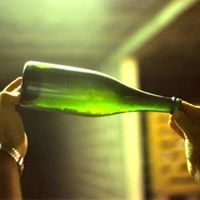
It is fashionable in professional wine circles to complain about the quality of champagne, but I am delighted to report that on the basis of my selfless tastings on your behalf, the quality and range of champagnes on offer today seems to me to be better than ever. This is partly because, at least in key markets such as the British and American ones, champagne lovers can now choose between the well-known, usually high-volume brands which generally strive for a consistent house style in every year's new bottling, and an increasing number of 'grower champagnes' made by much smaller outfits whose tendency has always been to provide individual lots of wine together with full details of their pedigree: which harvest(s) a bottling is based on; where which grapes were grown; when the bottle was disgorged (separated from the lees of the second fermentation in bottle – pictured above – that is responsible for the bubbles and much of any sparkling wine's character).
This means that not only can we enjoy a much wider range of champagne flavours and styles, we are also being told much more about what is in the bottle. Even among the bigger brand owners, there is a tendency to give increasing amounts of information on the back label or via codes, albeit sometimes somewhat arcane. (The determinedly upmarket Krug, for instance, now gives a six-digit code on the back of all labels of its luxurious multi-vintage Grande Cuvée, although you arguably need a Bletchley code-breaker, as well as access to their website, to work out what it means.)
But another welcome development is that champagnes have been getting both older and drier. More sophisticated and curious consumers demand more of the ageing on lees that provides champagne quality, and dryness has come to be viewed as a virtue. To be labelled Brut a champagne has to have a residual sugar level of less than 12 g/l (it used to be 15 g/l, although a tolerance of 3 g/l is allowed). The non-vintage blend (the sort of champagne that constitutes about 95% of all champagne sold) of the biggest champagne brand of all, Moët & Chandon Brut Impérial, had a sweetness level of more than 13 g/l when the current chef de cave Benoît Gouez arrived in 1998. On his watch, not only is the wine much more refined than it used to be, but the residual sugar level has been steadily reduced, as it has at most of the big champagne houses, to around 9 g/l today, which means that it definitely tastes dry.
In all wines, sugar is in a delicate counterbalance with acidity: the more acid a wine has, the less obvious its sweetness. Thanks to climate change, grapes in Champagne have been getting riper and riper, which means that average acid levels in champagne grape musts have been falling. In the 1990s the average was 8.18 g/l, expressed as sulphuric acid (that's 12.5 g/l expressed as tartaric acid), whereas in the first decade of this century it had fallen almost 8% to 7.52 g/l. (The equivalent average for sparkling wine musts grown in cooler England is around 9 g/l in sulphuric, incidentally.) It is hardly surprising, therefore, that there is less need to add sugar to compensate for acid levels that have traditionally been relatively high this far north.
Makers of sparkling wine have an unusually high degree of control over how sweet their wines are because the last winemaking operation before the final cork goes into the bottle is 'disgorgement', which involves expelling the lees of the crucial second fermentation in bottle that gives off the carbon dioxide responsible for the fizz. This leaves a space in the bottle that has to be filled with what was traditionally a mixture of wine and sugar, the amount of sugar, or dosage, being at the winemaker's discretion, according to how much was felt necessary to counterbalance the acidity while representing the house style.
Final residual sugar levels in the much sweeter Demi-Sec category being pushed by some champagne houses could be as high as 50 g/l, but at the other end of the sweetness scale there has been a flirtation with adding no sugar at all so that the resulting champagne has a residual sugar level of less than 2 g/l and qualifies as a Brut Nature, sometimes called Ultra Brut or Zero Dosage.
At the large family house of Louis Roederer, sweetness levels have been plummeting. Chef de cave Jean-Baptiste Lécaillon reported recently at a presentation of no fewer than nine vintages of the jewel in their crown, the super de luxe Cristal, that average residual sugars have fallen by around 3-4 g/l for all Roederer champagnes – although it is worth remembering that bottle age can compensate for sugar. The older the champagne, the less obvious the acidity and the less added sugar is needed. Benoît Gouez, for example, has reduced residual sugar to 6 g/l for the 2006 vintage Moët that will be launched in May – only two-thirds of the level in the younger blend that constitutes the non vintage Brut Impérial. (A level below 6 g/l may be labelled Extra Brut.) One of the reasons that dosage levels used to be so much higher was that non-vintage wines were released with less bottle age, so they needed the sweetness to make them palatable. Really young champagne plus no dosage can equal tartness and pain.
Dieters may wish to seek out wines with as little sugar as possible but in a champagne-making context, sugar is far from evil. A little bit of dissolved sugar not only counterbalances the high acidity, it helps to protect the wine from oxidation. Gouez experimented with reducing sweetness levels to 2-3 g/l but found that the wines aged too rapidly. Furthermore, if a champagne is given further bottle age after the final corking, as many top-quality vintage champagnes are, sugars will usefully react with the amino acids in the wine, given enough time, to create even more complex flavours.
So the boring message is, as usual, moderation in all things. Even sugar.
See these recent tasting notes on a collection of fizz. Stockists and prices on wine-searcher.com.
WELL-BALANCED NON-VINTAGE CHAMPAGNES
The following champagnes seem to have enough bottle age to compensate for their low residual sugar.
Agrapart et Fils, Terroirs Extra Brut Grand Cru
Bérèche & Fils, Le Cran Extra Brut Premier Cru
Chartogne-Taillet, Ste-Anne Brut
Doyard, Cuvée Vendémiaire Extra Brut
Egly-Ouriet, VP Extra Brut Grand Cru
Egly-Ouriet, Les Crayères Blanc de Noirs Grand Cru
Larmandier-Bernier, Longitude Extra Brut Premier Cru
Larmandier-Bernier, Terre de Vertus Blanc de Blancs Non Dosé Premier Cru
Jacques Lassaigne, Cuvée Le Cotet Blanc de Blancs Extra Brut
Marguet Père et Fils, Rosé Grand Cru
Champagne – now older and drier
• 1 分で読めます
This is a longer version of an article also published in the Financial Times.


購読プラン
スタンダード会員
$135
/年間
ワイン愛好家向け
- 296,386件のワインレビュー および 16,123本の記事 読み放題
- The Oxford Companion to Wine および 世界のワイン図鑑 (The World Atlas of Wine)
- askJancisへのアクセス(AIワインアシスタント)


プロフェッショナル
$299
/年間
ワイン業界関係者(個人)向け
- 296,386件のワインレビュー および 16,123本の記事 読み放題
- The Oxford Companion to Wine および 世界のワイン図鑑 (The World Atlas of Wine)
- askJancisへのアクセス(AIワインアシスタント)
- 最新のワイン・レビュー と記事に先行アクセス(一般公開の48時間前より)
- 最大25件のワインレビューおよびスコアを商業利用可能(マーケティング用)
ビジネスプラン
$399
/年間
法人購読
「プロフェッショナル」プランの内容に加えて
- 最大250件のワインレビューおよびスコアを商業利用可能(マーケティング用)
- レビュー依頼用のワインを提出可能
- 従業員向けにメンバーシップを提供し、一元的に管理可能
- APIアクセス(※別途料金)
More 無料で読める記事

無料で読める記事
この記事はAIによる翻訳を日本語話者によって検証・編集したものです。(監修:チャーリー・ギーガン、写真:ジェイソン・ロウ)...

無料で読める記事
20世紀のワイン界のアイコンたちが関わった初の大西洋横断ジョイント・ベンチャー、オーパス・ワン。この記事の別バージョンは『フィナンシャル...

無料で読める記事
速報!オールド・ヴァイン・レジストリが記録を更新し、障壁を打ち破り、新たな地平を切り開いている。そして今、オールド・ヴァイン...

無料で読める記事
この記事の別バージョンはフィナンシャル・タイムズにも掲載されている。 世界最高のシャルドネとは?も参照のこと。写真上、左から右へ:ロナン...
More from JancisRobinson.com

テイスティング記事
熱波に見舞われた年に生まれた、魅惑的にフレッシュで親しみやすいワイン。ソッティマーノは、写真上のコッタ・クリュから...
テイスティング記事
この記事はAIによる翻訳を日本語話者によって検証・編集したものです。(監修:Yuri Shiraishi)...
テイスティング記事
暑さの中でもリフレッシュできる25の方法。 先週、ヨーロッパは6月としては記録的な熱波に見舞われた。今週は...
今週のワイン
元化学者の正確さとブドウの樹の囁きを聞く者の魂で造られたヴィーニョ・ヴェルデの白ワイン。23ドル~、22ポンド~。写真上はラモスと...
テイスティング記事
ヴァーティカル・テイスティングで、ジャンシスがカリフォルニアを象徴する赤ワインの画期的な始まりを振り返る。ロンドンの67パル...

Don't quote me
ブドウの樹に日陰を提供し、ワイン樽の材料となる森のテロワールは、ブドウ畑やワインと相互につながっている。写真上は...
Don't quote me
キャンセルと治療に明け暮れた1カ月となった。 年配の読者の中には、コーニー&バロウの魅力的な人物として故ロビン・カーニック (Robin...
テイスティング記事
この人気の白ワイン品種の豊かな表現。写真上はラッドのマウント・ヴィーダー・エステート (© Rudd)。 過去3年間...