
The beginning of March may not exactly be the start of spring but it does usher in the start of that part of the year when, in the northern hemisphere anyway, champagne or a variant thereon is routinely poured at large gatherings. (And so many Brits, or at least British residents, regard champagne as the standard drink on any occasion at any time of year that the UK continues to be Champagne's leading importer by far.)
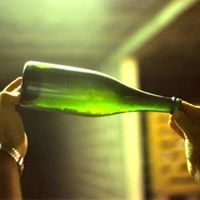
It is fashionable in professional wine circles to complain about the quality of champagne, but I am delighted to report that on the basis of my selfless tastings on your behalf, the quality and range of champagnes on offer today seems to me to be better than ever. This is partly because, at least in key markets such as the British and American ones, champagne lovers can now choose between the well-known, usually high-volume brands which generally strive for a consistent house style in every year's new bottling, and an increasing number of 'grower champagnes' made by much smaller outfits whose tendency has always been to provide individual lots of wine together with full details of their pedigree: which harvest(s) a bottling is based on; where which grapes were grown; when the bottle was disgorged (separated from the lees of the second fermentation in bottle – pictured above – that is responsible for the bubbles and much of any sparkling wine's character).
This means that not only can we enjoy a much wider range of champagne flavours and styles, we are also being told much more about what is in the bottle. Even among the bigger brand owners, there is a tendency to give increasing amounts of information on the back label or via codes, albeit sometimes somewhat arcane. (The determinedly upmarket Krug, for instance, now gives a six-digit code on the back of all labels of its luxurious multi-vintage Grande Cuvée, although you arguably need a Bletchley code-breaker, as well as access to their website, to work out what it means.)
But another welcome development is that champagnes have been getting both older and drier. More sophisticated and curious consumers demand more of the ageing on lees that provides champagne quality, and dryness has come to be viewed as a virtue. To be labelled Brut a champagne has to have a residual sugar level of less than 12 g/l (it used to be 15 g/l, although a tolerance of 3 g/l is allowed). The non-vintage blend (the sort of champagne that constitutes about 95% of all champagne sold) of the biggest champagne brand of all, Moët & Chandon Brut Impérial, had a sweetness level of more than 13 g/l when the current chef de cave Benoît Gouez arrived in 1998. On his watch, not only is the wine much more refined than it used to be, but the residual sugar level has been steadily reduced, as it has at most of the big champagne houses, to around 9 g/l today, which means that it definitely tastes dry.
In all wines, sugar is in a delicate counterbalance with acidity: the more acid a wine has, the less obvious its sweetness. Thanks to climate change, grapes in Champagne have been getting riper and riper, which means that average acid levels in champagne grape musts have been falling. In the 1990s the average was 8.18 g/l, expressed as sulphuric acid (that's 12.5 g/l expressed as tartaric acid), whereas in the first decade of this century it had fallen almost 8% to 7.52 g/l. (The equivalent average for sparkling wine musts grown in cooler England is around 9 g/l in sulphuric, incidentally.) It is hardly surprising, therefore, that there is less need to add sugar to compensate for acid levels that have traditionally been relatively high this far north.
Makers of sparkling wine have an unusually high degree of control over how sweet their wines are because the last winemaking operation before the final cork goes into the bottle is 'disgorgement', which involves expelling the lees of the crucial second fermentation in bottle that gives off the carbon dioxide responsible for the fizz. This leaves a space in the bottle that has to be filled with what was traditionally a mixture of wine and sugar, the amount of sugar, or dosage, being at the winemaker's discretion, according to how much was felt necessary to counterbalance the acidity while representing the house style.
Final residual sugar levels in the much sweeter Demi-Sec category being pushed by some champagne houses could be as high as 50 g/l, but at the other end of the sweetness scale there has been a flirtation with adding no sugar at all so that the resulting champagne has a residual sugar level of less than 2 g/l and qualifies as a Brut Nature, sometimes called Ultra Brut or Zero Dosage.
At the large family house of Louis Roederer, sweetness levels have been plummeting. Chef de cave Jean-Baptiste Lécaillon reported recently at a presentation of no fewer than nine vintages of the jewel in their crown, the super de luxe Cristal, that average residual sugars have fallen by around 3-4 g/l for all Roederer champagnes – although it is worth remembering that bottle age can compensate for sugar. The older the champagne, the less obvious the acidity and the less added sugar is needed. Benoît Gouez, for example, has reduced residual sugar to 6 g/l for the 2006 vintage Moët that will be launched in May – only two-thirds of the level in the younger blend that constitutes the non vintage Brut Impérial. (A level below 6 g/l may be labelled Extra Brut.) One of the reasons that dosage levels used to be so much higher was that non-vintage wines were released with less bottle age, so they needed the sweetness to make them palatable. Really young champagne plus no dosage can equal tartness and pain.
Dieters may wish to seek out wines with as little sugar as possible but in a champagne-making context, sugar is far from evil. A little bit of dissolved sugar not only counterbalances the high acidity, it helps to protect the wine from oxidation. Gouez experimented with reducing sweetness levels to 2-3 g/l but found that the wines aged too rapidly. Furthermore, if a champagne is given further bottle age after the final corking, as many top-quality vintage champagnes are, sugars will usefully react with the amino acids in the wine, given enough time, to create even more complex flavours.
So the boring message is, as usual, moderation in all things. Even sugar.
See these recent tasting notes on a collection of fizz. Stockists and prices on wine-searcher.com.
WELL-BALANCED NON-VINTAGE CHAMPAGNES
The following champagnes seem to have enough bottle age to compensate for their low residual sugar.
Agrapart et Fils, Terroirs Extra Brut Grand Cru
Bérèche & Fils, Le Cran Extra Brut Premier Cru
Chartogne-Taillet, Ste-Anne Brut
Doyard, Cuvée Vendémiaire Extra Brut
Egly-Ouriet, VP Extra Brut Grand Cru
Egly-Ouriet, Les Crayères Blanc de Noirs Grand Cru
Larmandier-Bernier, Longitude Extra Brut Premier Cru
Larmandier-Bernier, Terre de Vertus Blanc de Blancs Non Dosé Premier Cru
Jacques Lassaigne, Cuvée Le Cotet Blanc de Blancs Extra Brut
Marguet Père et Fils, Rosé Grand Cru
Champagne – now older and drier
• 1 min read
This is a longer version of an article also published in the Financial Times.


Choose your plan
Member
$135
/year
Ideal for wine enthusiasts
- Access 296,928 wine reviews & 16,140 articles
- Access The Oxford Companion to Wine & The World Atlas of Wine
- Access askJancis, our AI wine assistant


Inner Circle
$249
/year
Ideal for collectors
Everything in “Member”, plus:
- Early access to the latest wine reviews, 48 hours in advance
- Early access to the latest articles, 48 hours in advance
Professional
$299
/year
For individual wine professionals
- Access 296,928 wine reviews & 16,140 articles
- Access The Oxford Companion to Wine & The World Atlas of Wine
- Access askJancis, our AI wine assistant
- Early access to the latest wine reviews & articles, 48 hours in advance
- Commercial use of up to 25 wine reviews & scores for marketing
Business
$399
/year
For companies in the wine trade
Everything in “Professional”, plus:
- Commercial use of up to 250 wine reviews & scores for marketing
- Access to submit wines for review
- Offer memberships to your employees and manage them from a single place
- API access available for an additional fee
More Free for all

Free for all
Jancis remembers the most charming wine producer she has ever met. Above, Neill in his Two Paddocks vineyard. The worlds...

Free for all
After a first round of judging, we’re delighted to begin publishing the best of this year’s writing competition entries. All...

Free for all
Extraordinary seafood and the magic of a good pairing at The Rocket Store. Boscastle harbour is pictured above. The restaurant...

Free for all
How is the work of the ISVV transmitted to the châteaux? And how has it affected the wines? Plus, highlights...
More from JancisRobinson.com

Book reviews
Three additions to the Classic Wine Library plus a self-published guide to Portuguese wine. Three of the reviews below are...

Tasting articles
A revealing vertical that traces the evolution of South Africa’s most sought-after white. The wines were shown by UK importer...

Tasting articles
A quarter-century of wines from a legendary Bordeaux estate. See also this guide to our bordeaux verticals . Although Château...

Bite-sized
Umami junkies, head east for jaw-achingly tasty fusion and a Honshu sour. Having garnered itself quite a reputation for clever...

Tasting articles
A year of extraordinary balance, bright acidity and some of the best Gutsweine in recent memory. Plus a whole lot...

Wines of the week
The dry white wine that established New York’s Finger Lakes as the Riesling mecca of the US. And it’s only...

Inside information
Real cheddar for real wine. By some small miracle I manage to locate the one with four functioning wheels. My...

Tasting articles
Coolness and light in bottles from some of South Africa’s best producers. Above, Monty enjoys the cool surf in Betty’s...