My typing feels unusually awkward and a mite painful. The index finger of my left hand is bound in a rather unsavoury- looking plaster. In some ways it is a badge of honour, but the fact that this is the first time I have sustained such an injury is deeply shameful.
However, since confessional journalism is now an established genre, I will tell you that yesterday morning, after 26 years writing about wine, I finally went grape picking – and on the way managed to snip a neat little V in the fleshy bit at the end of one of my fingers.
How had I managed to escape this primeval experience, an integral part of wine production, thus far, you may ask. By a combination of sloth and wile, I suspect. Being deeply impractical and a control freak to boot, I have no desire to succumb to the whims of Nature and have to practise what I preach. Those who can do. The rest of us criticise.
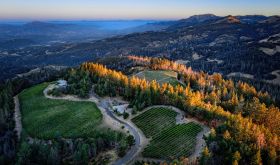
But this was no ordinary grape harvest. It was carefully stage-managed and took place one blissfully sunny November morning on a steep autumnal slope leading down to the lazy river Rhine just below the Rheingau's most famous wine domaine Schloss Johannisberg as part of its birthday celebrations. And not just any birthday, but a 900th one. The antiquity of the Benedictine monastery on this site, where records of grape growing date from at least 817 AD, puts any Australian, South African, Californian anniversary, or even the Tuscans' and Alsatians' six- and seven-hundred-year histories, in perspective.
The sprightly octogenarian, Tatiana Princess von Metternich-Winneburg, whose family have owned the castle and its vineyards only since 1815 had, with the help of Swiss wine collector Walter Eigensatz, put together a group of wine luminaries to earn that evening's celebratory tasting by finishing off the grape harvest.
Watched by the somewhat bemused troupe of real harvesters, mainly Poles, who doubtless had to go through the vineyard and grape intake tidying up after us, we were each issued with a plastic bucket and dauntingly sharp pair of secateurs and despatched down the grassy rows between the vines – all Riesling of course. (I couldn't think of a nicer grape to lose my viticultural virginity to – although in this 2001 harvest they were by no means perfectly healthy.)
I can report that even when hard at work in a vineyard, Christie's wine man Michael Broadbent dresses as for St James's Street in immaculately cut overcoat and trilby hat. (His previous grape-picking experience had been many years ago in Lord Montagu's vineyard at Beaulieu in England.) Serena Sutcliffe of Sotheby's and her husband, Master of Wine David Peppercorn, were also put to work, along with a smattering of topnotch Bordeaux proprietors.
This was most definitely a photo opportunity and at one point I swear there were more photographers than grape-pickers – which I will shamelessly use as an excuse for my self-inflicted injury, for I was surrounded by no fewer than four photographers at the time. 'Take off your sunglasses', 'Look up at the castle', 'Put the bucket on the ground' were all instructions received and obeyed. I can't help feeling this doesn't happen to real grape-pickers.
I need not have felt too ashamed about my bleeding finger. Others with plasters in exactly the same position that evening included Comte Alexandre de Lur-Saluces of Château d'Yquem, the editor of Der Feinschmecker and David Peppercorn.
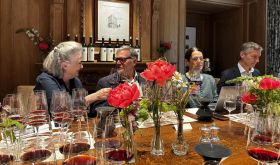
Fortunately you don't need whole fingers to taste wine, for the real business of the celebrations was the most extraordinary range of 10 vintages of Schloss Johannisberg from, if you please, 1862 to the present day.
That evening we were served a succession of 'fragments of eternity', as my neighbour, Catherine Faller of Alsace, put it. For if any white wine grape variety can claim to be eternal it is surely Riesling and, so long as noble rot shrivels it, Semillon, the grape on which great Sauternes depends. I have tasted wonderful Yquem from the early 19th century but even the Comte de Lur-Saluces concedes that noble rot was famously first recorded here at Schloss Johannisberg, in 1775, because the messenger giving permission to pick the grapes was two weeks late (although the Hungarians claim that nobly rotten wines were made in Tokaj even earlier than in the Rheingau and Sauternes).
The 1862 Goldlack (of which were we served two bottles, and three of all the other vintages) was remarkable by any standards – and apparently even better than at a previous Schloss Johannisberg/Chateau d'Yquem extravaganza in 1984 when 11 famous vintages of each were compared. The 1862 was dark amber with the same slightly green rim as ancient Sauternes. It smelt green too, the freshness competing with a rich smell closer to furniture polish than anything else. On the palate, this could go either way, I thought, but I should not have doubted. This was a luscious, lively wine, redolent of macerated sultanas with real sweetness that developed in the glass for almost half an hour before gradually drying out.
Another Goldlack, given a gold seal to signify grapes of Trockenbeerenauslese quality, from 1920 followed: lustrous amber again and slightly skinnier than its creamy, voluptuous nose suggested. This was elegant and lively but faded faster than the 1862 – hardly surprising since it apparently spent a whole nine years in cask. A 1934 Violettlack of mere Auslese quality was the weakest wine of the range, tasting almost simple next to the antiquarian treasures that preceded it.
My favourite wine of the tasting, for current (strictly theoretical) drinking, was the 1943 Rosalack of Beerenauslese ripeness, made in the middle of the Second World War when the cellar hands bottled the wine deliberately early – bottles, we were told, being so much easier to hide than barrels. This amber marvel was in its prime. Not as massively sweet (just 128 Oechsle) as the three vintages that followed it, this was the most complete wine of all: delicate, perfectly preserved, sparkling clean, a mouthful of Riesling nectar.
The post-war 1947 Goldlack was much, much heavier and richer with masses of both acid and sweetness and some exotic note that almost suggested coconut. It still had some development ahead of it – although much less than the extraordinarily exuberant 1967 which notched up 166 Oechsle counterbalanced by 11.8 gm/litre of acidity. This monstrous tooth-rotter was like concentrated creme caramel syrup and should ideally be kept for the Schloss's 1000-year celebrations – as should the 1976 Goldlack which, despite its dry, rather burnt edge and notable minerality, was like a taut spring far from ready to unwind.
The amber colours of all the wines served up to this point were remarkably similar, but the final trio were all a more familiar light gold. The 1991 Blaulack Eiswein looked rather simple and undeveloped next to the botrytised wonders that preceded it, while the 1996 Rosalack and 1999 Goldlack, from the period when the property has returned to form after some lacklustre years, looked like toddlers intruding on an strictly adult occasion.
I just wish that the millions of Riesling-doubters around the world could have had a sip of any one of these wines. Perhaps it is worth reminding them that when it was released, that 1862 was so highly prized that it sold for four times as much as Château Margaux or Lafite.