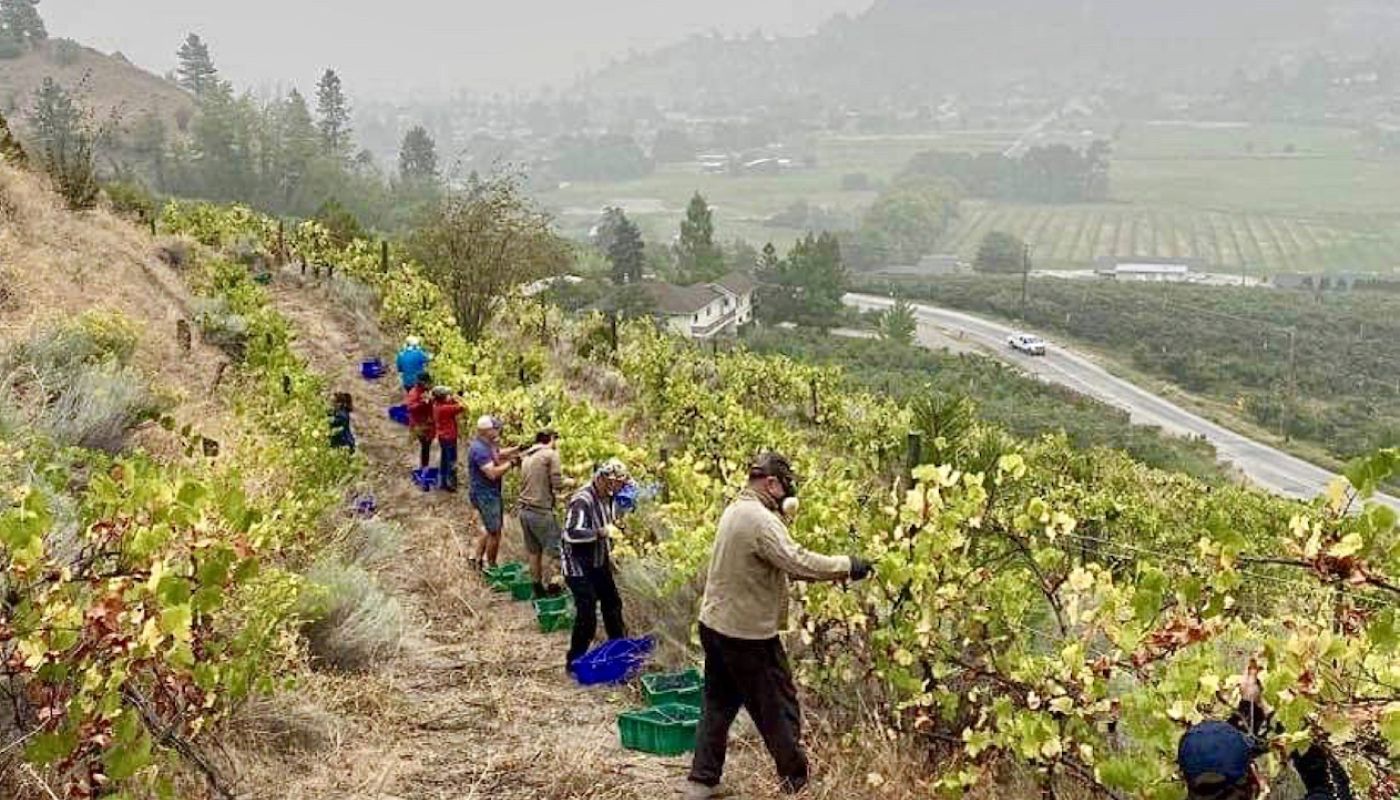
17 September 2020 Arnica Rowan lives in Okanagan, where the surrounding vineyards, such as this one at Lightning Rock in Summerland, British Columbia, are so smoke-affected that pickers have been given masks and respirators. Photo by Ron Kubek.
I could taste it, even before I opened my eyes. There was that restricted feeling in my lungs, and a bitter taste of ash on my tongue. I didn’t even need to get out of bed to know that our house would be surrounded by haze. Forest fire is too familiar an aroma, in the air and in wine.
Living in Western Canada, we are used to wildfires. More than 64% of my province of British Columbia is covered in forest – that’s 149 million acres (60 million ha) of trees, which naturally need to burn down every few decades in order to complete the circle of forest life. On average, 900,000 acres (360,000 ha) burn in our province each year. When I was a kid, my dad worked for the Ministry of Environment, and I remember helping him start controlled forest fires by lobbing flaming ping-pong balls out of a helicopter. Planned burns are still a technique used to control wildfires in Canada.
Planned or not planned, eventually all forests get older, drier, and they burn. Now, owing to climate change across the globe, hot and dry conditions are creating more and more uncontrolled fires. Vignerons in Australia, Chile, the USA, Canada and even Spain live in fear of flames harming workers, vineyards or buildings. But even more far-reaching than flames are the billows of smoke, poisoning the air and tainting the grapes.
When I got out of bed four days ago, I forced myself to peer out the window. I couldn’t make out the trees behind the house across the street – the smoke cover was that thick. A quick bleary-eyed news search told me the smoke was mainly coming from our closest neighbouring American states, Washington and Oregon. According to Alder Yarrow’s report published the next day, Washington had 500,000 acres (200,000 ha) and Oregon had one million acres (400,000 ha) on fire; California had an additional 3.4 million acres (1.4 million ha) burned or burning throughout the state. The longitudinal mountain valleys connecting America and Canada act like massive chimneys, sucking the smoke northwards. At the time of Alder’s report, the smoke was so bad that the Canadian postal service stopped delivering mail in many of our communities in Western Canada. Air-quality measurements in the usually pristine Vancouver and Seattle were among the worst in the world.
Out in our Okanagan vineyards, the beginning of the 2020 harvest was halted due to the dangerous air quality. Unlike their counterparts further south, not all Canadian wineries were bringing grapes in yet; some had just reached veraison. The smoke’s timing was impeccably bad – grapes are most vulnerable to smoke taint within two weeks of veraison, and from then until harvest they can be affected. My winemaking friends were universally having anxiety attacks, unsure how their wine will be affected, to what extent, and whether it would be smoke-tainted.
For those who haven’t experienced tasting wine laced with wildfire smoke, well, you are lucky. I hope you never have the opportunity.
Myself, I have the dubious distinction of being a trained smoke-taint taster. How did I earn such an unsavoury title? Well, when my chemist friend Matt was conducting his PhD research on smoke taint, he needed wine professionals to analyse the sensory experience of smoked wine. In the interests of science, I suffered through several blind tastings, exploring which compound levels can be perceived by expert tasters, and the effects of aroma additions to mask taint. Each tasting was a horrible experience, ruining my palate for days.
Smoke taint involves more than just the unpleasant classic aromas of campfire, ash and wood smoke. Tasters experience elevated levels of perceived tannins and alcohol; the wine tastes rougher and hotter than it actually is. With training, which I do not recommend, you can often smell the base fuel from the fire, such as a pine campfire aroma from a pine forest.
We all have classic markers for wine identification that relate to our memories. When I was 17, I lived as an exchange student in Germany. On the weekends, I frequented a dingy local café with my German friends who smoked unfiltered American cigarettes. When I taste smoke taint in a wine, however faint, it reminds me of that small, dirty café, with booze spilled all over the dusty floor, packed with the fumes of smoking, pungent teenagers. It’s not an experience most adults appreciate.
Sometimes, smoke taint is so dense and obvious that you can taste the ash in the grapes on the vine (as Jancis wrote about an Emperado Valley vineyard in Chile in 2017), but the more common scenario is wineries not knowing whether the grapes have been affected or not.
My friend Matt is now known as Dr Matthew Noestheden, the chief operating officer of Supra RnD wine and cannabis analytical labs. I reached Matt yesterday for a quick phone call, during a crazy busy day at his laboratory at the University of British Columbia. During our five-minute call, he sent three incoming calls from panicked California wineries to voicemail. There is such a high demand for sample-testing now, he is getting over 100 shipments from Napa, Sonoma and other wineries each day. I think he took my call only because he still owes me for the PhD tasting torture.
Matt quickly explained to me why predicting levels of smoke taint in wine is so difficult.
‘Grapes may contain chemicals that cause the smoky aromas’, he explained, ‘but the chemical compounds are bound in the grapes to other compounds, like sugars. It’s like they are hiding in the fruit. As chemists, we can test for them and recognise them – but you can’t taste those chemicals when they are bound, at least not in the grape. The winemaking processes of maceration and fermentation will break up some of those bound compounds, releasing smoky aromas. That’s why grape must might taste fine, but then the smoke taint will appear later in the bottle.’
You can see why winemakers surrounded by smoke are having anxiety attacks. No one wants their wine to taste like an acrid teen hangout, but often they have no idea if their wine is in danger until it is fermented and, potentially, aging on the shelf.
Although sending samples into a lab gives winemakers a heads-up if they have an obvious problem, or not, there isn’t a standard lab measurement to tell them if consumers will be able to taste smoke taint in their wines. Matt explained: ‘Science does not support definitive correlations between free and bound marker compounds measurements, and the sensory presence of taint in the wine. There isn’t a magic number because you can have differences in smoke markers related to geography, the fuel burning to produce the smoke, the variety, etc.’
If a winery has advance testing results and knows the grapes will surely be ruined, they can simply leave them to the birds and take a loss. As Tim Kirk told Max Allen in After the apocalypse earlier this month, when his New South Wales grapes showed ‘astronomically high levels of taint’, it ‘made the decision not to pick easier: if the results had been borderline, we would have um’d and ah’d and wondered if we could salvage the fruit.’
However, if the winemaker doesn’t get definitive results, or if labs are so backed-up that results aren’t available, or if the wine is already in tank or bottle before the winery knows they have a problem, then there are only so many options.
A winery can choose not to release a wine, such as Screaming Eagle’s 2017 Cabernet-based flagship wine. Instead, they can pour the must or wine down the drain, which is hugely costly. They may instead sell it off in bulk, to be diluted into other non-tainted wine.
Winemakers may also attempt to alter the wine physically before releasing it. ‘Some people swear by fining, nanofiltration or reverse osmosis’, says Matt, ‘but in my experience they don’t work all that well and also affect the quality of the wine.’ In her 2018 article Assessing smoke taint and fermentation issues, Elaine Chukan Brown concurred about the loss of phenolics through the use of reverse osmosis to treat tainted wine.
Winemakers may also play with additives, such as tannin adjustments, which have the strange effect of erasing the mid palate of a wine, as well as lessening the ashy aromas. These adjustments don’t, however, adjust the exaggerated hotness of the wine, so the wines may be drinkable, but fatiguing.
A common approach is to cross fingers, sell the bottles, and hope no one notices. You would think that the finger-crossing technique doesn’t happen that often, but I have personally tasted wine from four different continents that were smoke tainted and offered on the shelf. (Skills of a trained smoke-taint taster.) It happens more than you think.
The final technique is to embrace the smoke. Close to the US border, a Canadian winery made the questionable decision to release what they called a Fumé Franc in 2015. I never tasted it, but online reviews commented on the dark-berry and smoke aromas, and that it went well ‘with a big fat steak’. I’ll take their word for it.