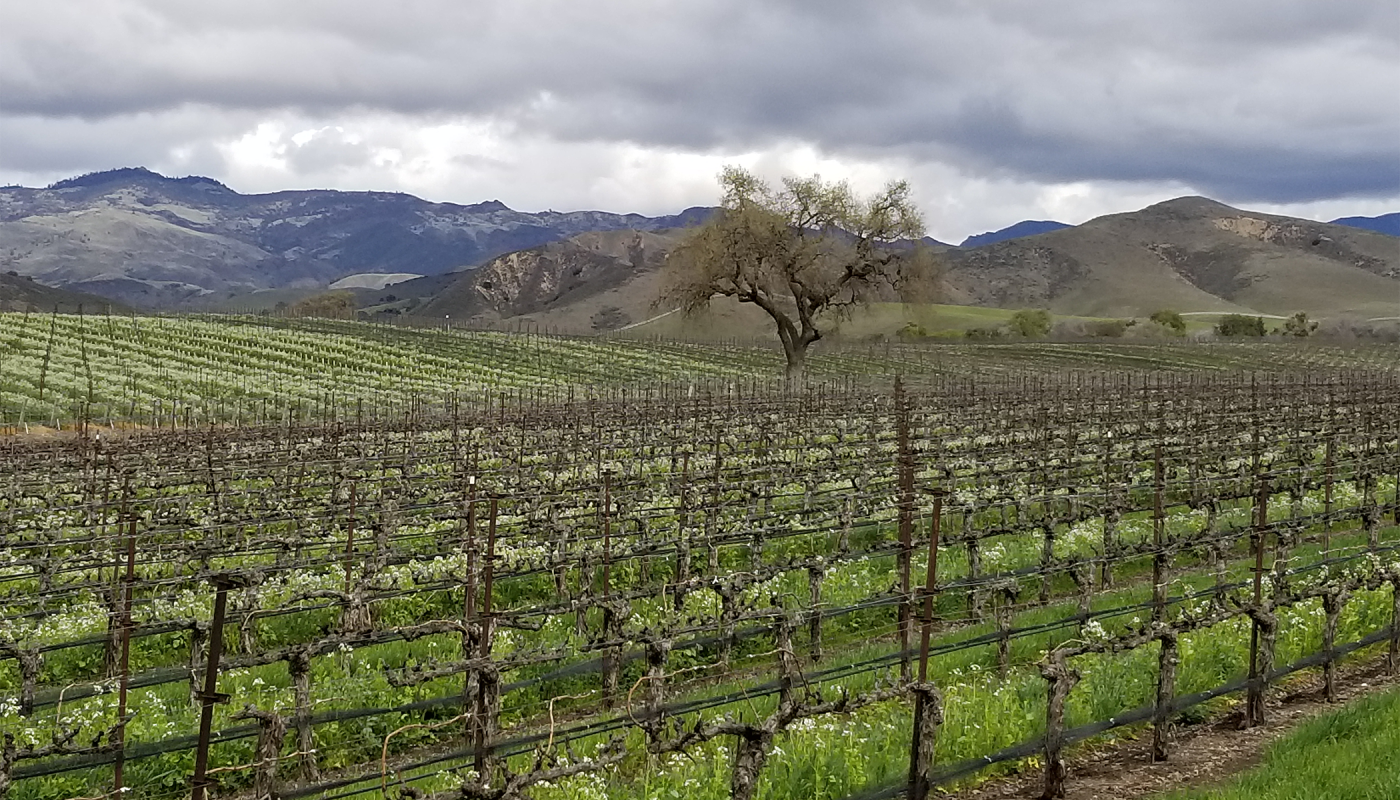
Dormancy begins with leaf fall.
Where I live, over the mountains from Santa Barbara in a wine-soaked valley called Santa Ynez, the calendar turns around the life cycle of the vine rather than following the cadence of the traditional seasons. The conventional wisdom of the northern hemisphere doesn’t seem to apply here. We don’t feel autumn chill until Thanksgiving, winter is January, and when the first 80-degree day arrives in early April, our people celebrate the return of summer like they thought it would never come. What a relief after those frigid 60-degree days in February. Instead, it is the rhythmical changes in the vines around us – seasons of dormancy, budbreak, veraison and harvest – that help us tell time.
The descent into dormancy is a beautiful death. Lingering leaves crinkle in the November winds, taking their final bow in costumes of gold and rust and burnt orange. The vineyards and the sweetgum trees that speckle town parks are our only arenas for fall foliage, but they do put on a good show. The vine masters call this stage senescence, when the leaves change and slowly die, and the energising sap goes home to the ground for a long sleep. The work in the wine cellars takes a welcome holiday. The bubbling energies of harvest have waned, and the fragrant grape spirit that filled the October air has dissipated. New wines have been entrusted to barrel, and the slow breaths they take through the wood will sustain them through winter. Tourists take their cue from the pace of the wineries, and, aside from the week of Thanksgiving and the week after Christmas, the tasting rooms fall quiet. The lone exception is a storybook Danish village called Solvang, in the heart of the Santa Ynez Valley, which looks like it was plucked straight out of the wintry slumber of Hans Christian Andersen. Solvang resembles a Christmas fairytale all year round, but during the holiday season it lights up like Santa Lucia and enfolds horse-led carriages of tourists in a cosy Yuletide hug.
For me, a gentle grief accompanies the fade into dormancy. It is a moment of wistful pause, a reflection on a season lived well but now departed. The sparkling, endlessly blue horizons of August are replaced by the close, steel-blue skies of December, and on the eastern side of the valley we are shaded by our first afternoon cloud cover since April. To the north the winter sunset casts swaths of dusty rose and garnet onto the San Rafael Mountains, the foothills in emerald shadow beneath. On the southern edge, thick fog foams like whitecaps over the Santa Ynez range. All the green growth that exploded out of the vines is extinguished, and in a few weeks the woody canes will be piled up like old bones and cremated into ash. I am glad for the wines that still breathe in the wineries after the lights are switched off, living memories of a harvest gone by. The past is not dead as long as there is old wine.
This is but a brief pause in the labour of the vineyard, because while the vines go dormant, vineyard workers do not. The first task is to sow cover crops. If, on a short January afternoon, you take a jaunt into the eastern parts of our valley, delightfully named Happy Canyon, with ages of unobstructed mountain views expanding before you, you will see hillsides covered with miles of auburn-tinged sticks, and, if there has been early rain, a lush carpet of green between the rows that conceals the loamy clay soils. This is cover crop.
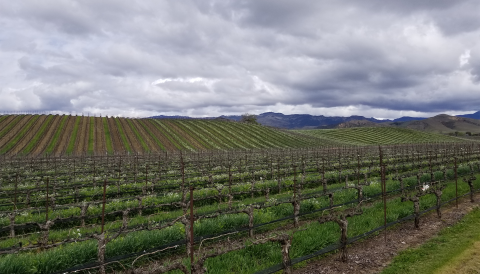
Sometimes the green carpet is woven with wild grasses and weeds, but usually it is a cocktail of seeds carefully mixed for the healing of the soil. The key ingredient is nitrogen. Plants like clover and peas capture the nitrogen out of the air and impart it into the soil. Nitrogen is milk for the vines: essential for growth and protein development. Cereal crops like barley, oats and rye also replenish tired soils with nitrogen and carbon, not to mention break up the dirt to allow for oxygen penetration. Cover crops are surprisingly clever little plants. They hold moisture, vital in an arid climate like Santa Barbara County, but have shallow roots that do not compete with the long roots of the vines. They prevent erosion in wet winters. They attract beneficial insects like ladybugs and lacewings that will prey on aphids who would otherwise feast on new spring growth like Easter brunch. And, with enough rain, peas will show off their soft purple flowers, and daikon radish its lily-white blossoms, until they go to seed.
Later in dormancy, winter pruning will begin in earnest. In other parts of the world, vines are pruned back in January or early February, but here pruning is delayed as long as possible. Pruning alerts the plant to start producing new growth. The temperate winters here threaten an early budbreak, which is a farmer’s nightmare, because the frost danger looms until April. If it weren’t for the plant enzymes that keep them in hibernation through the winter, the vines here would be rousted out of bed by a warm spell in February, and all our farmers would need therapy.
Almost all the vineyard work here is done by hand, and as we get closer to the annual springtime miracle the vines will be full of workers, pruning shears at the ready. The speedy and skilled teams of immigrant vineyard workers are the backbone of the wine industry here. Most of the old wood will be mercilessly snipped off, clearing the way for new growth. A few carefully chosen buds will be left on the arms of each vine. I have whiled long afternoons pruning in backyard vineyards with friends, and it is surprisingly complicated work, requiring a myriad decisions about what to take and what to leave. We would all start at the same time, but a couple hours later, my friends would be a glass in back at the house, and I would still be halfway down my row as the sun dropped behind the mountains, agonising over every cut. ‘Don’t quit your day job, McHugh!’ they would heckle me from behind a bottle of Sangiovese. But I know my row produced far better wine than their careless, unfeeling work.
Pruning is about energy management. It harnesses the energy of the plant to produce the best possible fruit. If you leave the vine to manage itself, it will pop out shoots and leaves in every which way. Vines care not for wine. Their only mission is to reproduce, and the birds seem to be quite undiscriminating consumers. Vines would produce a jungle of vegetation and a mass of watery fruit if it were up to them. It is up to humans to sculpt vines in such a way that just the right amount of foliage produces just the right amount of fruit. It is a high-wire balancing act. Vineyard managers try to match the vigour of the vine with its growing conditions, and to channel that energy into small amounts of choice fruit. In the shaping of grapevines, less is more.
The air over Santa Ynez tells us when pruning season is underway. The late winter winds carry primal aromas of smouldering branches, that ancient ritual that reminds us life will be reborn from the ashes. Truly in this dead season there are signs of life everywhere. In California it is the summers that are brown, and the winters are green. Parched creek beds start to murmur, and horses come out of their stables to feast on prairies of lush grass. It isn’t the revelry of budbreak, when the valley will burst in salvos of colour, but dormancy here is a verdant and bucolic season, a still and glossy pond waiting for life to bubble over again.
Dormancy is not the last phase of the vine’s annual cycle. It is the first season of the new one. The vines are barren, the leaves decompose, and the cuttings go to ash. Death is making a way for life.
Adam McHugh is the author of Blood from a Stone: A memoir of how wine brought me back from the dead, which tells the story of how he stumbled his way from hospice chaplain and grief counsellor in Los Angeles to wine tour guide and sommelier in the Santa Ynez Valley. (Read Tam's review here.)
















