
There was a time not that long ago when wine had much less social status than it does today, and a career in wine was viewed as a notch or two down from the professions or finance. Nowadays, especially in my role handing out Wine & Spirit Education Trust diplomas, I have seen a significant cohort of people leaving more lucrative jobs to pursue their dream of a career in wine.
One of the most pleasing side-effects of how much more fashionable wine is than a generation ago is that today it is so much more likely that wine producers’ children are happy to step into their shoes.
In fact the wine business is characterised by family involvement. So many fields of commerce are run essentially by a handful of giant companies that simply get bigger and bigger (the beer and spirits sectors, for example), but wine has managed largely to resist this sort of agglomeration.
Australia, a wine-producing country that has long embraced efficiency more than most, provides an exception. Two big groups, Treasury Wine Estates centred on Penfolds and Accolade focused on Hardys, have got bigger and bigger so that Australia’s family-owned wine producers have to work hard, not so much in order to make great wine, but to find a market for it.
In the over-regulated US there is a similar problem in that the biggest distributor, Southern Glazer’s, is so dominant that it can be difficult for small, family-owned wine producers to find space on retail shelves. This has had the effect of encouraging much more profitable direct sales via mailing lists and websites, difficult as it can be to ship to certain states.
But in very general terms, multinational corporations are not a major feature in making and selling wine. Instead there are many more flourishing dynasties than in most sectors of commerce.
A debate was recently organised by the Distillers Company, one of the old City of London trade guilds and one that operates in a sphere very much dominated by large companies, in which the motion was ‘this house believes that family companies think about the long term, publicly owned companies focus on the now’.
Although most people listening to the debate were presumably in the spirits business, the motion was proposed by Lizzy Rudd, chairman of family wine business Berry Bros & Rudd, and opposed by Colin Gordon, formerly of IDV, as the spirits division of multinational Diageo used to be called.
Lizzy Rudd pointed out that, while the average tenure of a CEO in public companies is between four and six years, the average for family companies is 25 to 28 years. Mind you, this presumably is not necessarily an advantage. Her father John Rudd has been on the Berrys board for 72 years, and is rumoured to insist on keeping his hand on the tiller, even at the age of 92…
Longevity and personal relationships do have their advantages though. She pointed out that Berrys has been dealing with some Burgundy domaines for 35 years. One imagines that it would be difficult for a public company to maintain such loyalty.
Colin Gordon argued that public companies could afford to have a broader portfolio than smaller, family-run ones, thus hedging against the whims of fashion (who would have thought even 10 years ago that gin would suddenly become so fashionable, for instance?). They also tend to be much more widely spread geographically, so are better protected from local crises, he maintained, and they generally have enviable access to cash and R&D capability.
He reminded us that IDV was created basically to ward off a hostile takeover (a common genesis for public companies) and was clearly proud of all the products the company created in the 1980s, its innovative heyday: Bailey’s Irish Cream (‘the single most successful brand ever created in our industry’), Malibu and, erm, Piat d’Or (the table wine brand that, its ad campaign memorably but erroneously assured us, ‘the French adore’).
A vote taken before the debate clearly showed that the majority were in favour of family companies, and the same was true when a vote was taken at the end of the debate even if the margin had been trimmed a little by the persuasive arguments of Colin Gordon and the wit of his seconder Tristan Van Strien, a financial analyst specialising in the drinks trade. Strien’s slogan was ‘the liquor industry landscape is littered with the dry (or was it dead?) bodies of second-generation family members'.
It is certainly true that in certain wine regions, particularly Burgundy, the temptation to sell family-owned domaines must be almost irresistible, now that the luxury goods business LVMH and Artémis Domaines, the wine interests of French billionaire François Pinault, have pushed Côte d’Or land prices to almost unbelievable heights.
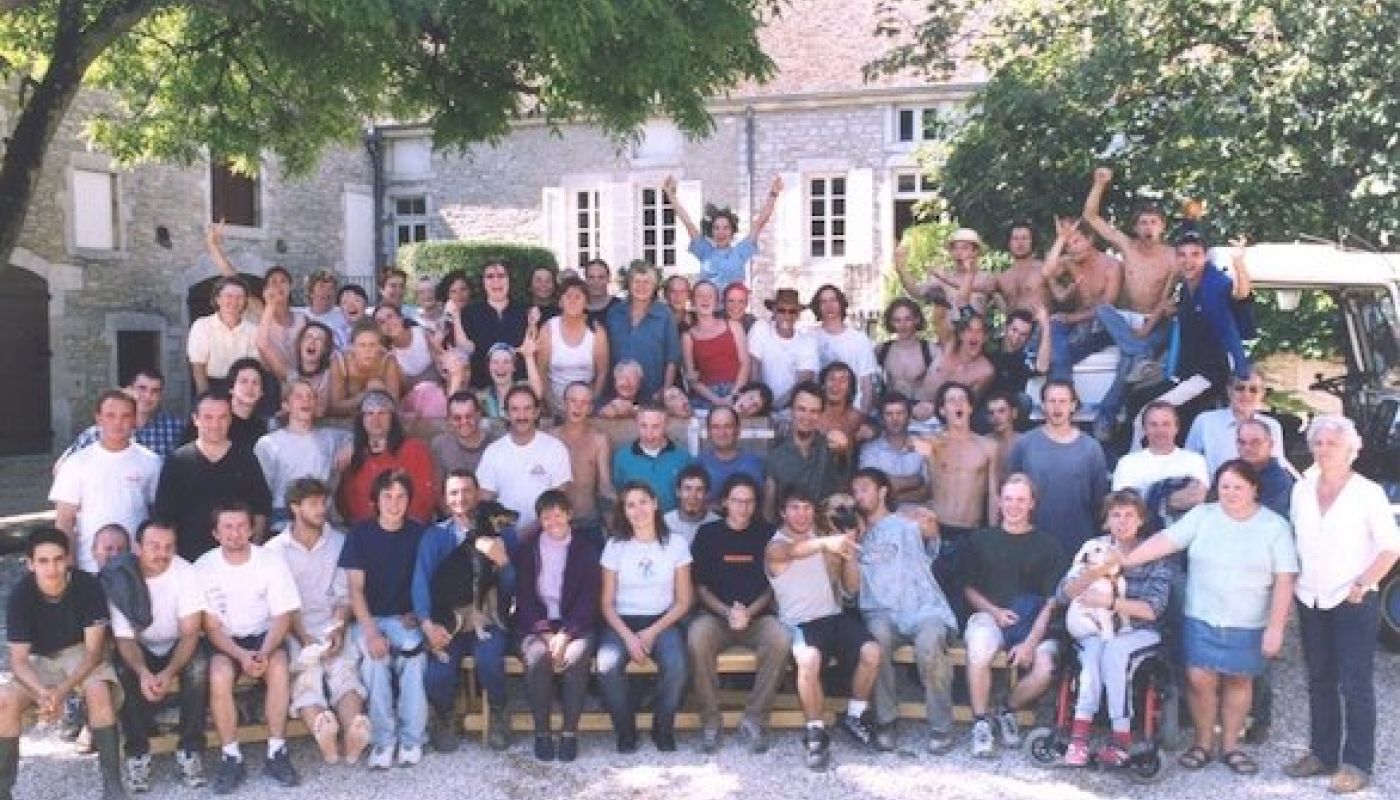
Typically, thanks to French inheritance laws, a domaine will belong to multiple family members, only one or at most two of whom actually live and work at the domaine and care that it has a long-term future. It is quite understandable, if tragic for the soul and traditions of Burgundy, that sleeping partners might wish to swap an annual dividend for a massive payout. The number of distant family members who are shareholders in the world-famous Domaine Leflaive of Puligny-Montrachet, for instance, is several dozen. (The picture above is of the 2003 harvest team in the Leflaive courtyard, Anne-Claude Leflaive can be seen on the extreme right.)
When in April Cava giant Codorniu rejected a takeover from the American investment fund the Carlyle Group (just after the latter had swallowed up Accolade from their previous Australian investors), it was reported that the Catalan company is owned by literally hundreds of family members. I can imagine that it could be difficult to come to a majority decision (although they did finally agree to sell a majority stake to Carlyle at the end of June).
If a family company decides against selling out, then succession is the big issue. Another world-famous family-owned white burgundy producer, Domaine des Comtes Lafon of Meursault, are having to decide who will succeed Dominique Lafon to run the business. Apparently five members of the next generation volunteered and a sort of head-hunting process was needed to choose the two best candidates.
I for one heartily celebrate the fact that the wine business is run by families rather than corporations with their changing roster of personnel. Long may this continue.













