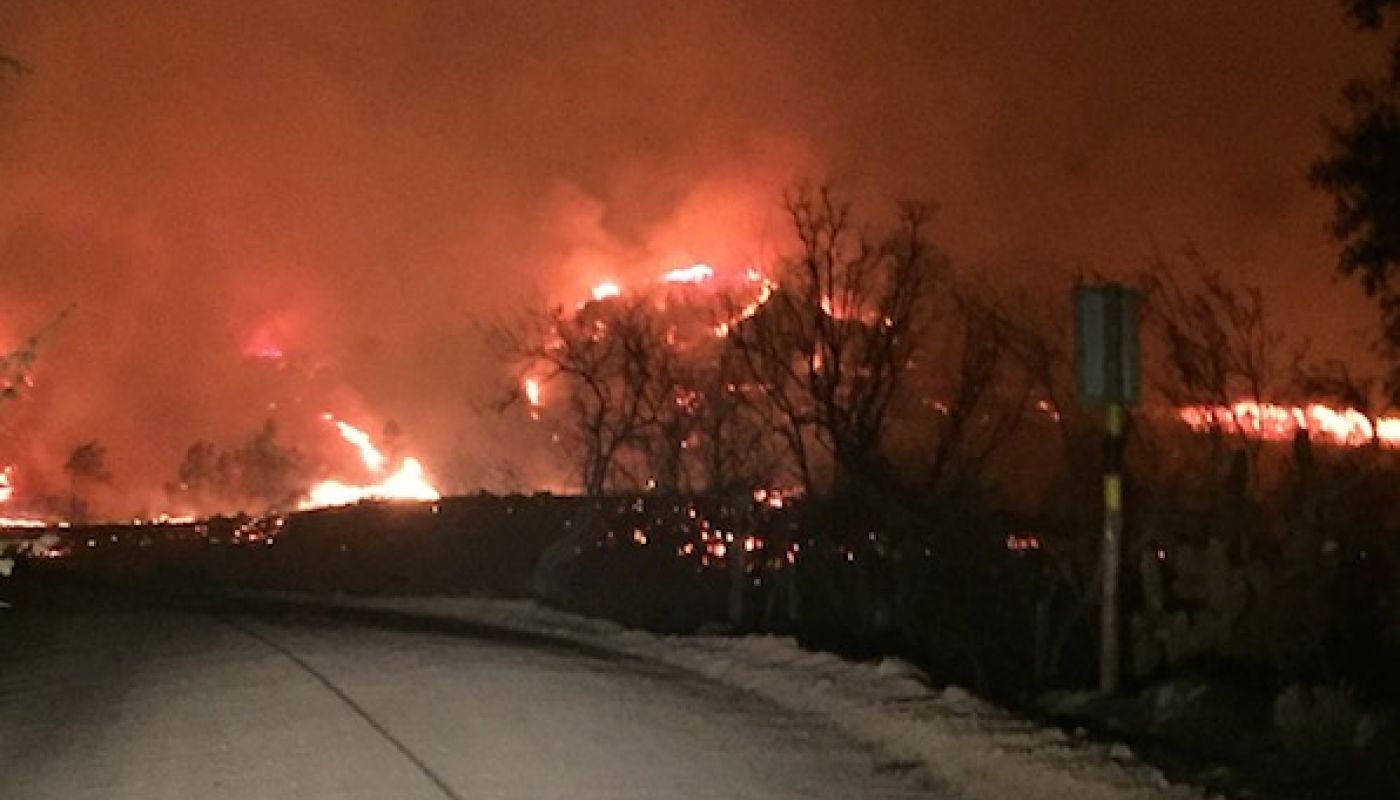
30 January Central Chile is currently suffering an unprecedented number of active fires – almost 80 – some of them affecting vineyards, including dry-farmed old-vines in the Maule, Itata and Bío-Bío regions where forestry companies have been planting indiscriminatingly for decades. Derek Mossman Knapp, who shared his account after the earthquake in the Maule back in 2010, reports on the fires from the perspective of the small farmer in the areas where he works, where the only green in the landscape after the fires have ravaged the forests are the age-old dry-farmed vines of the smallest producers in Chile – the vignerons of the Secano. He also took the devastating pictures.
Marco Antonio de Martino adds The situation keeps getting worse as the fires head southwards. Parts of Itata and Bío-Bío are under fire and it is very hard to predict how things will evolve. Luckily we haven't had any major problems, but Portezuelo in northern Itata (many small old País vineyards there) is under fire currently. Many say the origins of the fires are intentional but police haven't been able to determine this and new fires continue to appear.
Derek Mossman Knapp writes It’s dawn and much cooler today albeit still smoky. The calm lends time to make a plan for another day. Firebreaks have been dug with a borrowed digger and backhoe. Water from the cellar has been drawn and stored in the empty tanks (harvest is still a long way off). Every portable container available – from barrels and picking bins to the tractor used for spraying sulphur that has been adapted to disgorge water – is at the ready. Neighbours and friends volunteering are gathered hoping the afternoon sparks can be prevented from burning homes and winery installations. How many times have we heard wine folk speak about daily temperature variation and its positive effect upon the fruit? The current nightly cooling is the only thing slowing the flames down.
The fire will most certainly pass across the hills above us where forestry companies have a large tract of trees that stretch the 6 km westward to the approaching flames moving slowly across the cool dawn – for now without any tailwind from the coast.
It is hard to know where and when the flames and/or the burning ash will come down the hillside towards us. As the fire slowly approaches we make scouting missions up to the front line to see where and how fast the fire is advancing. Along the road fire brigades – from all over Chile now – advance ahead of the fire to protect homes along the roadside, but there is no means of putting the main fire out. Makeshift pools are filled by constantly arriving water trucks – most of these bulk-wine transporters – and the brigades then use the pools as their source of water.
On one of our many loops to survey the situation, a forestry firm´s truck with two white-helmeted supervisors stops us to ask how to get to a certain farm. They don´t know where their own farm is and have to ask the locals! I cannot help but think: where are the forestry firms and all of their resources? And how is it that with so many thousands of hectares of trees ‘under management’ that none of them seems to have had a plan for even a fraction of this? Their soil scientists knew full well that the pines have been drying the soils, just as surely as tobacco firms knew nicotine was addictive.
How did we ever allow such indiscriminate planting of a monoculture? What changes are needed in the wake of these fires? Surely the invisible hand of the open market has let Chile down abysmally.

Yesterday we spent the day in Sauzal and Puico further upwind behind the lines. There the fire had passed through the afternoon before and embers were still smoking. Small fires would begin again here and there, but would soon be doused by farmer´s children with buckets.
Here the locals had joined arms with neighbours to apply water and shovels of dirt on fallen flying ash, or pavesas. Various homes on the outskirts of town were lost because it was just too difficult to defend them with the meagre resources and water available, but these two towns at least were saved – unlike others close by.
Good friends with a winery in Villa Alegre sent four trucks full of water – trucks usually used for shipping bulk-wine. They played a large part in preventing a larger tragedy. The four had been distributed all around town and the water stored in barrels and bins alongside homes for fighting the fire. To make matters worse, there was no electricity as wooden power lines had come down with the fire. Poles with transformers still attached were scattered along the road burning ever shorter.
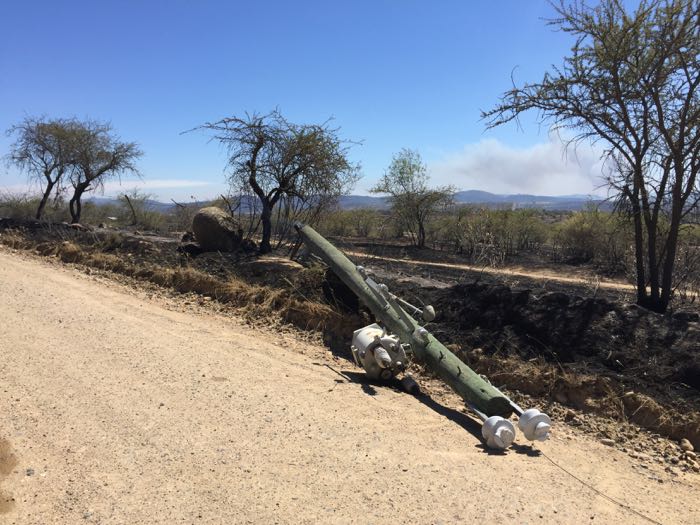
After two long nights of vigilance, and a day fighting flames, the sleep-deprived townsfolk walked about in the heat -- almost 40 ºC -- murmuring about wind direction and temperature. Some of the local volunteer fire brigades slept while others prepared for the afternoon. When smoke was spotted behind a surrounding hillside, word travelled across town and a small convoy of pickup trucks set out to extinguish the recurring flames.
These fires are different and they are worse. There are days of preparation full of angst before the flames arrive, then the flames themselves, and afterwards when the fires seem to have passed, they begin again, seemingly incessantly. The landscape is certainly more deeply scarred than in 2010. While the earthquake demolished homes, this time round people have managed to defend their homes from the flames, but their farms and much of what grew on them has been left scorched black. Fencing wire dangles between fields without the support of burned wooden posts. Gates have been transformed into ash. Animals that survived are still loose and are slowly being rounded up and taken to the town´s rodeo installations with everyone´s livestock mixed together.

The only green on the landscape here are the age-old dry-farmed vines of the smallest wine producers in Chile—the vignerons of the Secano. In some cases, the vineyards literally acted as fire-breaks.

Many vineyards old and new have not fared as well, however, and have been scorched – above the ground. It will take years to coax them back to proper production. Travelling from town to town with supplies of drinking water and hay bales for the animals one begins to recognise a pattern. In and around where we grow grapes at least, the vineyards that have been left uncultivated in recent years have fared far worse than those cultivated traditionally. The uncultivated had dried grass and weeds between the rows that grew up after an atypical December rain. These weeds drew the flames into the vineyard.
Perhaps this is the moment for the wine trade to reflect upon the low prices paid for this fruit over the past several years. Perhaps the industry doth protest too much when justifying low prices as being the product of an open market?
Let us remember that these age-old roots beneath the ground have been pushing life upwards every spring for more than a century. This small man-made calamity above ground will not stop them any time soon if the farmers have the will to lend purpose to this work. They will be back. It is telling that next to the green revolution´s ruined fast-rotation forests, these meek vines stand tall and green, a testament to traditional agriculture. Many crops have burned on these mixed farms and many vines have been singed around the edges, but these vines will give fruit this harvest.
Just as there were striking pictures of cracked roads and fallen adobe homes in 2010, today there will be haunting images and video clips of burning vines. But after this hunger for sensationalism and accusations directed at the politicians, what will be done? What will we learn from this?
Land or hand?
When tasting wine people often ask the question of ‘land or hand?’ Man´s hand was surely involved in the starting of these fires. It is difficult not to think that some part of this was avoidable – the hand of man is all over it. What is clear, even amid the smoke, is that even with billions of dollars’ worth of trees planted all over the region, no one had a real plan. It is the pines and eucalyptus of the forestry conglomerates that spread the fires. While their tree tops are green, the approaching heat quickly dries them out and then – poof! – the fire destroys the trees row by row. But the havoc has wrought damage far beyond the man-made forests.
Shame on these firms for not being better neighbours. It seems that in the crux of the moment the social responsibility and sustainability promised in their boardroom and on their website is far from their true colours based upon the actions of these days. Many more fire breaks were required, as well as more stand-by equipment, better training, and clear calls to action. In future Chile will need a proper contingency plan that perhaps should include a crowd-based Waze-type of app to allow the crowd on the ground to outsmart the erratic fires together. Central political command is no match for fire.
Conclusions
We have before us a tragedy both social and environmental, but perhaps with time if we choose to look a little deeper we can see a small piece of much larger challenges with ramifications far beyond Chile.
The question of scalability within the green revolution needs questioning. There are lessons from traditional agriculture to be applied. While it is natural for any young industry to ignore the past while growing up, eventually one must return to embrace it. Industries planting monocultures at scale may offer jobs and a certain progress, but how can we make these sustainable in the long term?
Water rights in Chile need serious revision and discussion. How can so much water have been tacitly given to the forestry firms for 100 years under Decree 701? Was there really enough water in these valleys to have given so much away? How is it that modern vineyard plantings destined to be machine harvested in these areas have access to water rights, when small farmers are forbidden from digging a new or deeper well? The runoff waters, the property of these ancestral farmers, are diminishing year on year as the newly planted forests slurp up the rains. And yet the original farmers have no access to water from deeper down on their own lands as fair compensation. If they had had access they could have done more to put out these fires.
I wish to acknowledge the admirable works and heroism of the volunteer fire brigades of Chile and the tremendous crowd-sourced relief efforts that arrived with help in the zone of the fires afterwards. In more than 12 years trundling about on these small roads of the Maule I have never seen so much traffic. I saw convoys of pickup trucks and cars full of the things the people will need to rebuild and get on with their lives. Some look organised, but many seem to have come of their own volition. The capacity of ordinary people in Chile to organise and get going in the face of hardship is astonishing.

I wrote this from my own experiences in these days in the Maule, but the fires are by no means limited to this one area that I know. While I recognise that any and all errors in the above are solely my own, I must share credit for the ideas and experiences shared by many people: Felipe Zuñiga of VidSeca in Cauquenes, Renan Cancino of Huaso de Sauzal, Daniela Lorenzo of Gonzalez Bastias, Andres Sanchez of Vigno Vignadores de Carignan, Daniela at Gillmore Vineyards, Sergio Amigo at Cancha Alegre, Eduardo Jordan at De Martino, Cristian Llanos in Portezuelo, ploughman extraordinaire Cristian Cancino in Puico, Waldo Orellano in Truquilemu, and Nivaldo, Otelia and family in Sauzal among many more.
















