Last weekend in Germany it seemed as though the Germans do many things so much better than we British. Admittedly it was sunny and springlike, which helps wherever you are. But in Mainz, Rheinhessen and Franken I could not help noticing how relatively prosperous and healthy everyone looked. The countryside seemed to have been designed with walkers rather than drivers in mind. Eating outside in a courtyard in the middle of Würzburg I saw not even a hint of the sort of rowdyism and general unseemliness that scars so many British town centres.
In a way I was there because of the devastating air-raid on this historic Bavarian city by the British six months before the end of the second world war. If the city’s famous churches and other religious institutions had not been so effectively wiped out in a few minutes of sustained bomb attack, destroying not just 90% of the buildings but also all of their archives and, incidentally, all the wine in the cellars of the three famous ancient institutions – the (rebuilt) bishop’s residence that dominates the city, the Bürgerspital and the Juliusspital – then there might not have been a 350th anniversary celebration of the Silvaner grape here in Franken last weekend.
As it was, dozens of us from the US, UK, Japan, Italy, France, Germany and Norway (now a prime market for fine German wine) gathered at the headquarters of the Castell estate, invited by 26th generation Ferdinand Graf zu Castell-Castell to marvel at his family’s extraordinary archive, housed in its own substantial stone house in the little town of Castell in the county of Castell, next door to the seat of Germany’s largest private bank (yes, the Castell Bank). Thirty years ago the first-ever mention of the Silvaner vine in Germany was found on a document dated 1659. (The discovery was relatively recent because the vines were then called Österriecher, or Austrian, and it took time for the Castell family’s archivists to make the connection.)
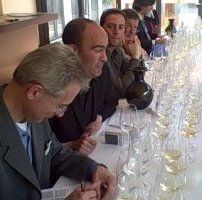
As is wine folks’ wont, we celebrated with a tasting – in this case a tasting of 27 of the finest Silvaners ever made, chosen by the Italian German wine specialist Professor Dr Gian Luca Mazzella. Silvaner is famous for being a grape with a history, being the most planted in Germany in the first half of the 20th century. It also has some quite demanding viticultural requirements, but no particularly strong flavour. What this tasting of wines from Alsace, Alto Adige in Italy, Pfalz, Baden, Rheinhessen but most of all Franken showed us was that its very lack of dominant aroma made it a thoroughly effective messenger for the many different soil types on which it is planted. We wallowed in a weekend of Myophorium, Estherium, Musselkalk, Keuper and Gipskeuper. Translations may have been difficult but the sensory messages were clear.
And if Gian Luca included a preponderance of magnificent sweet Silvaners – including four Trockenbeerenauslesen – then it was to make the point that great Silvaner, or Sylvaner as it is known in Alsace, does not have to be bone dry to be good, even if most of the best young Silvaners we tried were, with the extremely noble exception of Horst Sauer’s Eschendorfer Lump 2005 TBA. And the oldest wine of our tasting, one of the last bottles of 1915 Schloss Hallburg in the ancient Schönborn cellars of Franken, was bone dry and still one of the freshest apparently when the home team revisited the dregs in the opened bottles the evening after our tasting.
Dry v sweet in German wine is a highly contentious issue with some critics of Germany’s new wave of dry wines sceptical that a wine made from Germany’s most famous grape, Riesling, can be both good and dry. I had experienced another example of how well Germany can do things the day before this Silvaner celebration when television producer Markus Vahlefeld invited about 20 of us to compare some of the finest dry, mature German Rieslings with some other great dry wines of the world for a programme on wine he is making for the Franco-German Arte channel. His methodology was to sit us all round a table in the beautiful, modern Kühling-Gillot winery in Bodenheim just south of Mainz (overlooking a stunning garden), serve us a succession of great wines and delicious lunch dishes, and then film our comments on what we learnt at the end.
Compare and contrast with how the BBC made their last tv series on drink. My wine writer colleague Oz Clarke and co-presenter James May of Top Gear were expected to tour Britain with a leaky, rusty 30-year-old caravan for overnight accommodation.
Admittedly we were helped by the generosity of wine collector Karl-Heinz Frackenpohl, who was sufficiently curious about the outcome of the Bodenheim comparative tasting to donate virtually all the wines. This was a not inconsiderable feat since we compared flights of wines – up to eight at a time from Germany and the rest of the world – from the vintages 1989/90, 1993, 1998 and finally 2001.
We did not taste blind, but since the non German wines were such a mixture – from Corton-Charlemagne and Chevalier-Montrachet to Araujo, Eisele Sauvignon Blanc via Gravner Sauvignon, Coulée de Serrant and Chave Hermitage Blanc – this was probably a good thing. Otherwise we would have spent the whole time trying to identify the non-German wines.
But several general conclusions were apparent. We began by comparing a set of 1989/90 dry German Rieslings with a collection of French classics including two grand cru 1990 white burgundies but going back to a Domaine de Chevalier 1979 Graves Blanc. With the exception of a couple of medium-dry Mosel 1990s, the dry Germans had aged much less gracefully than the French wines and seemed to have lost their fruit.
From 1993, however, the German dry Rieslings more than held their own, and by 2001 these ‘dry’ wines were tasting much less austere than their 1990 counterparts had done – probably partly because of climate change, but also because German vintners today are so much more skilled at making well balanced dry wines – as had been clear at yet another tasting the night before of some of the greatest dry Rieslings of Germany (and Austria). I urge you to investigate them.
SOME CURRENT FAVOURITE DRY GERMANS
These were the most impressive dry German wines I tasted last weekend. Try www.wine-searcher.com for stockists.
Breuer, Nonnenberg 2001 Rheingau
Bürklin Wolf, Forster Kirchenstück GC 2001, 2005, 2006 Pfalz
H Dönnhoff, Hermannshöhle Riesling Grosses Gewächs 2005, 2007 Nahe
Fürst Löwenstein, Kallmuth ‘Asphodill’ Silvaner 2007 Franken
Keller, Hubacker Riesling Grosses Gewächs 2002, 2004, 2005, 2007 Rheinhessen
Rudolf May, Wellenkalk Silvaner Spätlese trocken 2008 Franken
Horst Sauer, Lump Silvaner Grosses Gewächs 2007 Franken
Emrich Schönleber, Halenberg Riesling Grosses Gewächs 2001-2007 inclusive Nahe
Robert Weil, Gräfenberg Riesling Grosses Gewächs 2002, 2004, 2006 Rheingau
Weltner, Küchenmeister Silvaner Grosses Gewächs 2004 Franken
Stefan Winter, Leckerberg Riesling trocken 2007, 2008 Rheinhessen
See the three most recent tasting articles for full tasting notes.