
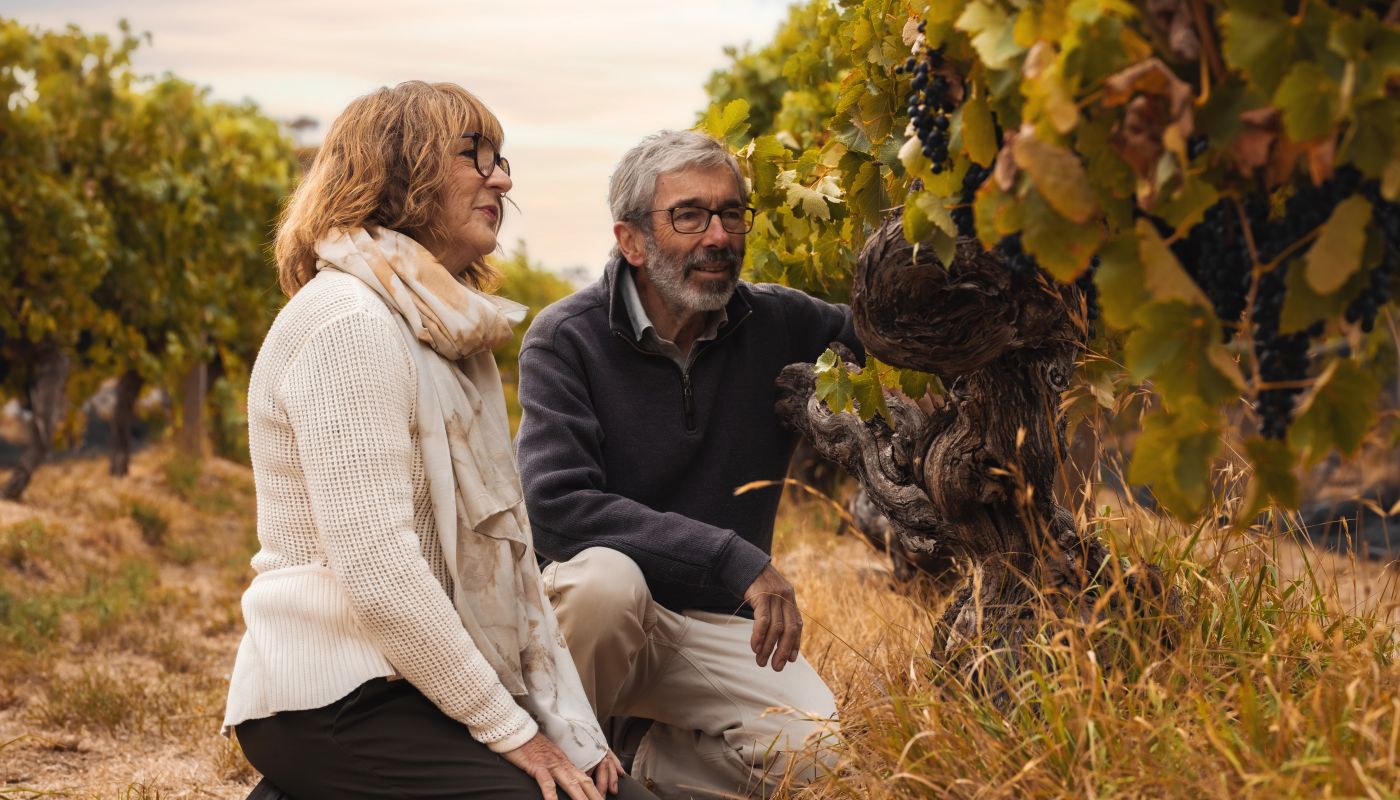
29 March 2023 A look forward and back at this venerable Eden Valley estate. Above, Prue and Stephen Henschke (photographed by Duy Dash).
Max writes Gwyn Olsen is on her best behaviour. She’s sitting at the ‘top table’ alongside Stephen and Prue Henschke and their eldest son Johann – Australian wine royalty. The four of them are facing a room full of wine media and trade assembled for a 60-year retrospective of the iconic Hill of Grace Shiraz, and a preview of the top Henschke wines from the 2018 vintage. Olsen started working as senior winemaker here in January this year, and this is her first public appearance in her new role. No pressure, then.
Olsen has come to this remote corner of the Eden Valley from the far-off Hunter Valley, where she spent many years developing a fine reputation at Briar Ridge and then Pepper Tree wineries, making top examples of the Hunter’s signature white: crisp, lean Semillon.
So, when discussion at the tasting turns to the 2018 Hill of Peace, a Semillon produced in painfully limited quantity from a half-hectare of near-60-year-old vines on the Hill of Grace site, all eyes turn to her.
‘It’s not Hunter Semillon, is it?’ says someone cheekily at the back. Someone else adds: ‘No, it actually tastes of something!’ And everyone laughs.
‘No, it’s not Hunter Semillon’, Olsen smiles, the ice broken. ‘And the lovely thing is, it’s not trying to be.’
She talks about how she can taste, in this white wine, the same interplay between acidity and fruit flavour that is the hallmark not only of the (much more) famous Shiraz grown in the same spot, but also the Riesling and Mataro planted here.
‘It’s a testament’, she says, ‘to Stephen and Prue and the family’s work maintaining these little parcels (of vines) that each tells a different story of the same bit of earth. I think it’s quite a fascinating way to look at them.’
Stephen Henschke obviously approves of his new employee’s interpretation (not that it’s an audition: Olsen’s already got the job). He responds by asking a question that has been put to him many times over the last few decades, as the price of – and demand for – Hill of Grace Shiraz has grown and grown.
‘You might think, well, why don’t we just pull everything else out and plant the whole vineyard with Shiraz?’ he says. ‘But it’s history. When my uncle Lou planted Semillon and Riesling and Mataro here [in the early 1950s, before Stephen’s father Cyril started bottling Shiraz from the older vines as a single-vineyard wine] it was really a time when people tended to hedge their bets. And so, you keep that (tradition). It’s an interesting, important story of what Eden Valley’s all about.’
Well, you keep most of it. History hasn’t quite saved all the vines at Hill of Grace.
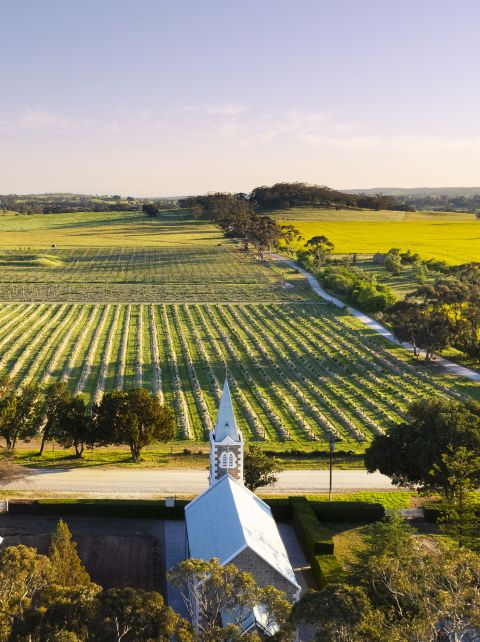
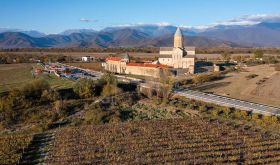
When I first visited Henschke in the mid 1990s, I was surprised to learn that one corner of this famous vineyard – the corner across the road from the much-photographed Gnadenberg church, next to where the Semillon is planted – still boasted a few rows of Sercial grapes. The vines were a legacy of the days when Stephen’s ancestors mostly produced fortifieds and the Sercial was used to make an Australian approximation of ‘madeira’.
But a few years later, with the popularity of Australian fortifieds in freefall, the Sercial was removed to plant a collection of Shiraz vines, propagated from cuttings Prue Henschke had taken from a selection of the oldest vines a few years before. These mass Shiraz selections are part of a comprehensive, long-term project Prue initiated in the mid 1980s after returning from studying viticulture at Geisenheim.
‘Uncle Lou and I worked together to select the material’, she says. ‘There was a little block of land he wanted to plant next to the Post Office Block [half a hectare of Shiraz he’d planted in 1965 across the road from an old, ruined post office]. So, we selected cuttings off the Grandfathers [the original 1860s Shiraz vines at Hill of Grace] and put them in the new block [in 1989]. This gave us an opportunity to compare wine made from young and old vines side by side on the same site. And that was pretty exciting.’
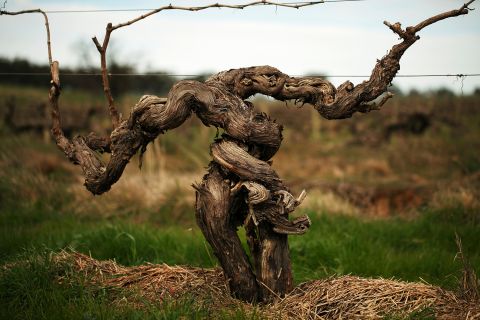
By 2001, the vines from the new block were producing wine good enough to be bottled on its own, under the Hill of Roses label. It wasn’t until the late 2010s, though, that it started to taste like the wine from the adjacent block.
‘We thought, well, it’s going to be interesting to follow the characteristics of a young vineyard, to see when it starts picking up that beautiful five-spice character we see so obviously in the old vines’, says Prue. ‘We waited, I suppose, 25 or 30 years before we could pick it up. Maybe this is an epigenetic story: we actually saw those vines tune themselves into that site and begin to present those characteristics. Which ties into the [question] of “what is an old vine?”: perhaps 35 years [the minimum for consideration as ‘old vine’ in the Barossa Old Vine Charter] is the right age to say, yep, a vine has adapted to a site.’
Tasting the Hill of Roses and Hill of Grace side-by-side is a fascinating exercise. The other two top Shirazes released each year by Henschke are a clear demonstration of the influence of site, vine age and elevation: you would expect Mount Edelstone, which comes from 100-year-old vines grown at 400 m (1,312 ft) to taste different from the Wheelwright, from 50-year-old vines planted 10 km (6 miles) away at 470 m.
But there’s a difference, too – as much as there are similarities – between the vines that produce Hill of Roses and Hill of Grace, despite being made from the same genetic material and planted side-by-side in the same soil, in effectively the same way. And it’s not a measurable difference, recorded in TA or pH. It’s something you can taste.
Prue Henschke describes the older-vine wine as having more complexity, a distinctive quality to the mid palate. Stephen describes it as an extra density. But Olsen thinks that, irrespective of vine age, there is also an intensity and tightly wound quality to the tannins in both wines that is a hallmark of the site.
‘Maybe one day, once the science catches up to being able to analyse every single compound that exists in wine, we might then have an answer to the analytical question of what makes these wines unique’, she says. ‘But at the moment, that’s where the magic is, I guess.’
The wines
The tasting notes that follow are in two parts: the first features Max’s report on the 60th-anniversary tasting of 26 vintages of Hill of Grace, grouped by decade, from the very first, 1958 vintage through to the 2018 tasted alongside the other new releases from the Hill of Grace site; the second part comprises Jancis’s reviews of the full set of Henschke’s new releases, tasted in London. The single-vineyard 2018s will be released on 3 May 2023.
Hill of Grace anniversary tasting
All wines tasted non-blind at the winery, 28 February 2023.
Sixty years of Hill of Grace, 1958–2018
Unlike in 2013, when the Henschkes opened every vintage of Hill of Grace released up to that point – a tasting that Jancis attended and reported on here – this time around, we tasters were treated to a ‘mere’ 26 vintages. Not so much a ‘greatest hits’ line-up (a couple of the vintages – looking at you, ’68 – could hardly be described as ‘great’), more a lingering snapshot of the major changes in winemaking philosophy that have characterised this label over the last six decades.
1958 and the 1960s
Stephen Henschke describes the wines from the 1960s as having a ‘naturalness’, reflecting the organic-by-default traditional viticulture and his father Cyril’s relatively technology-free winemaking.
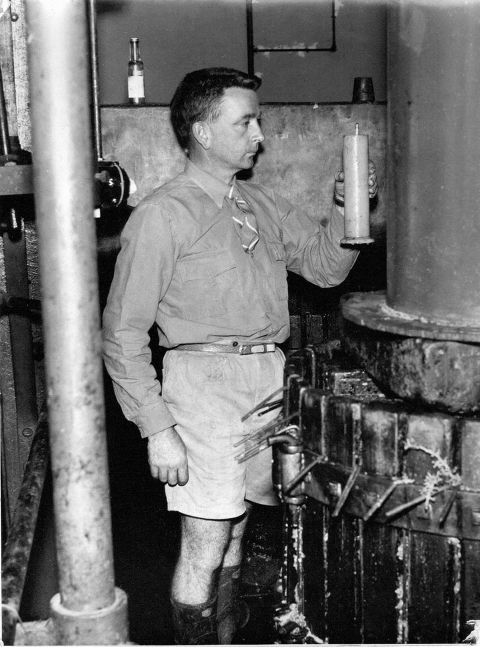
As Cyril told a journalist in 1967: ‘The new breed of winemakers worries me. The art is being lost and science is taking over. A tendency is growing to use laboratory techniques to get quick results which would be achieved in the natural way if wine were left to itself. The natural way seems better to me.’

The first year that Shiraz from Hill of Grace was bottled on its...
More density and fruit weight than the 1958, more harmonious and...
Good dark, dense colour, some red fruit still hanging around...
From a famously warm, dry, low-yielding vintage in South...
Not a great vintage (hot and dry) but the Henschkes’ 100th...
1970s
This decade, Stephen says, was about chasing a ‘Euro-style elegance’: the introduction of cultured yeasts, picking earlier, refrigeration in the winery, etc.
Looks and smells quite developed, noticeable browning in the...
Complex and unusual aromatics – a touch of eucalypt, some dark...
Dry, low-yielding vintage.
Savoury aromas, some iodine, coffee...
1980s
Stephen and Prue took over at Henschke after Cyril’s death in 1979 and through the 1980s began to introduce ideas and techniques they’d learned at Geisenheim: ‘We felt we were invincible because we’d studied overseas’, says Stephen. Cooler ferments, more focus on primary fruit, newer, fresher oak.
Considered a classic vintage: mild growing season, heatwave...
Despite Henschke rating this as an ‘exceptional vintage’ this...
Considered one of the great vintages of Hill of Grace, and still...
Tasted in the reputational shadow of the 1986 and coming from a...
1990s
The 1990s saw Prue’s work in the vineyard – mulching, composting, re-trellising – begin to pay off, with more fruit expression and definition in the wines.
Another Hill of Grace that comes with a stellar reputation...
Unlike 1990, this vintage was characterised by a hot summer and...
Cooler growing season than 1991, higher yields, later vintage.
B...
Mild summer and long, cool, dry autumn.
Very youthful ripe berry...
2000s
The 2000s Stephen describes as a decade of ‘refining style’, seeking more consistency and clarity in the wines, marked by the change from cork to screwcap from 2002.
An atypically cool growing season rescued by a warm, dry autumn...
Quite wild and brambly fruit, macerated, dense, chewy, with some...
Very lifted, almost exaggerated sweet black squishy mulberry...
Like the 2005, this has lots of lifted youthful, energetic black...
This has always been a supremely seductive wine but is proving...
2010s
This is where Prue’s regenerative viticulture – permanent swards of native grasses in the vine rows, ongoing use of biodynamic preparations, ever-more-careful attention to detail in the vineyard – is resulting (on the whole) in more fruit purity and terroir expression.
The first wet lead-in to the season after many years of drought...
For me, the least of the Hill of Graces tasted from this decade...
Unlike the following vintage, which is all about density and...
A super-dense and tightly wound expression of Hill of Grace...
New releases of wines from the Hill of Grace
Made from the older Shiraz blocks at Hill of Grace, planted...
Made from a 29-year-old not-quite-a-hectare of Shiraz, planted...
Made in such tiny quantities that it’s only available to members...
All Henschke 2022 releases
Single-vineyard 2018s
Full bottle a modest 1,214 g. Picked 11–12 April. 97% Cabernet...
Full bottle just 1,213 g. First vintage was 2015 to celebrate...
Full bottle just 1,278 g. First bottled as a single-vineyard...
Full bottle just 1,210 g. A baby by Henschke standards, this...
Full screwcapped bottle just 1,282 g. Bravo! 100% dry-grown, own...
Whites
Full screwcapped bottle just 1,260 g. Rated Dry on the back...
Full, screwcapped Eden Valley-embossed bottle just 1,280 g...
Full screwcapped bottle 1,278 g. From vines planted in 1968(!)...
Other reds
Full screwcapped bottle just 1,286 g. Shiraz, Grenache, Mataro...
Full screwcapped bottle just 1,287 g. Named as a tribute to the...
Full screwcapped bottle just 1,283 g. Single-vineyard wine named...
Full screwcapped bottle just 1,283 g. Blend of Shiraz, Cabernet...
All images courtesy of Henschke.