In defence of longevity

When I was little, tomato ketchup came only in glass bottles. By the time a decent amount had plopped onto the plate, your chips had gone cold. 'The best things come to those who wait', said the advert, and so a generation waited. Sure enough, after only a few years, we got squeezy plastic bottles instead. So everything worked out fine in the end.
Heinz capitulated only in 1987, but impatience is hardly a new phenomenon where food is concerned. As a species, we respond strongly to the taste of sugar, with its promise of immediately accessible energy; we do not share the squirrel's hoarding behaviour. Strategies to preserve food (salting, drying, cheesemaking and so on) emerged through ingenuity, not instinct, in only the last 4-5,000 years. At the same time, the advantages of ageing wine were being discovered.
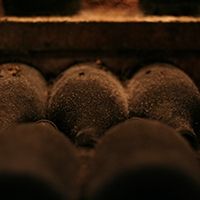
The wines of Ancient Egypt, Greece and Rome benefited from being stored in airtight amphorae, and could last for years. Amphorae were then superseded by porous wooden casks, and for more than a millennium, wines were consumed young by necessity. Then in the 18th century along came stackable, cork-stoppered bottles, allowing wine to be 'laid down' horizontally, and the joys of mature wine to be rediscovered.
These days the vast majority of wine is consumed within 24 hours of purchase, yet the notion that wine benefits from ageing in bottle is a persistent one. Wine may pour more easily from a glass bottle than ketchup does, but we still believe that the best things come to those who wait, even if many of us tend not to bother.
One Purple Pager recently posed an interesting hypothesis on our Member's forum: 'longevity is the most overrated quality of a wine'. I can think of a few other candidates for this honour (concentration; mouthfeel; alcohol content, whether high or low), but I don't intend to adjudicate. Rather, what I like about this hypothesis is the invitation to muster a defence for longevity.
Good evidence against the value of longevity for its own sake is offered by the original poster. He cites 1986 and 1988 as bordeaux vintages that have survived, but without necessarily improving a great deal in terms of the drinking pleasure they offer. I have certainly had similar experiences of drinking old wines that are still 'alive' but leave me thinking 'so what?' Moreover, the frustrations of dealing with bottle variation, predicting optimum drinking windows, and suffering cork taint in irreplaceable treasures are well documented on this site and elsewhere. On the other hand, virtually all my most rewarding wine experiences have been of aged bottles. (While I am a sucker for really good Condrieu, a wine whose pleasures only diminish with time, this is an exception. The joy of young Condrieu is also quite different in nature from the joy of other, mature wines.)
From these observations, we can infer that longevity is necessary but not sufficient to deliver a certain type of vinous pleasure. It is not a source of quality itself, but more a prerequisite for the emergence of some particular quality or qualities. It is through identifying these qualities that I shall mount a defence for longevity in wine.
The most obvious reason wine is laid down is to await an increase in two basic aesthetic merits: complexity of aroma and harmony of structure. While the chemistry of aroma development in bottle remains hazily understood, there is no doubt that aromas change during ageing and, in the happiest instances, change for the better, gaining this sought-after quality.
'Complexity' is often a loosely used term, so here is what I mean by it: a complex wine has numerous identifiable aromas, but these aromas must also be diverse. Five different fruit smells do not a complex wine make, but if we find strawberry, blueberry, jasmine, sous-bois and cocoa, for example, then we're getting somewhere. Furthermore, a degree of coherence is required: random, disparate aromas add up not to complexity, but to a mess. Finally, the attraction of the most complex wines (or paintings, or pieces of music) is the unfurling of layers and nuances on repeated engagement with them. We sense we cannot grasp them all at once, and thus develop an appetite that draws our attention into the detail. This combination of multiplicity, diversity, coherence and subtlety is nigh-on impossible for a young wine, full of brash primary aroma, to achieve.
The development of complexity, however, takes time, and hence requires longevity. Longevity, in turn, tends to arise from a certain level of tannin, acidity or sugar in the wine. Often, at the beginning, these structural elements stand apart, easily identifiable as components, offering unitary experiences isolated from the flavour of the wine. The hope is therefore that, as the aromas acquire their complexity, the structure resolves at the same rate.
It is hard to predict whether this hope will be realised in each case, but let us at least challenge the myth that unbalanced wine 'just needs time'. Wines that are clearly too tannic in youth often have this mitigating plea entered on their behalf, and – unless by some minor miracle the tannins soften twice as quickly as the fruit mellows – it is utter nonsense. By the time the structure is approachable, the fruit has long since departed. We only have to seek out champions of so many inscrutable 1975 bordeaux, or indeed charmless 2002s, to find critics mocked by this early miscalculation.
Balance, then, is a prerequisite of harmony, but harmony suggests something more – a coalescence that allows the structure to recede behind the flavour, to renounce its role as protector and push the fully formed flavour forth into the limelight. This is the simplest aspect of longevity: wines with capacity to age have the chance – no more – to become better than those destined to die young.
Next, a more overarching view. Wines acquire quality status through consensus: 'horizontal' consensus of many tasters agreeing on a wine's excellence, and 'vertical' consensus of one taster consistently reassessing a wine over time. When wines are very young, our assessments amount to no more than moderately well-informed guesswork. As they age and are re-tasted, the network of consensus strengthens, and the true stars of a vintage begin to brighten in the firmament. By the time a wine is several decades old, it has had the chance not just to please most of the people most of the time, but even to have transcended generational shifts in taste.
Works of art are made to satisfy a contemporary audience – even if, in the case of artists unsuccessful in their own time, that audience might number only one. Those that stand the test of time must therefore possess some more innate underlying appeal; their longevity indicates that their merits approach the universal. Even though artworks do not typically change as wines do, the context in which they are appreciated certainly shifts. There is something very special about tasting a wine made before the invention of the internet, before CDs, before cinema, even before the motorcar, and finding not just that it has survived, not just that it is complex and harmonious, but that it still appeals, hedonistically, to you, in the second decade of the 21st century. That timelessness, that transcendence of era, is the ultimate affirmation of that wine's quality. At this point, guesswork can cease.
When assessing a young wine's longevity, therefore, two questions need to be asked. First, obviously, how long will this wine last? Second, how long will this style appeal? Now, the second question is all but unanswerable; how can we possibly predict this? That does not mean the question is irrelevant, though. For example, while the longevity of super-ripe reds, especially in Napa and Bordeaux's right bank, was being debated, the discussion centred on acid-alcohol balance and the fragile nature of the raisiny fruit. Now, as fashion swings back to valuing refreshment over mass, we should be asking not whether these wines will survive, but whether anyone will care. They may end up being dismissed on the same grounds as a catchy but forgettable pop single: though the CD still works, the sound has rapidly dated.
A further benefit of longevity is more sentimental. Many of us like to construct narratives between wines, and sometimes to weave those retrospectively into the narratives of our own lives. Vertical tastings are a simple example, and are interesting by virtue of the two parallel timelines presented: the ageing of the wine, and the evolution of approach by the producer in question. You can also take a broader, grander sweep through history, and taste moments of pivotal change in a whole region, as at Linden Wilkie's California tasting described here. Finally, the opening of a mature bottle can be a moment for reflection, either historical or autobiographical. What was going on around the time these grapes were picked?
If the wine is lousy, then there is no joy in considering this. If the wine sings, however, then the contemplation of the moment can make that singing resonate, and the experience is something approaching magic. A few privileged personal examples that spring to mind:
Opus One 1979 (their début, my birth year)
Château Lynch-Bages 1961 (The Beatles' first performance at the Cavern)
Vieux Château Certan 1948 (my mother was born)
Charles Thomas, Clos Vougeot 1929 (Roaring Twenties become Great Depression)
Blandy's Malmsey 1865 (abolition of slavery in the US)
Longevity, then, can be defended by viewing it not as a quality of wine per se, but as a source of opportunity. It affords wine the opportunity to gain in quality; the opportunity to acquire critical consensus, even between generations; and the opportunity to elicit moments of profound narrative connection. Lastly, it affords us wine drinkers the opportunity to perceive something over a much longer span than we normally do in the maelstrom of the information age.
Now that we have squeezy plastic ketchup bottles, it is surely healthy that we have to wait for something.


- 297,198件のワインレビュー および 16,153本の記事 読み放題
- The Oxford Companion to Wine および 世界のワイン図鑑 (The World Atlas of Wine)
- askJancisへのアクセス(AIワインアシスタント)


- 297,198件のワインレビュー および 16,153本の記事 読み放題
- The Oxford Companion to Wine および 世界のワイン図鑑 (The World Atlas of Wine)
- askJancisへのアクセス(AIワインアシスタント)
- 最新のワイン・レビュー と記事に先行アクセス(一般公開の48時間前より)
- 最大25件のワインレビューおよびスコアを商業利用可能(マーケティング用)
「プロフェッショナル」プランの内容に加えて
- 最大250件のワインレビューおよびスコアを商業利用可能(マーケティング用)
- レビュー依頼用のワインを提出可能
- 従業員向けにメンバーシップを提供し、一元的に管理可能
- APIアクセス(※別途料金)
More Alex on taste
More from JancisRobinson.com







