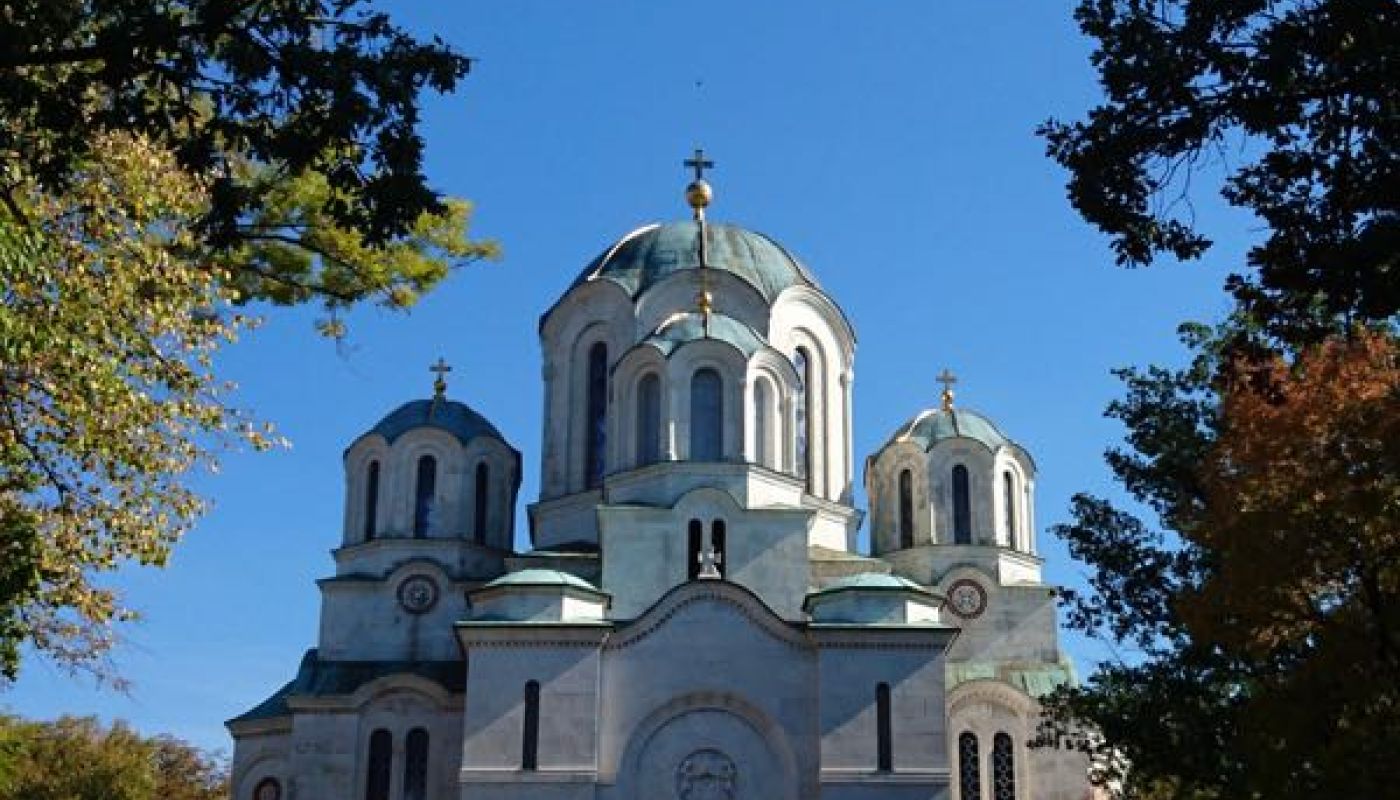
6 November 2017 Caroline Gilby MW specialises in wines from central and eastern Europe, and is a major contributor to the Oxford Companion to Wine and the World Atlas of Wine. She was also a very popular finalist in our recent wine writing competition. Here she reports on the wines and winemakers of Serbia, focusing on the potential for the dark-skinned variety Prokupac. The photo shows St George′s Church and the Mausoleum of the Karadjordjevic dynasty, on top of Oplenac hill, in the town of Topola.
For most wine drinkers, Serbia remains unknown, and the country has been late to the party in reinventing itself as a post-communist wine producer, but the last few years have seen fast-paced and exciting changes.
I’ve been connected to Serbian wine for around quarter of a century. In the early 1990s, I was buying wine for Augustus Barnett off-licences, when eastern Europe was big business in the UK. Back then I was paying just over £9 per dozen, UK delivered, for Merlot and Cabernet Sauvignon wines from Yugoslavia. These were sourced from the huge collectivised winery Navip in what is today’s Serbia and were sold under the Milion brand name.
Older readers may remember how much central and eastern European wine was sold in the UK in the late 1980s and early 1990s. But with the fall of the Iron Curtain, all these countries had to go through major upheavals to reinvent themselves, losing focus on wine along the way. In the UK, they inevitably lost market share in the face of the rise of the New World.
My next in-depth look at the wines of Serbia was a consultancy project in 2014 at one of the now-privatised, large former state wineries. It was a real step back in time to a setup that has long since disappeared in most of the wine world. Swimming-pool-sized concrete vats, complete with cracks and leaks, rusty pipes and dodgy seals meant that little of quality could possibly be produced (a far cry from today’s trend of returning to concrete in winemaking).
The vineyards were a different story though, with some amazing locations and great soils, let down by lack of investment. Some of the tough-looking vineyard managers I talked to then were practically in tears about not being able to look after young vines as they wanted because of lack of money for posts, wires and vineyard treatments. Today the industry is a mix of these lingering giants and their cheap, wine-flavoured alcoholic beverages and a raft of small new wineries. It’s hard to see the giants holding on for long without some serious outside investment. For instance, Navip’s assets were put up for sale at the end of 2016 as part of bankruptcy proceedings to address a reported debt of €30 million. Pictured below are the historic King's vineyards at Oplenac.

The dramatic change in the industry is highlighted by a look at some statistics. At its peak Yugoslavia had 220,000 ha (543,630 acres) under vine and was one of the world’s top ten volume producers. Today Ministry of Agriculture statistics show 22,300 ha of registered vineyards, with estimates of a further 3,000 ha unregistered, grown in 22 wine regions. These are spread across approximately 400 wineries, and owned by 120,000 vine growers (indicating quite how fragmented vineyard holdings are).
There’s a mixture of international varieties plus increasing focus on local ones, with Prokupac to the fore. This looks set to be the country’s best hope of an indigenous flagship variety and two enterprising wine writers Igor Lukovic (editor of Serbia’s leading wine magazine Vino & Fino) and Tomislav Ivanovic (vinopedia.rs) recently set up a Prokupac Day initiative with tastings and a conference to discuss and explore wine styles, quality potential and marketing strategies, at which I was a guest speaker.
The fortunes of eastern European grape varieties such as Kadarka, Kékfrankos/Blaufränkisch, Vranec/Vranac, Furmint and so on have ebbed and flowed. Prokupac is no exception: around a century ago it was the most planted grapevine on Serbian territory. It is naturally vigorous, and capable of generous yields, but by the 1960s it was regarded as the ugly duckling of Serbia’s varieties.
Despite its ability to produce large crops, typically at least 15 tonnes/ha at that time (today 5 tonnes/ha is more typical now that producers are seeking quality), it gave very poor results with low extract and unripe tannins, so the state co-operatives replaced much of it with international grape varieties. These varieties had arrived in Serbia with Alexander I (who served as Prince Regent from 1914 and was then king until his assassination in 1934). With the renaissance of winemaking early this century, Serbian producers started to re-examine their local grape varieties, even though today Prokupac is planted in just 3.22% of Serbia’s officially registered vineyards.
Prokupac is probably a very old variety, largely confined to Serbia’s territory. The genetics have not been fully worked out, but it has been suggested (see this online table) that it is a parent of Turkey’s Papazkarası, which is in might be a parent of Kadarka. (There may be a case of mistaken identity in Hungary, where it is thought that one clone of Kadarka in Szekszárd may actually be Prokupac.)
Part of the Prokupac project has included an attempt to define the grape’s key features. Its wine is light to medium-coloured, often inclined to develop garnet and brick colours quite early. Typical aromas and flavours include black and/or red cherry, blackberry, plum, spice, pepper and tobacco or forest-floor notes. It sometimes has a hint of floral character described as hibiscus. Lukovic sees its features as a combination of Pinot Noir and Cabernet Franc but I see parallels with Kékfrankos/Blaufränkisch or Kadarka. My argument is that it tends to be light to medium-bodied with moderate acidity but tannins that can be sharp if the grapes are not fully ripe.
Stylistically, I see closest parallels with Kékfrankos/Blaufrankisch (that great central European red grape, which now turns out to originate in today’s Slovenia, not Hungary or Austria (see Caroline’s article on this fascinating subject), so perhaps it should be renamed Modra Frankinja). This is also a grape that is not deep-coloured, can yield highly but doesn’t produce great quality when it does. It also depends on acid balance for its structure, and tannins can be sharp and green when not well-ripened, so there are lessons to learn from the best Kékfrankos producers. The key message is to treat it more like Pinot Noir with a focus on gentle maceration, not too much new oak, and a search for elegance, rather than like Cabernet Sauvignon with a focus on extraction, intensity and structure.
The next question is that of blending. Some producers are wedded to the idea of 100% Prokupac as their top category, but others are blending it with up to 15% of other great varieties and still retaining the varietal label, or using the grape to add a Serbian note to flagship Bordeaux blends. This is an approach that works well for Romania in wines such as SERVE’s Cuvée Charlotte or Davino’s Domaine Ceptura, where Bordeaux blends are given a local connection by the inclusion of their own local flagship variety Fetească Neagră. A couple of promising examples of this approach in Serbia include Vino Budimir’s Svb Rosa and Ivanovic’s No ½. It would certainly seem naïve to limit winemakers’ options too early while they are still rediscovering the variety’s potential.
It’s widely repeated that Prokupac doesn’t age, and maybe it doesn’t matter much in reality, because most wineries are having to market their wines early due to market demand and cash-flow needs, and anyway there is no culture of cellaring wine in Serbia. But it does seem to help establish credibility for quality if a variety can demonstrate ageability. One of the few producers that is in a position to show aged examples of Prokupac is Vino Budimir, so one masterclass at Prokupac Day looked at a selection of wines based on Prokupac from this producer, going back to 2007. In fact, the 2007 Svb Rosa still needed more time to resolve its structure, but the highlight of this line-up was Boje Lila 2009, a single-vineyard selection of 100% Prokupac from century-old vines.
There are several issues still facing the Serbian wine industry. Serbian oak is one question that producers need to consider. It often appears to have a particularly, and perhaps inconveniently, dominant character (something I have seen with other local oaks from Bulgaria and Macedonia). This often appears even though Serbian producers are not ageing their wines in oak for longer periods than is normal elsewhere in the wine world. Of course, if the local market prefers these styles, then it makes commercial sense to continue, but if Serbian producers want their wines to be appreciated on a more global scale, then they need to be aware of the current trend towards more subtle oak use.
There’s still some research to be done to get to the bottom of whether it is the oak species, the seasoning of the staves or the cooperage itself that cause issues with Serbian oak, and while I generally approve of the idea of using local oak, it has to be good enough. Radovan Đorđević (below) of the tiny (and impressive) garage winery Čokot says there are two types of oak in Serbia from two oak species which give different flavour profiles. A number of producers are also moving from barriques to 500-litre barrels or using very large casks instead to reduce oak influence.

Some Serbian wines are still, unfortunately, volatile, oxidised or just tired, suggesting that understanding of good bottling hygiene, sulphites and handling is lacking, perhaps not surprising given the very tiny size of the many producers who have only two or three hectares of vines.
At the other end of the scale, the big wineries are too big and not good enough. To help create a category for a country yet to establish an international reputation for its wines it is important to have a big winery that offers fair commercial quality, something that is working well for both Romania and Hungary. Even the biggest of the new generation of wineries have well under 100 ha (250 acres). It has been a challenge for many producers to put together consolidated plots due to the problem of land fragmentation after restitution. For instance, Veselin Despotovic of Despotika winery reports buying 80 different vineyard plots to put together 5 ha of vines in the next village. Pretty much everything is done by hand, with workers earning around €20 a day but, as is common across central and Eastern Europe, youngsters are leaving the land for the city, and working and studying abroad if they can. While lack of labour is not yet a problem in Serbia, it may well need to be addressed in the future. Even more of a concern, according to Despotovic, is a lack of well-educated winemakers and other key professionals in marketing and sales roles.
There’s more to Serbia than its native varieties, and some relatively new, local crosses such as Probus, Neoplanta, and Morava have promise. Some wineries are also looking back into history to rescue rare varieties such as the spicy, strawberry-scented, pale red Seduša made only by Šijački. There are also successful wines made from international grape varieties based on Chardonnay, Sauvignon Blanc, Traminer, Cabernet Sauvignon, Pinot Noir and even Marselan. The most planted variety, 14.1% of vineyards, is still Graševina (aka Welschriesling). However, this variety has an awful reputation with Serbian consumers, so several wineries are adopting the traditional local name of Grašac to counter this. There’s still much to be done in developing a wine culture in Serbia. In 2014, sources reckoned that Serbians drank only around 10 litres of wine per capita per year, far behind her neighbours. And exporting wine is still very much in its infancy.
Serbia’s wine scene is undoubtedly dynamic and one to watch, with the best wineries showing that Serbia’s wines really do have great potential. And along the way, Prokupac is turning from that ugly duckling into a graceful swan.
These were some of my favourite examples of Prokupac.
Botunjac Sveti, Grai 2016 13.5%
100% Prokupac. From 50 to 100 year-old vines.
Bright purple-pink. Aromas of damson, violet and wild herbs with subtle oak. Fresh raspberry and cherry fruit with appetising acidity. 16.5
Čokot Radovan Prokupac 2015 14%
100% Prokupac.
Aromas of black cherry and forest floor and spicy oak. Good depth, textured grainy tannins and good length. 17
Ivanović Prokupac 2016 13.5%
85% Prokupac, 10% Cabernet Sauvignon. 5% Merlot.
Youthful with aromas of plums and blackberry, well-integrated oak (500-litre barrels here). Well textured with good length and rounded mid palate. 17
Zivkovic Prokupac 2015
100% Prokupac.
Mid garnet wine with notes of black cherry and chocolate, and very subtle oak (steam-bent Serbian oak here). Well-balanced, ripe, rounded and nicely textured wine. 16.5+
Vino Budimir, Boje Lila 2009 12.5%
100% Prokupac. Single-vineyard wine from 100-year-old vines.
Fantastic bouquet showing white pepper, violet, mint and sun-dried tomatoes. Lovely expression and intensity in the mouth with good fruit, lively backbone and a long finish. 17.5
Despotika, Zmajeviti Prokupac 2015 13.5%
86% Prokupac 14% Pinot Noir.
Light ruby, plenty of oak overlaying black fruit on nose. Flavours of dried fruit and black cherry, with some grip and structure. 15.5
Doja Prokupac 2015 13%
90% Prokupac, 5% Merlot, 5% Syrah.
Mid ruby. Lots of black cherry, violet, spice and a subtle hint of vanilla. On the palate, it shows black fruit with slight earthy beetroot undertone, fleshy fruit and nicely tamed tannins. 16.5
Janko Bas 2016 12.5%
100% Prokupac.
Soft and spicy with notes of black plum, a little jammy and dry on the palate. Deliberately light style with strawberries and spice nose. Palate shows a hint of earthiness with red cherry fruit and gentle tannins 15
Milanov Podrum Prokupac Belo 2016 12%
100% Prokupac. Vinified as a white wine, direct pressed free-run juice.
Pale straw yellow with amber hint. Nose is quite spicy with a hint of peach. Crisp with a little phenolic grip, understated fruit and note of mandarin zest 15.5
Virtus Prokupac 2014 13.5%
90% Prokupac 10% Cabernet Sauvignon.
Light ruby, youthful. Noticeable oak, cherry fruit, firm and crisp on palate. 15
Yotta Prokupac 2015 13.5%
100% Prokupac. From 80 year-old vines.
Scented cherry and violet nose. Good texture, smoky tobacco overtones and firm finish. Oak still needs to integrate a little. 16