Last autumn my fellow wine writer and well-known American novelist Jay McInerney wanted to treat his favourite chef, Eric Ripert of Le Bernardin, to a meal in New York with some really nice wine from his cellar.
He booked a table at Frenchette, then the hottest ticket for fashion-conscious diners (reviewed here by Nick), and intended to take along a bottle of the Bordeaux first growth Château Haut-Brion from the near-mythical 1982 vintage together with the 1982 from its stablemate, the equally famous Ch La Mission Haut-Brion.
Frenchette’s wine list is devoted to natural wines, wines made determinedly not only from organically grown grapes but also with minimal additions in the winery. It seemed as though the team at Frenchette are so fanatical about this growing subset of the world’s wines that they would not let Jay open his bottles.
Since they were worth a good $2,000 in total, I’m sure McInerney offered to pay far more in corkage than the restaurant made from selling him a bottle or two off their wine list, but it was clearly a matter of principle. The Haut-Brion stable is not known for its noxious winemaking ways, but this is stark illustration of the fanaticism that can be associated with the natural wine movement. (I have since been sent the following explanation of their wine policy: 'Frenchette believes that one should experience a restaurant in its entirety from cocktails to wine through to dessert. The owners have never been fans of BYOW (Bring Your Own Wine), no matter the style of wine, and for that reason do not offer corkage.')
Whatever the ins and outs of this incident, what distresses me, an observer of the global wine scene, is the polarisation that natural wines seem to engender. A very significant proportion of the wine establishment, by which I mean producers and traders of conventional wine, roll their eyes at the very mention of natural wine. On the other hand, there is no shortage of converts to natural wine who, like the Frenchette team, will not sully their or their customers’ palates with wine they do not consider natural. They have a tendency to lecture the world on the iniquities of conventional wine. Newish bistros and wine bars in eastern Paris represent a nucleus of natural wine proselytising.
Natural wine has no strict definition but tends to be defined by what it isn’t. All but the most hideously industrial wines are ‘natural’ products to a certain degree but, just like fruit itself, anything fruit-based such as juice, wine and dried fruits is prone to being spoilt by excess oxygen and/or harmful bacteria. For centuries, sulphur or sulphur-based compounds have been used to stabilise and preserve freshness in all these products but, as technical knowledge increased in the twentieth century, so did the array of additives used in winemaking. In the 1970s many a wine smelt more of the chemistry lab than the fruit basket.
This century and in the later years of last century, however, there has been a global, industry-wide move to reduce agrochemicals in the vineyard and additives in the winery – this last encouraged not least by the discovery that asthmatics are particularly and sometimes dangerously sensitive to compounds associated with sulphur, which is why any wine containing more than 10 mg/l of sulphur dioxide has to be labelled ‘contains sulphites’.
Those making natural wine try to minimise their use of sulphur dioxide (a small amount is routinely produced when grape juice is fermented into wine anyway), and also tend to see forms of stabilisation such as filtration as equally evil. But sulphur dioxide is effectively a preservative, and low- or no-sulphur wines easily brown or lose their fruit if exposed to warmth, and the lack of stabilisation can result in cloudy wines.
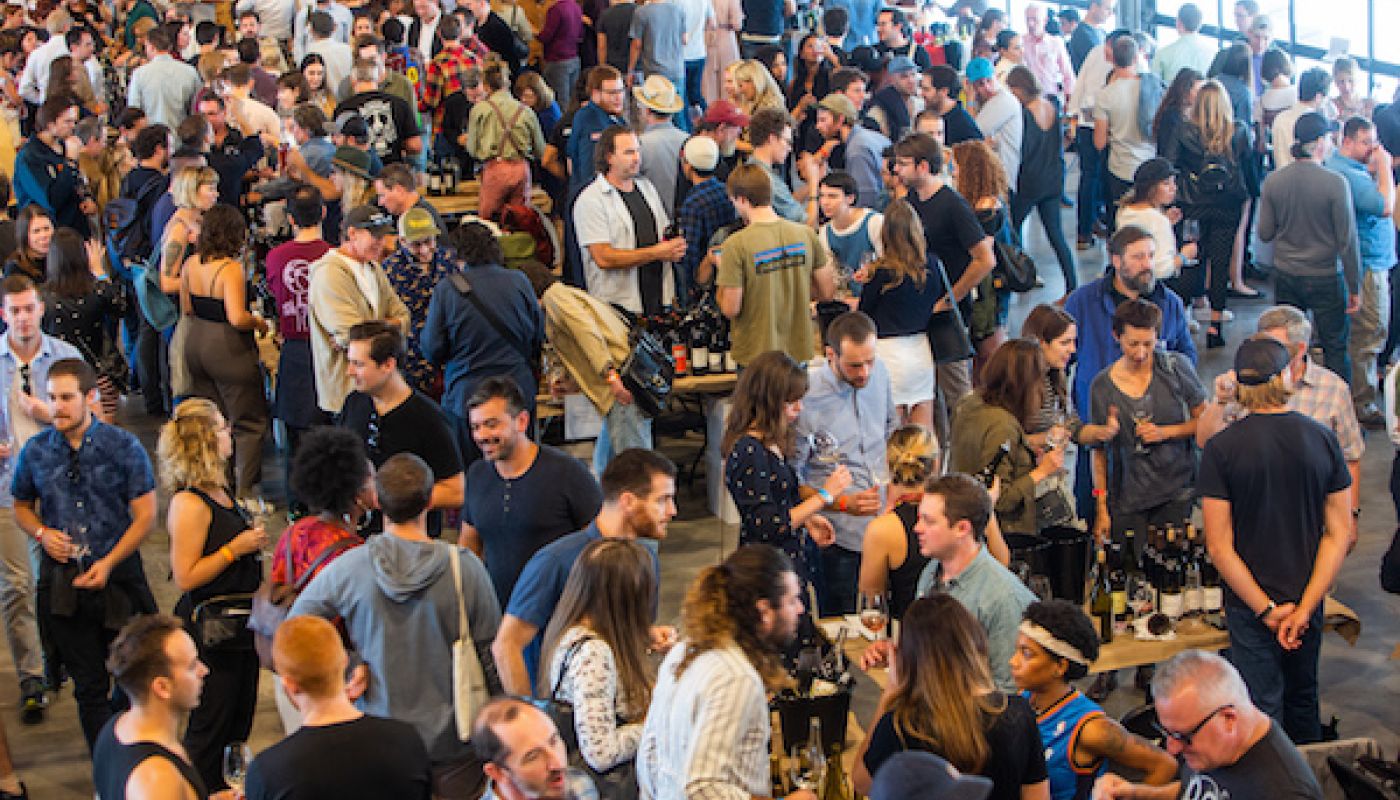
Although the most famous practitioners of the current era of natural winemaking were senior vignerons in Beaujolais in the 1960s, and then the Loire Valley, today’s ‘naturalistas’ tend to be relatively young. Making and/or consuming natural wine has become a generational thing. Above right is the crowd at the recent RAW Wine Fair organised by Isabelle Legeron MW in Los Angeles. From Australia, to South Africa, to the Americas and throughout Europe, many an experienced winemaker shakes their head in dismay at the cloudy, cidery ferments they probably first came across as natural wines, and resolve never to taste them again. But younger drinkers love them for their anti-establishment connotations.
The other day in Madrid I met a young sommelier who had been introduced to natural wines in the Loire and had enjoyed them there, but was now horrified by the dogmatism evident at natural wine bars in Spain, where, she felt, the quality of the wines served was so much lower.
As a result of this sort of phenomenon, the reputation of natural wines is so bad in some quarters that even some of those producing them – the respected Philippe Pacalet of Burgundy and Envinate of Spain for instance – deliberately avoid the term. One of British Columbia’s most successful wine producers, Okanagan Crush Pad, grows exclusively organic grapes and is careful to preserve every nuance of what nature provides in their Free Form wines but, as the company’s Christine Coletta explained recently in London, they deliberately avoid the term ‘natural’ and use ‘minimal intervention’ instead.
But this doesn’t exactly trip off the tongue. I asked the queen of natural wine, New York wine writer Alice Feiring of The Feiring Line, what she felt about the nomenclature of these increasingly prevalent wines. She admitted, ‘it's a term in flux for sure. However there's no other term for it, and when pushed those people [who repudiate the term] will admit that they [their wines] are indeed natural. So at some point it's going to be just wine, like it used to be before technology shaped it all. It's a very tricky question and a trickier answer. For one, I don't mind it one bit.’
Wearing my wine consumer hat, I feel quite strongly that wines that most obviously belong to what Feiring calls ‘the natural wine “club”’, those that are very different from the conventional norm, should be clearly signalled on wine lists and shelves. I have ordered less successful natural wines from even quite celebrated wine lists and had to leave everything but the first sip. I approve of those restaurant wine lists that recognise the popularity of natural wines with a segment of their customers by offering some, but corral them clearly in a separate section, perhaps headed Natural, New Wave or Off Piste Wines.
It seems to me that the average quality of natural wine has been improving considerably. Coletta points out, ‘people who dismiss natural wines need to rethink and revisit as there have been a lot of positive changes in the last ten years. As our consulting winemaker Alberto Antonini likes to say, “you need to know a lot in order to do very little”. You can’t just decide to make natural wine and expect good results without having some serious talent and experience in the cellar.’
The winemakers I admire are those who have established a reputation for their conventional wines but who, unblinkered by prejudice against natural wines, try out some of the strategies adopted by the naturalistas. Despite the current polarisation, I suspect that eventually everyone will meet somewhere in the middle.
There was, incidentally, a silver lining to the Jay McInerney story. For us anyway. We met Jay for dinner two nights after the Frenchette incident and very much enjoyed both 1982s.
PERMITTED WINE ADDITIVES
These are some of the most common additions in the winery. The better the wine, the fewer of them (sometimes none) are used. Roll on ingredient labelling for wine.
Sugar, beet or grape-derived, to increase the eventual alcohol level or prolong fermentation.
Acid, usually tartaric, which occurs naturally in grapes, to make wines from excessively ripe grapes taste crisper, and to protect them against harmful bacteria.
Sulphur dioxide, a preservative and disinfectant that keeps fruit flavours fresh and can help stave off harmful bacteria.
Yeast to effect and control fermentation.
Yeast nutrients to encourage fermentation.
Water to dilute wines that would otherwise be excessively alcoholic.
Tannin to add structure to wines made from grapes deficient in tannin and to stabilise colour.
Colour, a particularly controversial, grape-derived, additive used by producers who still think that deep crimson is a quality indicator. One notorious product is called Mega Purple.
Lactic acid bacteria to encourage the conversion of harsh acids into softer ones.
Grape concentrate to sweeten wine.
Ascorbic acid (Vitamin C), an antioxidant.
Sorbic acid, a preservative.
Enzymes, to encourage the extraction of juice from grapes.
Carbon dioxide, to make wine slightly or very fizzy.