
Burgundy lovers, such as the hundreds of tasters who attended more than 20 tastings during London’s Burgundy Week earlier this month, may complain about the recent steep price rises for the wines they love so much. But the price of the land that is responsible for them has risen even more sharply.
In the last nine years, while grape prices have risen threefold, the price of prime sites on the Côte d’Or has increased tenfold.
Burgundy’s top vineyards are now so valuable that banks are apparently falling over themselves to lend against them. Twelve years ago Olivier Bernstein owned a modest wine farm in Roussillon in the far south west of France. He moved north to Burgundy and started out in 2007 making wine in a dilapidated garage in a Gevrey-Chambertin backstreet buying the grandest fruit he could get his hands on.
His has been the most meteoric rise I have witnessed in the region. Today he commands his winemaking empire from the old cellars of the world-famous Hospices de Beaune within this historic city’s ramparts. Immaculate barrels of grands crus rest in state in the cellars while the upper floors have been decorated with such style that they have been featured on the pages of an architectural magazine, he told me with pride during my visit last November.
His wines are featured in their own full-colour booklet rather than with hoi polloi of the general Burgundy Week tastings by his UK importer Berry Bros & Rudd. In the US, Wilson Daniels, who also import the wines of the traditional blue chip Domaine de la Romanée-Conti, accord him the same sort of treatment.
Bernstein’s eponymous operation is just one of the more glamorous of the new breed of Burgundian producer. In the old days Burgundian producers were divided into growers who made their own wine (good) and négociants or merchants who bought in grapes and wine, made big blends and sold the results under their own label (bad).
Today such big négociants as remain, the likes of Bouchard Père et Fils, Drouhin, Faiveley and Jadot, are as fastidious as anyone about quality, often oversee work in the vineyard, many of them their own (well over 90% of their needs in the case of Faiveley), as well as making wine.
But there is an increasing number of newer producers who may not own their own vineyards but make extremely good wine thanks to a network of grower-suppliers. Let’s call them modern négociants. They are multiplying because it is becoming rapidly clear that only the super-rich such as Bernard Arnault and François Pinault can afford to buy vineyards. If someone wants to make burgundy, as so many wine romantics do, or expand a family-owned domaine, the only option may well be to buy grapes from land belonging to someone else.
Bernstein told me this year that he has now decided he wants to buy the vineyards that supply him. Thanks to new record prices set when LVMH acquired Clos des Lambrays and Pinault bought nearby Clos de Tart – not to mention the sale of Bonneau de Martray to American sports magnate Stan Kronke – he is confident of raising the money. He already has a range of backers and admits, ‘I’m lacking just a little tiny bit by not owning vineyards. Even though we are responsible for all the vineyard work, I don‘t have total control. And if the investisseurs pay hundreds of euros a bottle for my wines, they need continuity of supply.’
With his tight curls and impish smile, he does look ever so slightly smug when musing, ‘The dearer the wines are, the more people want them. I was lucky to arrive just before the hysteria of vineyard prices. Le Musigny went for €60 million a hectare but today it could easily sell for €75 million.’
On the same day I visited another celebrated modern négociant, a white wine specialist this time, who has deliberately chosen to adopt a quite different strategy. Pierre-Yves Colin-Morey’s rise has been more or less concurrent with and as marked as that of Olivier Bernstein. Using as a basis the vineyards he was due from his father Marc Colin, he and his wife Caroline Morey have built such a reputation for finely chiselled white burgundies that they no longer show their wines at their kitchen table in the village of Chassagne-Montrachet but operate out of a sleek, custom-built facility with usefully deep cellars and a thoroughly modern tasting room overlooking the village.
He is adamant that, although he owns 85% of the vines that supply his grapes and his team tends 100% of them, he wants to retain his status as a négociant, but he has no ambitions to expand for expansion’s sake, even though, to his parents’ delight, his eldest son is already studying winemaking.
‘I don’t want to be a second-rate négociant. A vineyard owner needs to see the quality of your work to trust you, to see you sweat. I don’t want the sort of relationships that are made in the bar.’
There are many other models for the growing band of modern négociants. Étienne Sauzet and Olivier Leflaive are well-established names. One of the first of his generation was Nicolas Potel, son of the family who used to own the eye-catching Domaine de la Pousse d’Or in Volnay. His local network is unrivalled and the only hiccup in building his business was losing control of his name to one of the old-style big négociants.
Today his businesses are Maison Roche de Bellene (for wine from bought-in fruit) and Domaine de Bellene (for wine from his own vineyards). He operates from a courtyard on the outskirts of Beaune with a very particular business model. For every six hectares he works, he attracts 90 investor lots which together form a GFA (groupement foncier agricole). Investors have to be approved by him and get his permission to sell their shares. Gradually he is able to buy some of these shares so his percentage of ownership increases as and when he can afford it. In the last 10 years he has amassed 23 ha in this way which gives him control, unlike the situation in family or public businesses. No wonder he always looks so relaxed.
The real problem today is the family business, which is unfortunately the most common in Burgundy. Typically, many different family members will have a share of a wine domaine, the majority of them often with no day-to-day involvement. Now that vineyard prices are so demonstrably high, there can be terrible pressure from such relatives to sell. As Louis-Michel, Comte Liger-Belair of Vosne-Romanée observed last November, ‘the Bonneau de Martray sale really hit people – they thought if that family can sell and make a lot of money, why shouldn’t we?’ He is particularly well plugged in to Burgundian land deals and reckons ‘there’ll probably be a couple more big sales in the next couple of years’.
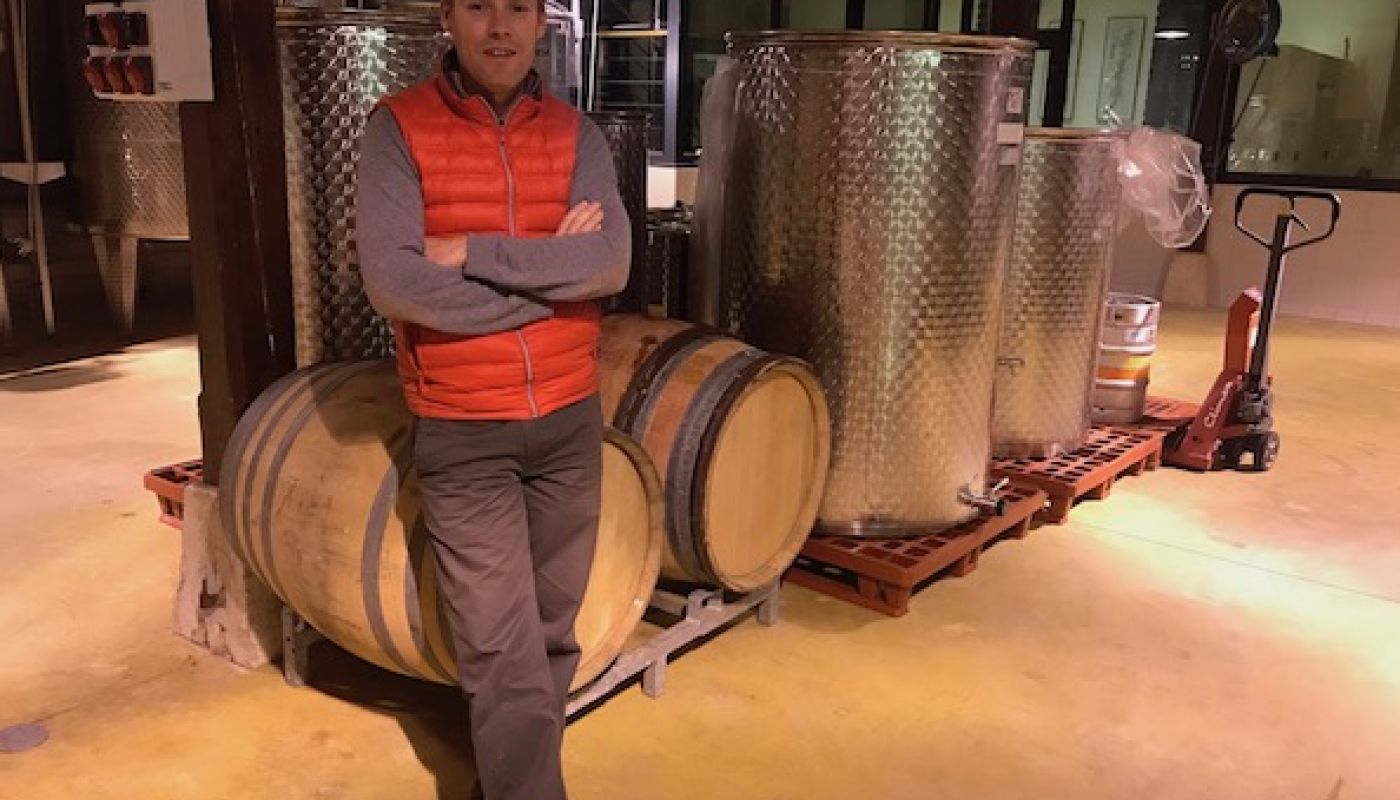
Meanwhile such modern négociants as Benjamin Leroux (pictured above right in a small part of his spacious winemaking playground) and Pascal Marchand with their luxurious and spacious winemaking facilities in Beaune and Nuits respectively are laughing. Both extremely talented winemakers, they are bankrolled by well-heeled outsiders: British businessman and sailing enthusiast Ian Laing and Canadian banker Moray Tawse respectively.
Or there is the Australian model. Mark Haisma, Andrew and Emma Nielsen of Le Grappin and Jane Eyre show their wines, aimed at cost-effective direct sales, together at a modest tasting in London every January and burgundy lovers lap up their carefully-made liquids. ‘I’m at the bottom of the pile to be offered fruit’, Haisma admitted cheerfully in his new modern cellars outside Gilly. ‘Thanks to the short crop I went from filling 65 barrels in 2015 to 25 in 2016.’ He’s sold every bottle of 2014 and 2015 already so he must be doing something right – as now-friendly banks acknowledge. He has had such success that he is now able to buy about 2.5 ha in the Mâconnais.
2016 BURGUNDIES OF INTEREST
All of these favourites were made by modern négociants. My sincerest apologies if UK allocations are already sold out. See winesearcher.com for merchants who generally offer these names and Purple Pages for tasting notes on more than 1,800 2016 burgundies.
Olivier Bernstein anything you can get your hands on – and can afford
Pierre-Yves Colin-Morey Cuvée Marguerite St-Aubin; Garennes, Puligny-Montrachet; any premier or grand cru
Jane Eyre Gevrey-Chambertin
Jean-Marie Fourrier Bourgogne Rouge
Le Grappin Les Gravières Premier Cru Santenay Blanc
Maison Roche de Bellene Vieilles Vignes Chambolle Musigny; Chevalières Meursault
Mark Haisma Chaffots Premier Cru Morey-St-Denis
Benjamin Leroux Volnay; Clos de la Cave des Ducs Premier Cru Volnay; Vougeot Clos du Village; any premier or grand cru
Marchand Tawse Vosne-Romanée; Champs Perdrix, Vosne-Romanée; Meursault













