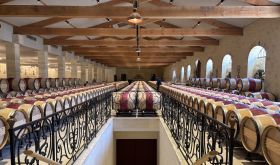
Two plants are crucial to modern wine production: the vine, of course, and the oak tree. Yet it seems to me that the average wine drinker, and even the average wine enthusiast, has only the haziest notion of what oak barrels can do, good and bad, for a wine.
Most of us are dimly aware of wines' having an 'oaky' flavour. About 10 years ago this sweetish toastiness was viewed as rather novel and a positive addition to wines such as New World Chardonnays which were otherwise a bit bland. Then the pendulum swung, as pendulums are apt to do, and it became fashionable to decry such wines as 'too oaky'. First the Australians and then the Californians reacted to this market trend and their wines became noticeably less marked by the flavours of oak.
But the makers of top quality wine do not use oak barrels for their oak flavour. In fact they positively do not want their wines to taste of oak. They use small barrels for their physical rather than their gustatory properties. A stainless steel tank may be cheaper and easier to clean and maintain but red wine well stored in oak has a much deeper, more stable colour than one kept in tank. Oak barrels tend to shield maturing wine from variations in temperature and the result is usually a rounder, smoother, fuller wine that is more flattering to taste.
Maturing wines in barrels also helps to stabilise the tannins that are so important during a wine's ageing process, and clarifies the wine much more naturally and effectively than simply chilling, or adding chemicals to, a tank full of wine.
But the coopers, who have benefited enormously from the world's winemakers' love affair with oak, have been increasing their influence yet more by singing the praises not just of maturing wine in oak but making it in oak too. Renowned French coopers Taransaud had Masters of Wine quiet and seated for a record length of time, one whole day, last month in London as they put the case for their large oak fermentation vats as a superior alternative to conducting the alcoholic fermentation of grape juice to wine in stainless steel or concrete fermenters.
The same wine fermented in a wooden fermenter was certainly much more luscious than the reference sample fermented in stainless steel, but the thoughtful owner of St Emilion's Château Angélus, Hubert de Bouard, rather spoilt things by declaring that, despite the current fashion among winemakers for wooden fermenters, he felt it was unwise to rely solely on them. After all, cement is good enough for wines of such elevated reputations as Châteaux Pétrus and Lafleur.
This fashion for oak fermenters follows a noticeable, worldwide one for another extension of oak's influence: the increasing habit of conducting wine's second, softening fermentation, so-called malolactic fermentation, in small oak barrels rather than in large fermentation tanks.
This is much more fiddly as temperatures are crucial but it has become a popular practice because it tends to make wines taste charming much earlier in their life, notably at six months old when, in Bordeaux, they are first shown to the waiting world at the annual en primeur tastings which I am currently conducting on your behalf. The jury is out, however, on whether this time-consuming, acceleration technique brings any long-term benefits for wines designed to age over many years.
Some producers are even going to the extent of conducting not just the second, malolactic fermentation in small oak barrels but also the first, alcoholic fermentation there too. This has been common practice for a decade or two for top quality white wine, especially white burgundy, but really masochistic red winemakers are also trying it out, undeterred by the inconvenience of all those skins floating about, often slicing an end off a barrel and standing it upright. They really, really want to immerse their wines in oak's special properties.
All I have written above applies to the minutiae of top quality wine production. And to be frank I am amazed that there have been as many developments in this tiny segment of the market as there have been over the last 15 years or so. (I shall spare you the detailed researches into exact fermentation temperatures, maceration periods, topping up, frequency of lees stirring and racking – moving the wine off the lees in one barrel to another, clean barrel.)
But oak plays an extremely significant part in the production of medium and some basic quality wine too. Nowadays if producers want to imbue a cheap wine with oak flavour they tend to do the financially sensible thing: throw in a sackful of oak chips and let the wine draw the flavour from them. This will not give the wine any of the physical properties outlined above, but it will impart oak flavour and nowadays vendors of chips can offer just as wide a range of provenances and quality of chips as coopers can of barrels.
At the Taransaud seminar someone was tactless enough to mention the fact that at the Geisenheim Research Institute in Germany they had been shown that there was no discernible difference between wines aged with top quality oak chips and the same wines aged in barrel. This drew an understandable blank from the men from Taransaud, whose lives are founded on selling barrels worth 700 euros apiece rather than sacks of chips for a few sous, but it was Frenchman pointed out that oak chips, widely used in the New World and southern Europe, are not allowed for France's appellation contrôlée wines. "They have been authorised for France's less exalted wines but the Office International du Vin has not yet defined what is an oak chip" was the somewhat enigmatic rider.
The posh alternative to oak chips, by the way, is to leave the wine in contact with individual barrel staves – a sort of halfway house which saves the time and expertise of building a barrel.
It was convincingly demonstrated to us Masters of Wine that two aspects of barrel production are crucial to wine quality: the extent to which the inside of the barrel is toasted and the length of time the oak is seasoned, left to soften in the open air, before being made into a barrel. Two years seemed ideal, but this of course ties up capital.
Cheaper barrels made from under-seasoned wood that has been dried fast in a kiln rather than slowly in the open air are, I am convinced, responsible for the huge proportion of wines on the market today that seem to have had the fruit knocked out of them by harsh, green-flavoured oak. I often wonder whether French coopers, masters of the oak world, are really as careful about the oak they supply to winemakers in, say, farflung regions of Chile and South Africa, as they are with their French customers. I have fewer doubts about the service they offer to American wineries now that so many of them have opened up branches in California.
The great majority of oak used by today's winemakers the world over has, so far, come from France's well-tended forests, already overseen by Colbert to provide 17th century shipping. American oak has a certain following in some wine regions, especially in Spain and Australia, but the flavours tend to be a bit sweeter, more obviously coconut, unless the oak has been treated to seriously long seasoning.
The Taransaud team attempted to show us the difference between French, American, and eastern European oaks by serving unidentified samples of the same wine matured in each. I was most impressed by the performance of the Polish oak, and I have had several chances to admire wines aged in Hungarian oak too. One hundred years ago, even red bordeaux was made using Baltic oak, and it would seem that once the mismanagement of the forests of eastern Europe is sorted out, France's supremacy as supplier of oak for wine barrels may wane – especially since prices of eastern oak tend to be usefully lower.
Several French coopers now have joint ventures with eastern European cooperages. The Taransaud team bought their oak from a French-speaking wood merchant in Poland but have no idea who owns the forest. It will clearly take time to sort of this state of affairs but there would be a pleasing symmetry if eventually Bulgaria, for instance, which seems to have been sold some thoroughly third-rate French and American oak barrels, eventually upgrades its wine industry thanks to well- seasoned eastern European oak.
Wines that benefit from oak:
Most top quality red wine
Most Côte d'Or white burgundy
A high proportion of other Chardonnays
Some white bordeaux
Wines that may well be best left unoaked:
Riesling
Gewurztraminer
New Zealand Sauvignon Blanc
Most Loire whites
Chablis
Beaujolais and Beaujolais-Villages
Many Languedoc reds
Most of us are dimly aware of wines' having an 'oaky' flavour. About 10 years ago this sweetish toastiness was viewed as rather novel and a positive addition to wines such as New World Chardonnays which were otherwise a bit bland. Then the pendulum swung, as pendulums are apt to do, and it became fashionable to decry such wines as 'too oaky'. First the Australians and then the Californians reacted to this market trend and their wines became noticeably less marked by the flavours of oak.
But the makers of top quality wine do not use oak barrels for their oak flavour. In fact they positively do not want their wines to taste of oak. They use small barrels for their physical rather than their gustatory properties. A stainless steel tank may be cheaper and easier to clean and maintain but red wine well stored in oak has a much deeper, more stable colour than one kept in tank. Oak barrels tend to shield maturing wine from variations in temperature and the result is usually a rounder, smoother, fuller wine that is more flattering to taste.
Maturing wines in barrels also helps to stabilise the tannins that are so important during a wine's ageing process, and clarifies the wine much more naturally and effectively than simply chilling, or adding chemicals to, a tank full of wine.
But the coopers, who have benefited enormously from the world's winemakers' love affair with oak, have been increasing their influence yet more by singing the praises not just of maturing wine in oak but making it in oak too. Renowned French coopers Taransaud had Masters of Wine quiet and seated for a record length of time, one whole day, last month in London as they put the case for their large oak fermentation vats as a superior alternative to conducting the alcoholic fermentation of grape juice to wine in stainless steel or concrete fermenters.
The same wine fermented in a wooden fermenter was certainly much more luscious than the reference sample fermented in stainless steel, but the thoughtful owner of St Emilion's Château Angélus, Hubert de Bouard, rather spoilt things by declaring that, despite the current fashion among winemakers for wooden fermenters, he felt it was unwise to rely solely on them. After all, cement is good enough for wines of such elevated reputations as Châteaux Pétrus and Lafleur.
This fashion for oak fermenters follows a noticeable, worldwide one for another extension of oak's influence: the increasing habit of conducting wine's second, softening fermentation, so-called malolactic fermentation, in small oak barrels rather than in large fermentation tanks.
This is much more fiddly as temperatures are crucial but it has become a popular practice because it tends to make wines taste charming much earlier in their life, notably at six months old when, in Bordeaux, they are first shown to the waiting world at the annual en primeur tastings which I am currently conducting on your behalf. The jury is out, however, on whether this time-consuming, acceleration technique brings any long-term benefits for wines designed to age over many years.
Some producers are even going to the extent of conducting not just the second, malolactic fermentation in small oak barrels but also the first, alcoholic fermentation there too. This has been common practice for a decade or two for top quality white wine, especially white burgundy, but really masochistic red winemakers are also trying it out, undeterred by the inconvenience of all those skins floating about, often slicing an end off a barrel and standing it upright. They really, really want to immerse their wines in oak's special properties.
All I have written above applies to the minutiae of top quality wine production. And to be frank I am amazed that there have been as many developments in this tiny segment of the market as there have been over the last 15 years or so. (I shall spare you the detailed researches into exact fermentation temperatures, maceration periods, topping up, frequency of lees stirring and racking – moving the wine off the lees in one barrel to another, clean barrel.)
But oak plays an extremely significant part in the production of medium and some basic quality wine too. Nowadays if producers want to imbue a cheap wine with oak flavour they tend to do the financially sensible thing: throw in a sackful of oak chips and let the wine draw the flavour from them. This will not give the wine any of the physical properties outlined above, but it will impart oak flavour and nowadays vendors of chips can offer just as wide a range of provenances and quality of chips as coopers can of barrels.
At the Taransaud seminar someone was tactless enough to mention the fact that at the Geisenheim Research Institute in Germany they had been shown that there was no discernible difference between wines aged with top quality oak chips and the same wines aged in barrel. This drew an understandable blank from the men from Taransaud, whose lives are founded on selling barrels worth 700 euros apiece rather than sacks of chips for a few sous, but it was Frenchman pointed out that oak chips, widely used in the New World and southern Europe, are not allowed for France's appellation contrôlée wines. "They have been authorised for France's less exalted wines but the Office International du Vin has not yet defined what is an oak chip" was the somewhat enigmatic rider.
The posh alternative to oak chips, by the way, is to leave the wine in contact with individual barrel staves – a sort of halfway house which saves the time and expertise of building a barrel.
It was convincingly demonstrated to us Masters of Wine that two aspects of barrel production are crucial to wine quality: the extent to which the inside of the barrel is toasted and the length of time the oak is seasoned, left to soften in the open air, before being made into a barrel. Two years seemed ideal, but this of course ties up capital.
Cheaper barrels made from under-seasoned wood that has been dried fast in a kiln rather than slowly in the open air are, I am convinced, responsible for the huge proportion of wines on the market today that seem to have had the fruit knocked out of them by harsh, green-flavoured oak. I often wonder whether French coopers, masters of the oak world, are really as careful about the oak they supply to winemakers in, say, farflung regions of Chile and South Africa, as they are with their French customers. I have fewer doubts about the service they offer to American wineries now that so many of them have opened up branches in California.
The great majority of oak used by today's winemakers the world over has, so far, come from France's well-tended forests, already overseen by Colbert to provide 17th century shipping. American oak has a certain following in some wine regions, especially in Spain and Australia, but the flavours tend to be a bit sweeter, more obviously coconut, unless the oak has been treated to seriously long seasoning.
The Taransaud team attempted to show us the difference between French, American, and eastern European oaks by serving unidentified samples of the same wine matured in each. I was most impressed by the performance of the Polish oak, and I have had several chances to admire wines aged in Hungarian oak too. One hundred years ago, even red bordeaux was made using Baltic oak, and it would seem that once the mismanagement of the forests of eastern Europe is sorted out, France's supremacy as supplier of oak for wine barrels may wane – especially since prices of eastern oak tend to be usefully lower.
Several French coopers now have joint ventures with eastern European cooperages. The Taransaud team bought their oak from a French-speaking wood merchant in Poland but have no idea who owns the forest. It will clearly take time to sort of this state of affairs but there would be a pleasing symmetry if eventually Bulgaria, for instance, which seems to have been sold some thoroughly third-rate French and American oak barrels, eventually upgrades its wine industry thanks to well- seasoned eastern European oak.
Wines that benefit from oak:
Most top quality red wine
Most Côte d'Or white burgundy
A high proportion of other Chardonnays
Some white bordeaux
Wines that may well be best left unoaked:
Riesling
Gewurztraminer
New Zealand Sauvignon Blanc
Most Loire whites
Chablis
Beaujolais and Beaujolais-Villages
Many Languedoc reds