


11 October 2023 Listen to Julia Harding MW discussing the new edition with David Kermode on The Drinking Hour.
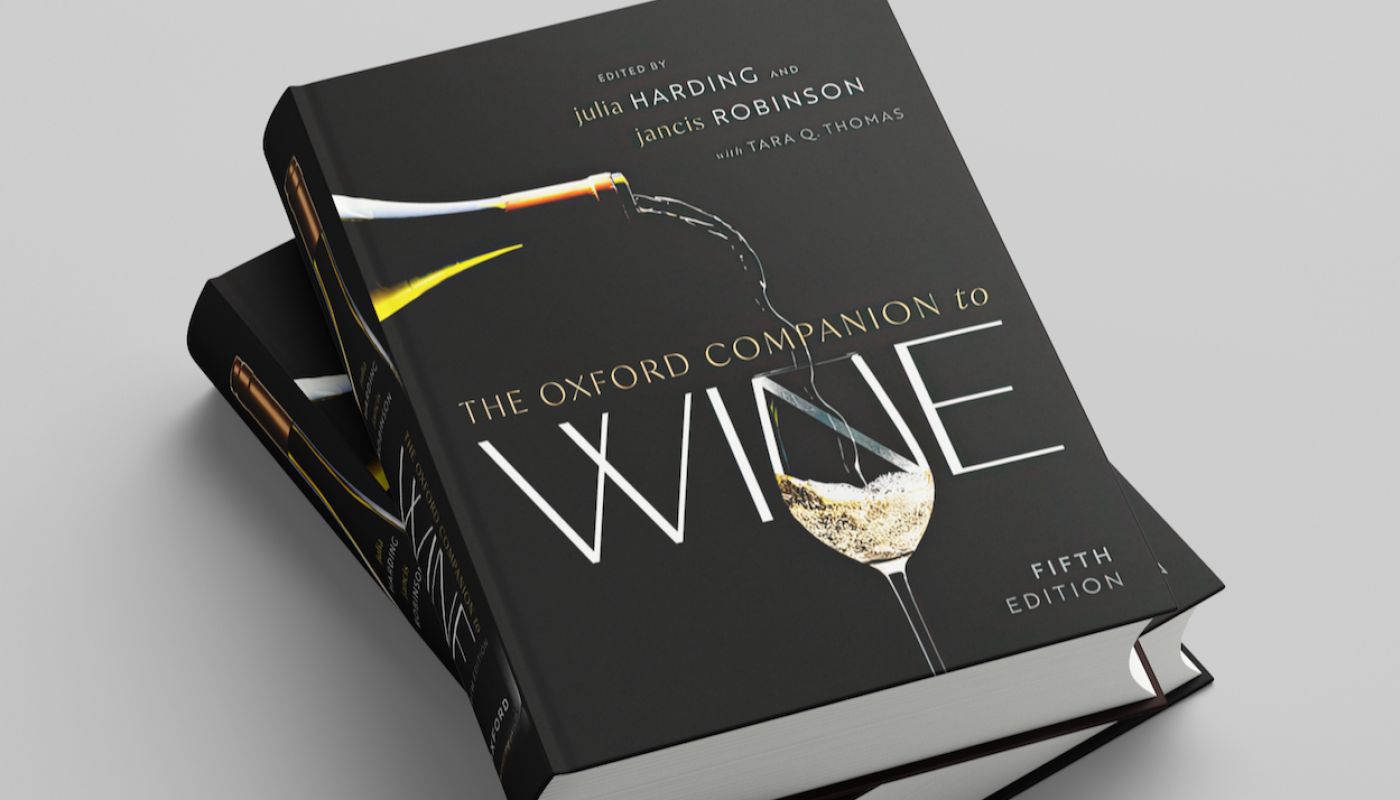
14 September 2023 Let the trumpet sound while Julia, Tara and Jancis breathe a deep sigh of relief. Today the new, fully revised and expanded 5th edition of The Oxford Companion to Wine is finally published.
Julia writes With a total of more than 4,100 substantive entries, including 272 new ones, more than a hundred new expert contributors on all aspects of the glorious and diverse world of wine, we have for the first time breached the one-million-word mark.
As far as I am aware, no blood was shed in the making of this new edition but there was no lack of sweat and tears. When Jancis asked me way back in 2016 whether I would be willing to take on the role of lead editor of the next edition, I knew it was a big and, with little exaggeration, life-changing decision that would affect my daily life, and not just my working days but also evenings and weekends, and result in quite a few sleepless nights, for about three years.
It has been hugely demanding and exhausting but also extremely gratifying now it’s all over. Jancis created a unique and monumental book with the first edition in 1994 and, having already worked with Jancis on the third and fourth editions, I was honoured to be handed the baton.
The responsibility was daunting but mitigated not only by Jancis’s continued involvement in certain sections of the book (see below) and her readiness to advise in my moments of uncertainty but especially by the sharp editorial mind, resilience and extensive network of contacts of our assistant editor Tara Q Thomas, known to members of JancisRobinson.com since last November as our managing editor and to others as the former long-standing executive editor of New York-based Wine & Spirits magazine. She took on all the geographical entries.
I could say that the process of updating this book took more than two years, followed by a year in production. However, it would be more accurate to say it took closer to nine years: as soon as the 4th edition went to the printers in 2014, I created a file to record possible updates for the 5th edition. By the time we started sending out entries to contributors and thinking about new ones, it had become a huge document. (The day this book was sent to the printer, I started a file entitled ‘OCW5 possible updates’.)
This list of possible updates formed part of our deliberations on the need for new entries – entirely new ones or breakouts from existing entries that had become unwieldy. For example, the New Zealand entry has been divided into several subregional ones, making the updated information much easier to access thanks to the cross-references that litter the book.
One of the most rewarding aspects of preparing a new edition is also one of the most logistically challenging: working with previous and new contributors to review and update their entry/entries. Then comes the process of sifting, editing and inputting the changes, typically with several sets of queries along the way, and this is all going on at the same time but staggered to spread the workload, like the to and fro of a very busy parcel depot. Digital file and record-keeping to the nth degree.
We were blessed with the specialist input of 267 contributors around the world. There are 310 substantive new entries and every single one from the 4th edition, published in 2015, was reviewed to see whether it needed updating. It would be easy to focus on new entries but the revisions are just as significant: a rough estimate suggests that 65% of the entries from the last edition were updated, some practically rewritten by us the editors or by our contributors. Bibliographical references at the end of the entries were also reviewed and revised. It never ceases to amaze me how much has changed in such a relatively short time.
Our long-standing viticulture advisory editor Dr Richard Smart and our more recent oenology advisory editor Dr Valérie Lavigne must be singled out for the huge amount of work they did in helping me oversee these topics and bring them bang up to date, with input from many more specialist contributors working in those fields.
Within the topics that I oversaw and edited, including viticulture, oenology, labelling, packaging, academia and grape varieties, it was noticeable that there were far more new entries in viticulture than in oenology even if the latter all had a thorough overhaul thanks not only to Valérie Lavigne but also a small army of practitioners and academics around the world, notably but not exclusively from the AWRI and UC Davis. Perhaps we have reached the limit of technological advances, or have chosen to revert to traditional practices in the knowledge that the greatest adaptation to our changing world has to take place in the vineyard.
I am particularly pleased with the extra precision we have brought to all the knotty sulfur-related entries (eg sulfur, sulfur-related compounds, oxidation, reduction), topics that are hardly sexy but are critical to high-quality winemaking and so often written about in a lazy short-hand that leads to confusion or in overly technical terms that perpetuate their obfuscation. At the other end of the spectrum, we have included for the first time entries on underwater ageing, the new-old technique of stabulation (look it up when you get the book), and paper bottles, as well as expanding the entry on kegs.
Climate change and concerns about the environment were probably the main drivers behind the revised and new entries related to viticulture: describing and dealing with trunk diseases such as esca, the spread of Pierce’s disease to Europe, heatwaves, wildfires, anti-transpirants, artificial intelligence, and, more positively, regenerative agriculture, biological treatments for pests and diseases, the vines’ own mechanisms such as epigenetics for adapting to climate change, and the increasing awareness of wine’s carbon footprint – the need to first measure and then reduce it.
While we cannot be as comprehensive as Wine Grapes when it comes to listing and describing grape varieties, we have added some that are gaining in currency, for example Kydonista, Vidiano, Liliorila and several that have been bred for disease resistance, a field of study that is rapidly expanding. And, thanks to Dr José Vouillamoz, any new DNA-based information regarding relationships between varieties has been included here before it makes its way to any future edition of Wine Grapes.
Changes to labelling and regulations seem to take a very long time for those waiting for them but they come thick and fast in a book like this, including the long-overdue defining of Italian single vineyards (UGA and MGA) and the final piece of the Austrian DAC puzzle. Frustratingly, some changes in regulations happened just too late for the final proofs. Our unique appendix on appellations and their grape varieties has been painstakingly updated. My great sadness is that the talented and conscientious Angeliki Tsioli, who put so much time and effort into this part of the book, died suddenly and horribly prematurely, and will not see the results of her hard work in print.
Jancis adds I can’t tell you how delighted I am to put my 3.2-kg baby into such capable hands. To put together a book of this size and comprehensive range, with its myriad cross-references, requires a memory very much more powerful than mine is today. As she explains above, Julia was already responsible for major sections of the 3rd and 4th editions and, with her extreme attention to detail and her previous work as a copy-editor, plus star performance in the Master of Wine exams, is the perfect person to take over as lead editor of the wine student’s bible.
And who better to assist her than our blessed managing editor Tara Q Thomas, who shares with Julia and me standards of editorial fastidiousness and is also hugely knowledgeable about every corner of the world of wine – as you will read below. I know how exceptionally hard they have both worked on this new edition, righting some of my wrongs, while I was left simply to update about 10% of the entries. Thank you, Julia and Tara!
It’s always interesting to see which new entries are needed for new editions of the Companion. Of the many new entries in the sections I was responsible for updating – people, producers and brands, wine and the consumer, and tasting – some of the more telling ones are Artémis Domaines, blockchain, celebrity wine, Jim Clendenen, wine critics (we previously had wine writers), e-commerce, glou-glou wine, Randall Grahm, Harlan, Henkell-Freixenet (who claim to make more sparkling wine than anyone else), influencers, Jackson Family Wines, Sir William Macarthur, Master Sommelier (we had Master of Wine only), NFTs, Palacios Family, wine-preservation systems (Coravin mainly), Steven Spurrier, unicorn wine, Whispering Angel, Warren Winiarski and zero-zero wines.
Tara adds Working with Julia and Jancis on updating the Companion has been the highlight of my professional life, even if it was a bit like training for a high-stakes ultramarathon with two Olympic-level athletes. Both are endlessly knowledgeable and indefatigable. However, they balance their seriousness with a good bit of wit, which makes for better working conditions as well as better writing!
But just as exciting has been the opportunity to work with so many wine experts around the world, who shared their knowledge with such generosity and excitement that it was a constant reminder of why wine is so compelling.
We made it a priority to have as many authors as possible reporting from the place where they live, to get an on-the-ground, of-the-moment view. Some are names you know already from previous editions, such as James Lawther MW in Bordeaux and Jasper Morris MW in Burgundy, Walter Speller in Italy and Michael Fridjhon in South Africa, to name just a few.
More than 60 of our regional specialists, however, are brand-new to the project. Climate change and human creativity have pushed the borders of the wine world to include places never before included in the Companion, such as Denmark, Estonia, Finland, Latvia, Lithuania and Norway (all written by residents). There are also entries for Gabon, Togo and Uganda among 15 other African countries. We’ve not only explored new latitudes but new elevations, with entries on Peru, Colorado and New Mexico as well as each of the DOPs of Tenerife. Places such as Mexico and New York State, which were just coming into their own in the last edition, get a full update in this one (by Carlos Borboa and Maiah Johnson Dunn, respectively); the South American coverage now extends into the far southern reaches of Patagonia and even out to Easter Island; and Israel now shares the spotlight with an entry for Palestine.
We’ve also worked to better capture the depth and dimension of previously covered regions such as California, where an A-team of local writers including Elaine Chukan Brown, Patrick Comiskey, Matt Kettman, Kelli White and Alder Yarrow covered the state’s vastly diverse wine regions; we did the same in Australia, with Andrew Corrigan MW, Curly Haslam-Coates, Erin Larkin, Ed Merrison, Andrea Pritzker MW and Rachel Triggs reporting from their home regions.
This expansion of the wine world – into new latitudes, new elevations, new cultures – also brought with it a reckoning of how we talk about wine. While we’ve retained an entry for ‘New World’, there are no regions referred to as such. ‘Emerging’ is a more accurate descriptor, reflecting the newness and excitement of wine cultures that are rapidly developing, each in their own way, and on their own terms. We hope that you get as excited reading this volume as we did putting it together.
The Oxford Companion to Wine, 5th edition
Edited by Julia Harding and Jancis Robinson with Tara Q Thomas
Published by Oxford University Press
ISBN 9780198871316
RRP £50, $65, CA$80
The book is widely available from today, for example from the following sellers:
Oxford University Press (UK)
Oxford University Press (US)
Amazon UK
Amazon US
Bookshop UK
Bookshop US
Waterstones (UK)
Blackwell’s (UK)
Barnes & Noble (US)
IndieBound (US)













