
For too long a perennial essay question in wine-trade exams has been, ‘How would you revive the fortunes of sherry?’ Now, at last, there is a thoroughly exciting answer.
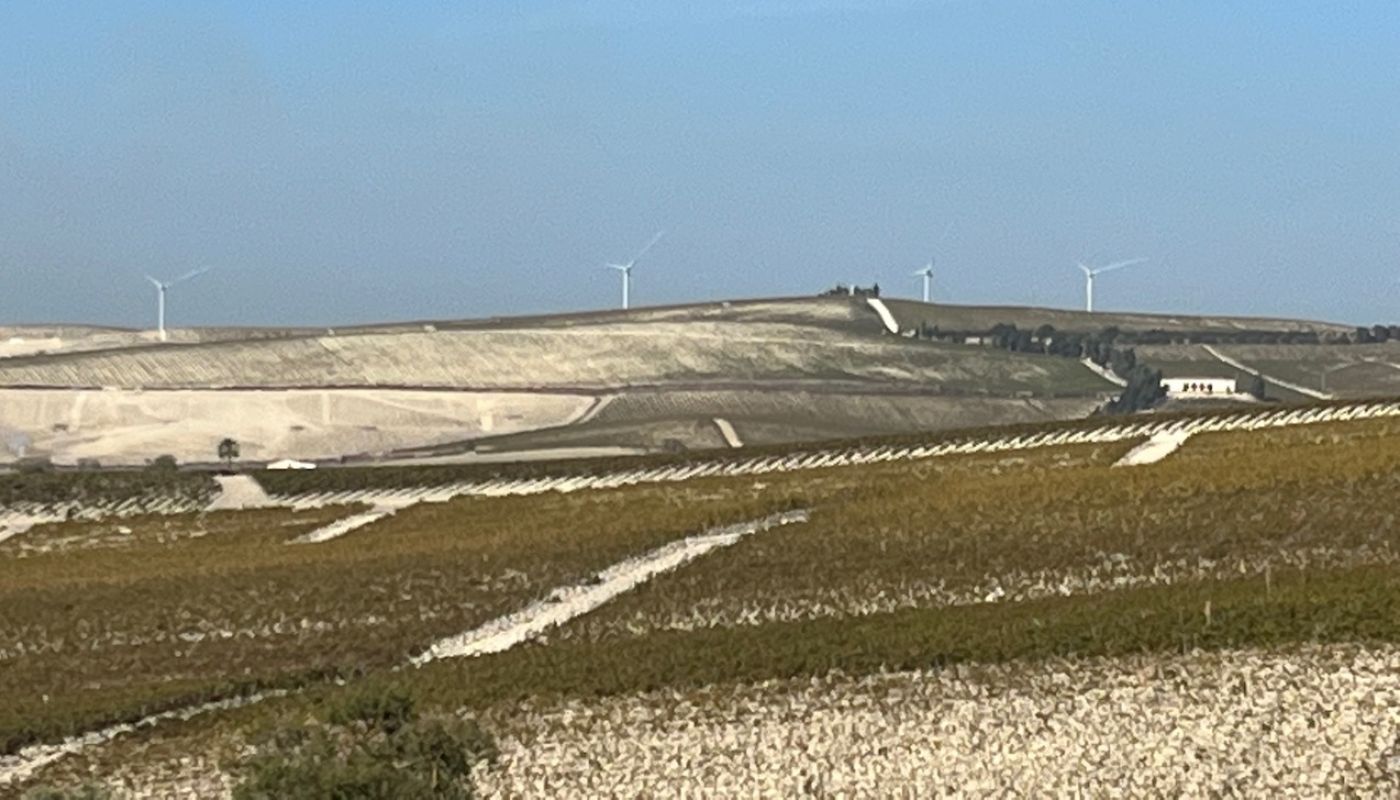
Sherry has gone from being Britain’s favourite wine in the 1970s, when the UK imported eight million cases a year of it, to a drink that is largely ignored by the great majority of the world’s wine drinkers. The total vineyard area surrounding the sherry capital of Jerez has shrunk from 22,000 ha (54,363 acres) in 1978 to less than 7,000 ha (17,297 acres), the rolling hills no longer a sea of green in summer. The white, chalky landscape is now dotted rather than covered with vineyards, some of which have been replaced by olives, almonds and cereals.
But help is at hand. A whole new category of wine has emerged and is already celebrated in the best restaurants of Spain and, crucially, by the grandees of the traditional sherry business. These new wines are handcrafted, unfortified wines made mainly from the region’s signature Palomino Fino grape. They may be as low as 11.5% alcohol, as opposed to the 15% mandatory minimum of a fino or manzanilla sherry, achieved by adding neutral grape spirit to the base wine – ‘fortifying’ it. But some of them are as potent as 14.5%, so varied are the provenances and techniques of these new, unfortified wines.
On the basis of the 37 examples from 11 producers that I tasted in and around Jerez recently, these are quite thrilling wines – some with more than a passing resemblance to white burgundy in terms of structure – that are re-energising the whole category of wines produced in what is known as the Sherry Triangle between the towns of Jerez, Sanlúcar de Barrameda and El Puerto de Santa María.
The only problem in terms of publicising them is that the category doesn’t yet have an official name. The Consejo Regulador that governs wine production in the region is in favour of them but has yet to decide what they should be called. The traditional name for these wines, common in the nineteenth century before the industrialisation of sherry production, was Vino de Pasto, or food wines. And many a Spanish restaurant lists a raft of them under that heading – often more of them than their selection of sherries. But in a way that name is misleading as these wines would make excellent aperitifs, while many a sherry, as in the fortified wines with which we are more familiar, make excellent accompaniments to food.

For the moment, producers of these new wines can choose to label them officially either as Vino de España or with the name of the administrative region, Cádiz. Both of these are unhelpfully imprecise, for the province of Cádiz encompasses far more than sherry country.
Before this new wave emerged, some of the bigger sherry producers produced rather ordinary table wines for local consumption, notably Barbadillo of Sanlúcar’s Castillo de San Diego that was first made in 1975 and is still a popular supermarket brand. But the flame for the new, quality-orientated movement, of which Barbadillo has been part since 2015, was lit by a clearly superior unfortified 2008 white labelled Navazos-Niepoort. It was inspired by a visit to the sherry bodegas in April 2008 by Dirk Niepoort of port fame, American wine writer David Schildknecht and me that was organised by the founders of top-quality sherry producer Equipo Navazos, criminologist Jesús Barquín and Valdespino winemaker Eduardo Ojeda. We visitors were knocked out by the quality of some of the young, unfortified wine that we tasted from cask and wondered why it was never bottled as is.
Niepoort returned to Jerez four months later to discuss the possibility of bottling an unfortified wine with Barquín and Ojeda, who thought the name Niepoort, already famous for top-quality Douro table wine as well as his family’s port in Portugal, would be ideal to add gravitas to a brand-new high-quality table wine from the world’s other famous fortified wine region. Equipo Navazos launched a second new-wave unfortified wine, Florpower, in 2010.
Both are still made but have been joined by a growing and thrillingly varied array of unfortified wines, many of them designed not just to express the Palomino grape at its freshest, and not just the different areas of sherry country with their surprisingly different climates, but, in the current fashion, individual vineyards.

Passion is an overused word in the wine world but it did truly seem prevalent when I met the members of Territorio Albariza, a group of nine producers of this new style of wine, named after the characteristic white chalky soil of the region. They were keen to explain that their varied wines express history as well as geography. Encouraged by the fact that the vineyards of their region were classified according to soil type and therefore quality as long ago as 1771, earlier than most other Spanish wine regions, they pointed out that the wines of the region used to be labelled by vineyard, or pago, especially when they were made from famous ones such as Macharnudo and Balbaína.
But it was in the 1970s that the seeds of sherry’s decline were sown when José Maria Ruiz-Mateos, presumably encouraged by the wines’ popularity then, expanded vineyards and production at an unsustainable rate and with scant regard for quality, destabilising the whole economy of the region. Sherry became a commodity rather than a wine.
The likes of Willy Pérez (seen below briefing me and Nick), a driving force behind Territorio Albariza and the son of Luis Pérez, celebrated winemaker for the hugely important sherry family Domecq (a brand now owned by a Filipino brandy producer), want to go back much further into sherry’s history.

His father joined Domecq in 1974, which was at the end of the era when sherry was generally fermented in traditional sherry casks, or botas, before stainless-steel tanks took over. ‘Even he didn’t know the old way of making sherry and now there’s no one left to ask’, he told me in front of a dramatic black and white photograph of the old soleo way of drying grapes on circular straw mats in the hot sun to concentrate flavours and fermentable sugars. Some of the new producers of unfortified wines have reintroduced this labour-intensive system, as well as reintroducing the system of picking the same vineyard several times in order to produce wines of differing ripeness and character.
Another variable that affects the taste of the wine – quite strongly in some cases – is the flor yeast endemic in the region. If a barrel isn’t full, and the wine in it isn’t too potent, it naturally forms a thin, doughy layer of flor on the surface of the wine that can give the wine a special yeasty flavour and protect it from oxidation.
I tasted a couple of red unfortified wines from the Tintilla de Rota grape, a local answer to the Graciano of Rioja, but most of these exciting new wines are hugely sophisticated dry whites, each with its own very distinct character. As someone who lived through the Ruiz-Mateos era, I am thrilled that there is once more a reason to celebrate the uniqueness of the sherry region. Nowhere else in the world can produce wines remotely like these, whether fortified or not.
Not sherries
In the UK
Bodegas Cota 45, Ube Paganilla 2022 Vino de España 12%
£21.61 Gourmet Hunters UK, £27.13 Les Caves de Pyrène
Barbadillo, Patinegro 2021 Vino de la Tierra de Cádiz 13.5%
£21.99 DBM Wines, Bristol, and €18 Barbadillo.com in Europe
Bodegas Cota 45, Ube El Reventón 2021 Vino de España 12.5%
£25.95 Vin Cognito, £26.03 Les Caves de Pyrène
Muchada-Léclapart, Lumière 2019 Vino de España 12.5%
£63.30 Mother Vine and widely available internationally
M Antonio de la Riva, La Riva Macharnudo 2019 Vino de España 14.5%
£54.95 Thorne Wines; 2020 is £68 The Sourcing Table
In Europe
Meridiano Perdido 2021 Vino de España 15.5%
€15.25 Bodeboca, Madrid, €15.20 Andalucía de Vino
Barbadillo, Mirabrás 2021 Vino de la Tierra de Cádiz 15%
€16 Barbadillo.com in Spain
Alberto Orte, Atlántida 2021 Vino de España 14%
€26.50 Finca Tablanca, Cantabria, Spain, and in the US Olé & Obrigado
Bodegas Cota 45, Agostado Cortado 2017 Vino de España 14%
€40 Coalla Gourmet, Asturias, Spain
In the US
Bodega de Forlong, Stardust 2019 Vino de la Tierra de Cádiz 12%
US importer La Luz Selections
M Antonio de la Riva, La Riva Lacave 2021 Vino de España 13.5%
US importer José Pastor
M Antonio de la Riva, La Riva El Cuadrado 2021 Vino de España 12.5%
US importer José Pastor
For tasting notes, scores and suggested drinking dates, see Jerez’s unfortified gems. For international stockists, see Wine-Searcher.com.













