The recent changes to the format of Bordeaux’s en primeur tastings and ways to ‘steer’ journalistic behaviour is not exclusively an affaire bordelaise. Although they differ radically – the Bordeaux en primeur circus features wines that have barely begun their élevage, whereas Nebbiolo Prima shows the new vintage releases of bottled Barbaresco, Barolo and Roero – the organisers of both seem to strive for ever greater control (some would say influence) over the way we taste and assess wines. I perceive this as a covert slap in the face, because what it reveals is a certain lack of respect for wine writers, as well as the unspoken assumption that we are unable to exercise any objective or independent judgment of wines. The overall effect, as already pointed out by Jancis, may well be to make our tasting less and not more accurate.
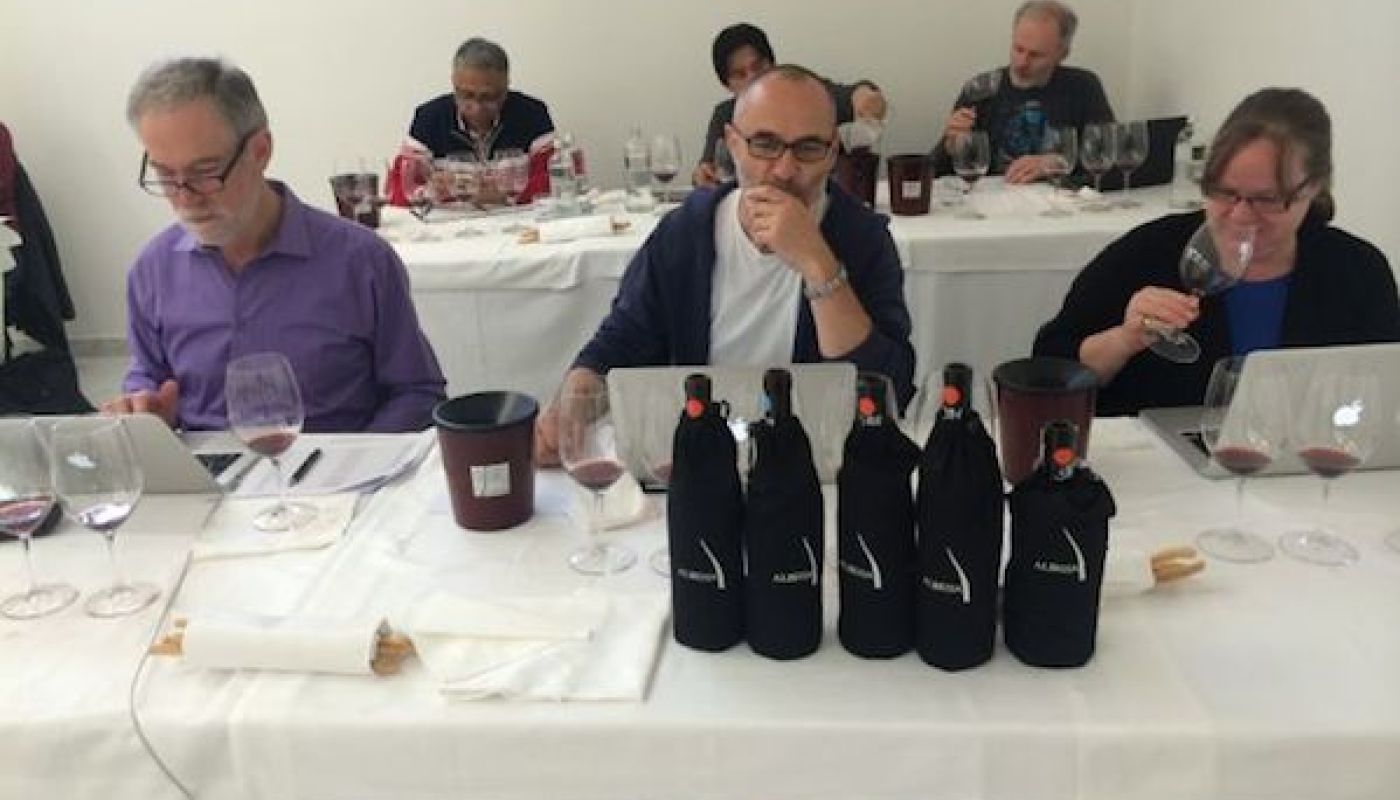
It is an argument the organisers of Nebbiolo Prima seem to be unable to take on board. For the last three years the number of wines in this five-day tasting, limited to early-morning sessions, has grown from a total of 350 wines in 2012 to 492 this year. The enormous number, more than a 100 to be tasted before lunch on five consecutive mornings from 8 am, has met with widespread criticism from many of my international colleagues who fear that the sheer number of wines leads to palate fatigue and a less-than-precise assessment of the wines. Several notable wine writers declined to attend Nebbiolo Prima this year because of this growing concern, which now is shared by many who I spoke to during the event. (The picture shows Walter flanked by two Australian tasters, Huon Hooke and Jane Faulkner, engaged in this particularly 'intensive' tasting.)
The exercise has been made even more challenging since Alberto Cordero di Montezemolo took over the presidency of Albeisa, the producers' association responsible for organising Nebbiolo Prima. Before this, the wines were tasted blind, as they are today, but were divided into communes, and further into crus, all of them stated on the tasting sheet, but without the producers’ names. This logical structure has been replaced by a system of total anonymity and an order that can only be called random. Cru or single-vineyard wines, arguably the pinnacle of quality, are followed by basic, or traditional multi-commune blends and then again by the crus. Any order in terms of the weight of the wines (I feel that certain communes should be tasted before the more structured wines of others) is totally disregarded.
I have questioned Cordero di Montezemolo a couple of times about this lack of order. His explanation is that some of my colleagues are so well versed in the wines and the vineyards that, if commune and cru were specified, they would immediately know which wine was in the glass, even under blind conditions. I know only one, perhaps two, people who would realistically claim that kind of all-encompassing knowledge, whereas monopole vineyards, with a single proprietor only, are truly rare. Still, Cordero’s concerns suggest his conviction that we are unable to maintain objectivity.
If I try really hard, I can see that the organisers wanted to maximise the wines’ anonymity, but fail to see the virtue of arranging the wines in a totally illogical order. I keep wondering who decided on the sequence and how he or she came to the particular order of wines. If there is a principle to it, I think it is only fair that we should know what it is. Any order has an effect, positive or negative, on the wines as well as the taster. In this case I fear it might be negative.
Too much of a good thing?
But there is another point that worries me at least as much. The increase in the number of wines is a bit like the London property market – unstoppable. The reason for this is that for a couple of years Albeisa has teamed up with the Consorzio of Langhe wines, of which Barolo, Barbaresco and Roero are part, to finance the high cost of Nebbiolo Prima. As a direct consequence, any producer who is not an associate of Albeisa yet is a member of the Consorzio can enter their wines, and as many of them as he or she fancies. With this system in place it is easy to see that no one single producer can be excluded. Yet, at the same time, I find the relentless increase in the number of wines a little cynical. The cost of the event may be high, but to enter wines is a relatively low-cost marketing exercise for producers who, more and more, want to take advantage of this tool.
The cynicism I perceive is that it has begun to look as though wine commentators are being functionalised. An indication of this is that the organisers are deaf to our pleas that they reduce the number of wines for the sake of the wines themselves, not the wine writers. Another is the fact that any journalist who fails to show up before 9.30 am is refused entry to the tasting room. Either you taste all, or nothing. Admittedly, I haven’t heard of any cases in which someone has been banned, but anyone wanting to ‘get the job done’ and taste more than 100 wines before lunch had better be in the tasting room at 8 am sharp. The programme further entails two estate visits in the afternoon and dinner on two nights in local restaurants with many producers taking part with yet more wines to taste. That can easily be some 30 or 40 wines in total. To be back in the hotel before midnight is virtually impossible, so it all becomes a huge endurance test, and the reason why I gave up being wined and dined in the evening out of sheer self-preservation.
The possible solution to the conundrum that Nebbiolo Prima has become is to limit access to members of Albeisa. The current situation has led several high-profile producers, Albeisa associates, to withdraw from Nebbiolo Prima. The second part of the solution is to exclude the wines of Roero (which I did not taste this year in a feeble effort to spend more than one minute on each wine). Since 2014 producers here have founded their own Consorzio and hence are no longer part of the Consorzio of the Langhe, which accordingly has renamed itself Consorzio di Tutela Barolo, Barbaresco, Alba, Langhe e Dogliani. For several years now I have maintained that the lighter style of Roero doesn’t do itself any favours by being shown alongside Barolo and Barbaresco. Current production of Roero red wine is just 350,000 bottles whereas it produces six million bottles of the white Arneis. One questions the relevance of red wines in Roero, as well as its participation in Nebbiolo Prima, now that it has styled itself as a white-wine region.
There are signs that Albeisa is rethinking the format of the event, spurred by increasing criticism from the journalists who still attend and, perhaps more tellingly, by the absence this year of key people such as Kerin O’Keefe of The Wine Enthusiast and leading Italian blogger Franco Ziliani. Part of the solution would be the aforementioned access to Albeisa members only, or allow journalists to taste what is relevant to them and their markets.