The long view, now
It began with a little curiosity and a lot of trust. In 1985, Spottswoode Estate Winery became the first organically farmed vineyard in Napa Valley when Mary Novak took the advice of Tony Soter, Spottswoode’s founding winemaker and vineyard manager. Today, her daughter, Beth Novak Milliken, second-generation President and CEO, admits, ‘This was the single most important decision we ever made.’ Despite the popularity of manicured rows and weed-free dirt floors, her mom was willing to try something different. She trusted Tony and her team.
This decision set the tone for so many others Spottswoode would make in the future. It started a healing process to repair a broken relationship with the land that for decades had been all take and no give. Like any relationship on the mend, it has required trust and curiosity, the willingness to make mistakes, seek guidance, and continue showing up.
Thirty-five years down this path, Spottswoode has emerged as an environmental leader, while becoming a known name for ultra-fine wine. They have committed to mitigating their footprint in ways that make environmental, economic, and social sense; they have adapted vineyard and business practices to the changing climate; they are pressing the dialogue with deliberate transparency to cultivate collaboration among like-minded wineries. This dedication to doing things differently begins with fundamentally rethinking what matters – and then actually following through. Which is simply uncommon.
Sustainability
Organic farming may have been the starting point, but Spottswoode soon realized this alone misses the bigger picture – the systemic nature of sustainability.
Sustainability is a lovely word that gets thrown around a lot and is thus diluted. What does it actually mean?
Ask Beth Novak Milliken that question and she brings it back to connection, community, and conversation. Sustainability is about nourishing the land in a way that you would care for yourself or your family (she laughed at how ‘golden rule’ that sounds, but that’s the best way to explain it).
‘At a basic level, sustainability is all about the resilience of the soil and the vines,’ says Beth. ‘If we as humans take care of our health, we should be more resilient to stress and disease. This is the same principle behind organic and biodynamic farming – building systemic resilience. With climate change, we need this more than ever.’
Beth calls it ‘capitalism with a conscience.’ It’s a principled approach that acknowledges we all need to eat; lots of people depend on the winery’s survival. It’s in everyone’s interest to preserve Spottswoode by making sure the land and people have what they need, not just to survive, but to thrive, while still making world class wine that turns a profit. This view of sustainability helps break down the old environment versus agriculture paradigm that can pit neighbors against one another and stoke resentment, obscuring the values people do hold in common and gumming up opportunities for the community to come together.
Beth wants to farm, make wine, and carry on her family’s legacy. She reminds everyone, ‘We are deeply committed to responsible farming and being exceptional stewards of our land. We are in agriculture. We are part of this.’
Mitigation
Climate change feels far away for most people, but Beth is on a tight timeline: ‘The next decade is crucial to flatten the curve, so to speak.’ This is what compels her to get out of bed each day – that the earth will regenerate if we give her the space to try.
Thankfully, she is not alone. Vineyard manager and winemaker, Aron Weinkauf, came on in 2006 and has been instrumental in executing the winery’s core values. He immediately set to converting to biodynamic, for which they will soon be certified. His team bolstered soil & microbe health and promoted greater biodiversity by maintaining native cover crops, apple and olive trees, farm animals, permanent insectaries, apiaries and birdboxes on the estate – and they dramatically restored their beloved creek. By using mildew spore trap data, they identify when vines actually need mildew treatments, enabling a 50% reduction of seasonal spray passes. Switching to lighter ATV’s (one of which is electric) and switching heavier machinery tires to flatter, wider tracks has dramatically reduced soil compaction. This decreases the pressure per square-inch on the ground by over 99%, avoiding extra tillage and carbon release.
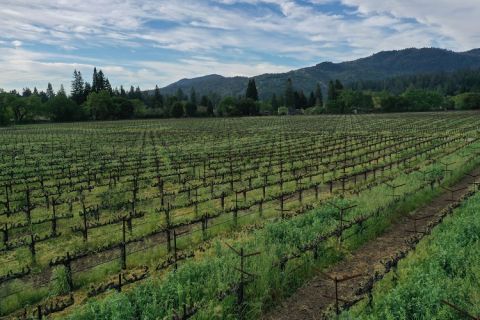
Aron describes the feeling of seeing foxes and coyotes roaming the vines and flocks of swallows painting the sky. ‘There is a difference between sustenance and nourishment,’ he explains. You can have a lifeless vineyard and still make a product. Maybe even a good one at that. But you aren’t creating a habitat in the process. You are simply using the earth for your own gains.
The results of all these measures are significant. The healthy soils absorb waters from torrential downpours without contributing to run-off and erosion. The vineyards are growing more resilient. The worm population is strong.
According to an independent analysis of GHG emissions in 2018, Spottswoode reduced their vineyard practices to only 4% of their overall emissions. Winemaking and electricity are both down to 1%. The home and winery rely almost entirely on solar power, introduced in 2007. Even when their needs extend beyond what solar alone can provide, they participate in Marin Energy’s Deep Green program, an alternative to the local California utility that generates renewable energy. Some developments, like xeriscaping the grounds with less water-intensive native plants and conversion to ultra-efficient LED bulbs were no-brainers, especially with rebate incentives (spoiler alert: policy matters; it takes a village.)
Eight years ago, they overhauled their grape reception process and purchased an optical sorter, reducing winery water usage during harvest from 500,000 gallons to 190,000 gallons. The sorter enables them to now process six tons of fruit per hour with four people, instead of two tons per hour with ten people. This has improved quality, plus it’s safer and cuts down on long harvest hours that wear on the staff, allowing for more breaks to rest and restore.
Spottswoode’s unwavering commitment has led to countless certifications and accolades, but Beth and her team know there’s more to be done in areas like packaging, transportation, employee commute, and business travel, which account for 78% of Spottswoode’s emissions. This mirrors some of the industry’s biggest mitigation challenges, while highlighting the tough tradeoffs within the concept of sustainability. To reduce these figures, they are rethinking their direct-to-consumer shipments and currently exploring the prospect of working with an intermediary shipping company to lessen air freight and the extra repacking required. Business travel was up in 2019 to secure new markets in Europe and Asia, but Beth says this became a business lifesaver during the pandemic. Tradeoffs are real.
Adaptation
Spottswoode enthusiasts recognize a style defined by finesse and elegance instead of the riper expressions often found in the appellation. However, this means rising temperatures are a more immediate threat that demand adaptation. Spottswoode has started to prepare for a future that might not be anchored on Cabernet Sauvignon if St. Helena ends up warm as Lodi by the 2040s, as some studies suggest. They have planted an array of warm-climate grapes to assess blending alternatives. These include Portuguese varieties like Tinta Cao and Touriga Nacional, along with Mediterranean grapes like Mourvedre and Carignane. Meanwhile, to protect Cabernet, they’ve added shade cloth to the vineyards, greatly reducing the temperature of the grapes, especially on days that exceed 105 degrees (which can give grapes a roaring fever of almost 150 degrees internally).
A warming climate has created even scarier existential worries. Catastrophic wildfires amid years of biblical drought mean Spottswoode also needs a plan to prevent their winery buildings from literally going up in smoke. This is just one more facet of sustainability: safeguarding everyone’s livelihood. They installed roof vents with finer mesh that can be fully sealed to stop embers from blowing into the winery as well as gutter guards to remove another source of fuel.
The payoffs of foresight don’t always take years. Spottswoode has demonstrated that even small shifts can be good for the environment and the bottom line. At night, they allow cool air to flow into the cellar naturally, sucking out the warm air and lowering the temperature, thereby reducing their reliance on air-conditioning.
Community
At a retreat last spring, the Spottswoode team created a Core Purpose statement – the fundamental beliefs and standards to which they hold themselves accountable in the vineyard, the community, and the planet. It pushes them to think about all the ways they are connected to everything and everyone around them – the ripple effect of their choices. This practice affirms and reaffirms their intentions, ingraining an ethic they hope will help sustain the health of the system.
At the heart of this ethic is almost radical transparency. Beth and Aron believe sharing information is the only way to reach a hopeful place within ten years. Spottswoode has thrown open their doors, allowing neighboring wineries to observe and ask questions. By cracking open hard concepts, experimenting with solutions, and listening to others in the community, they have nurtured the kind of conversation that is rare in this business.
Spottswoode’s courage and unrelenting engagement has made them leading activists in their community, and they are part of a growing chorus of voices worldwide. Recently, they joined the ambitious International Wineries for Climate Action (IWCA) as well as the Porto Protocol (Napa was the first AVA to join the Porto Protocol). They also began to apply for Leadership in Energy and Environmental Design (LEED) certification. In July, they achieved a significant milestone — the rigorous B-Corp certification, which formally identified them as a company demonstrating leadership in environmental and social action in a way that is impactful, inclusive, and economically sustainable – a proud moment for Spottswoode.
Though relatively small, Spottswoode’s high profile in a famed growing region has garnered global visibility, not only for themselves, but for the broader Napa Valley community. This is one way that tending their own garden is helping to build the kind of movement needed to achieve progress at a planetary scale.
Napa can play a profound role in encouraging wineries elsewhere to rethink their operations in necessary ways. Napa was built because neighbors trusted each other and shared knowledge. This region’s grand visions were founded by dreamers who also knew the value of humility and collaboration. It took making a lot of bad wine to get it right. But together they shocked the world and reshaped the industry. Now they have the chance to do so again.
Perspective
A quiet panic has settled over the worldwide wine industry in recent years. ‘The reality is that we are living in climate change. We're not waiting for it. We are not waiting to see the effects,’ says Beth.
Beth’s perspective is uncommon. Humans are terrible at responding to abstract, long-term threats, especially if it means delaying gratification now. Recall the famous study from the 1960s, where Stanford professor Walter Mischel promised children a second marshmallow if they could refrain from eating the first. Most kids cracked in minutes.
Will this ‘live for the moment’ mentality grow even stronger as we emerge from the pandemic, desperate for a little joy today at the expense of tomorrow? Or is this finally the wakeup call we needed to be a little less selfish?
Maybe the answer is that this is a false choice – and framed thus we’ll always fail. Beth would probably turn this choice on its head. Taking care of the future doesn’t have to mean depriving ourselves of good things today; it might actually (likely) make us happier in the present to do the right thing. Beth has found daily, hard-fought satisfaction – nourishment even, perhaps – in cultivating a better future. She doesn’t even want the marshmallow.
















